astronaut
 Pearl
Pearl Hyperliquid
 Walrus
 Pudgy Penguins
 Bitcoin
 NEAR Protocol
- Senator Lummis advocates for establishing a Bitcoin reserve as a safeguard against inflation.
- She emphasizes the pivotal role 2025 will play in shaping the future of Bitcoin and digital assets.
- The appointment of David Sacks bolsters efforts to promote policies favorable to Bitcoin.
Senator Cynthia Lummis of Wyoming is stealing the spotlight again. The Senator has reaffirmed her commitment to creating a strategic Bitcoin reserve as part of U.S. fiscal policy.
In recent public remarks, she underscored her vision of integrating Bitcoin into the national financial system. Senator Lummis highlighted 2025 as a crucial turning point for digital assets.
Furthermore, she expressed her enthusiasm for collaborating with David Sacks. Sacks was recently appointed as the administration’s “Crypto Czar.”
In a tweet, she shared her excitement about working with Sacks to advance legislation. The aim is to establish Strategic Bitcoin Reserves for the United States. The proposal reflects Lummis’ view that Bitcoin can be a reliable hedge against economic uncertainty.
“2025 will be the year for bitcoin & digital assets. With David Sacks as Crypto Czar, this will be the most pro-digital asset administration ever! I look forward to working closely with @DavidSacks to pass comprehensive digital asset legislation & my strategic bitcoin reserve.”
-Senator Cynthia Lummis (@SenLummis) December 18, 2024
With the upcoming administration’s pro-crypto stance, Lummis sees a unique opportunity to drive forward Bitcoin-focused policies. She aims to strengthen the United States’ position in the digital asset space.
Sen. Cynthia Lummis Advocates for Strategic Bitcoin Reserve in BTC Act
Senator Cynthia Lummis has been a vocal advocate for adopting Bitcoin as the nation’s reserve currency. In July 2024, she introduced the BITCOIN Act, proposing that the U.S. Treasury acquire 1 million BTC over five years.
This initiative aims to secure approximately 5% of Bitcoin’s total supply. That would safeguard against currency devaluation and the growing national debt.
Lummis argues that Bitcoin’s inherent scarcity and decentralized structure make it an effective hedge against inflation. She envisions the reserve as a tool to help the U.S. reduce its $35 trillion debt by 2045.
Senator Lummis suggests leveraging gold certificates to convert some of the U.S. Treasury’s gold holdings into Bitcoin. This strategy could avoid disrupting the federal balance sheet while saving billions of dollars.
The proposed Bitcoin reserve could have far-reaching effects on the U.S. economy. That includes reducing the national debt and shielding the country from inflation.
Additionally, it could strengthen the U.S.’s economic positioning against rival powers like China and Russia. With exemplary leadership and political backing, the proposal can potentially transform the global financial landscape.
Despite its potential, the plan faces significant political challenges, even with Republican majorities in Congress and the Senate. Senator Lummis has acknowledged resistance within her party.
Some GOP lawmakers are concerned about Bitcoin’s volatility and its perceived risks as a federal investment.
BTC Reserve Will Not be a Fluke Under David Sacks
The appointment of David Sacks as the “Crypto Czar” has sparked optimism among Bitcoin and digital asset policy proponents. Sacks is expected to be pivotal in shaping digital currency regulations under the new administration.
Senator Cynthia Lummis praised Sacks’ extensive knowledge of financial innovation and his advocacy for digital assets. This highlights his potential to drive meaningful change in the industry.
Sacks’ strong support for Bitcoin and other cryptocurrencies has positioned him as a key figure within the crypto community. Many see his leadership as critical to fostering the growth of digital assets.
Senator Lummis expressed confidence in Sacks. He stated, “Under David Sacks’ leadership, the U.S. is primed to lead the world in digital assets and financial innovation.”
Bitcoin advocate Michael Saylor echoed this sentiment. He remarked, “Sacks’ leadership will not only position the U.S. as a global leader in digital assets but also pave the way for unprecedented financial innovation.”
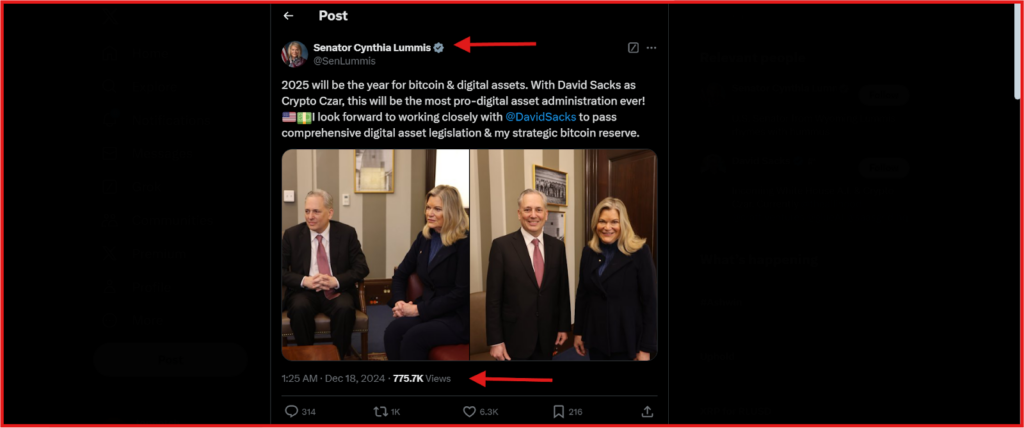
Senator Lummis had recently met with Sacks to discuss their shared goals of promoting fiscal responsibility. They also shared thoughts on advancing legislation to integrate Bitcoin into national policy.
She emphasized the importance of his leadership in building confidence in Bitcoin as a strategic asset. This policy direction reflects a broader shift in federal attitudes toward cryptocurrencies. It accompanies the support extending back to Trump’s endorsement of a national Bitcoin Reserve.
Growing Support For Crypto Could Make US Financial System More Resilient
Lummis’ advocacy for a strategic Bitcoin reserve reflects a broader shift in U.S. political attitudes toward digital assets. Increasingly, lawmakers focused on financial innovation recognize Bitcoin and cryptocurrencies as tools for economic diversification.
However, achieving policy consensus remains challenging, with regulatory agencies like the SEC maintaining a cautious approach. The success of Senator Lummis’ proposal hinges on congressional support and further evaluations of Bitcoin’s viability as a reserve asset.
This initiative could fundamentally reshape how the U.S. manages its financial reserves if implemented. That could set an example for other nations.
Adopting Bitcoin as part of the federal financial strategy would also significantly boost the cryptocurrency market. Some states have already begun exploring cryptocurrency investments in their portfolios.
If the federal government takes similar action, it could encourage greater participation from institutional investors and global financial players. Lummis believes this policy would position the U.S. alongside other nations that have integrated Bitcoin into their economic frameworks.
Dennis Porter’s Team Has Finalized A Model Of Executive Order For President
Dennis Porter, CEO of the Satoshi Action Fund, recently revealed the first page of an Executive Order. This could lay the foundation for a Strategic Bitcoin Reserve.
The order outlines plans for the U.S. Treasury to manage Bitcoin as a reserve asset alongside traditional reserves like the dollar and gold. A key proposal in the order involves repurposing approximately 200,000 Bitcoins, valued at around $20 Billion. Those were seized in criminal cases.
Rather than auctioning these assets, the plan suggests integrating them into the reserve to bolster national financial stability.
He said- “my team has finalized a model EXECUTIVE ORDER for the president of the United States to establish a ‘Strategic Bitcoin Reserve’”
To maintain trust and accountability, the Treasury would oversee these Bitcoin holdings. That would implement strict security measures and conduct regular audits.
This approach aims to establish Bitcoin as a strategic asset. At the same time, it ensures transparency and safeguarding its role in the broader financial system.
Disclaimer
In this article, the views, and opinions stated by the author, or any people named are for informational purposes only, and they don’t establish the investment, financial, or any other advice. Trading or investing in cryptocurrency assets comes with a risk of financial loss.