Altai the Tiger
 Sword Inu
 streamoors
 IGNITION
 NEAR Protocol
 Pearl
Pearl Injective
- Risk/reward ratio measures a trade’s potential loss versus its potential profit.
- If the risk/reward is below your threshold, raise your downside target to attempt to achieve an acceptable ratio; if you can’t achieve an acceptable ratio, start with a different investment.
The Risk-Reward ratio is a mathematical calculation used by investors to measure the expected gains of a given investment against the risk of loss.
All investing involves risk. While investors usually are looking to profit from their investments, there’s the potential to lose some or all the money invested as well.
The risk/reward ratio is a tool investors can use to compare the potential profits and losses of an investment.
Explanation
- The risk/reward ratio in the trading is determined by dividing the expected rewards involved in trading by the potential risk. So, the two factor are important for the determination of this ratio, risk and the rewards where risk refers to the potential loss of the money invested by the investor from the trading and the reward refers to the reward expected by the investor for undertaking the risk potential of the loss of money invested.
- These factors are judged or estimated by the investor himself, as they will depend on the risk tolerance capacity of the investor. If the ratio calculated is greater than 1, then it indicates that the risk of the transaction is greater than the expected rewards. And if the ratio calculated is less than 1,then it indicates that the risk of the transaction is less than the expected rewards.
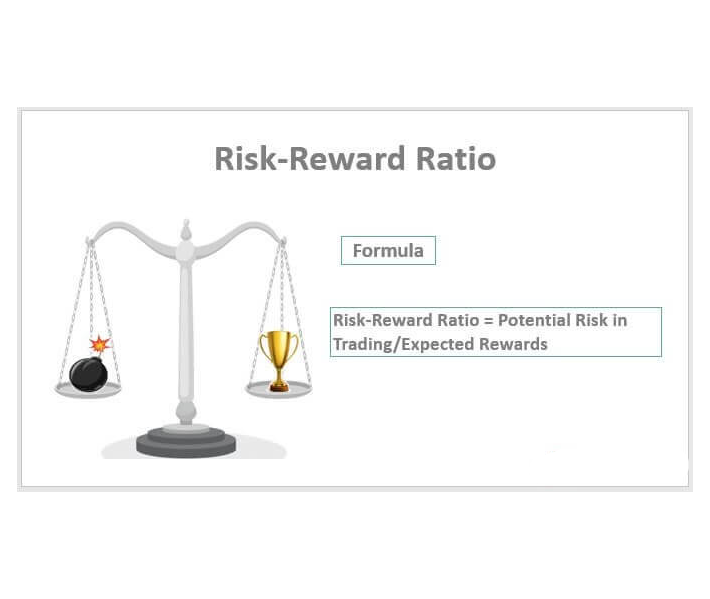
Risk-Reward Ratio Formula
In order to calculate the risk-reward ratio, the investor firstly has to determine the risk involved in the transaction. After determining the risk, it needs to determine the expected rewards which it will be getting after undertaking the involved potential risk and loss of the money invested by him. Lastly, after determining the potential risk and expected rewards, the risk-reward ratio will be calculated by dividing the potential risk by the expected rewards in trading. The formula is:
Risk-Reward Ratio = Potential Risk In Trading / Expected Rewards
- The ratio is considered by the investors while they are trading in stock as it helps them in assessing their expected return along with the risk associated with such a transaction. The ratio varies from one strategy to another, this ratio does not remain the same and differs as per the strategy adopted by the person.
- So, in order to calculate the risk-reward ratio, expected return, and the risk associated with the same is to be judged by the trader himself. Risk is known mainly on the basis of the stop-loss-order value and the value at which trade is entered by the investor, and the expected return is calculated by calculating the difference between the stop-loss order value and the profit target of the trader.
Importance
- The risk-reward ratio helps the trader in managing the potential risk of loss of the money invested by him.
- It provides an idea to the investor that what is the expected return it could generate with the given level of risk, and accordingly, the decision can be taken.Thus, it will help the investor in making the decision according to his risk-taking capacity.
Conclusion
The risk-reward ratio provides the measurement of the expected rewards which the investors are going to generate with the given level of the potential risk. This ratio is very helpful for investors while making decisions with respect to their trading investment. So, the investment will be made by the investor according to his own capacity on the basis of this ratio.