Dacity Coin
 astronaut
 streamoors
 Celestia
 NeoSoul
 Sui
Sui Injective
- Hedera is the first company that leverages DLT through Hashgraph.
- It is based on the Gossip protocol and aBFT methods.
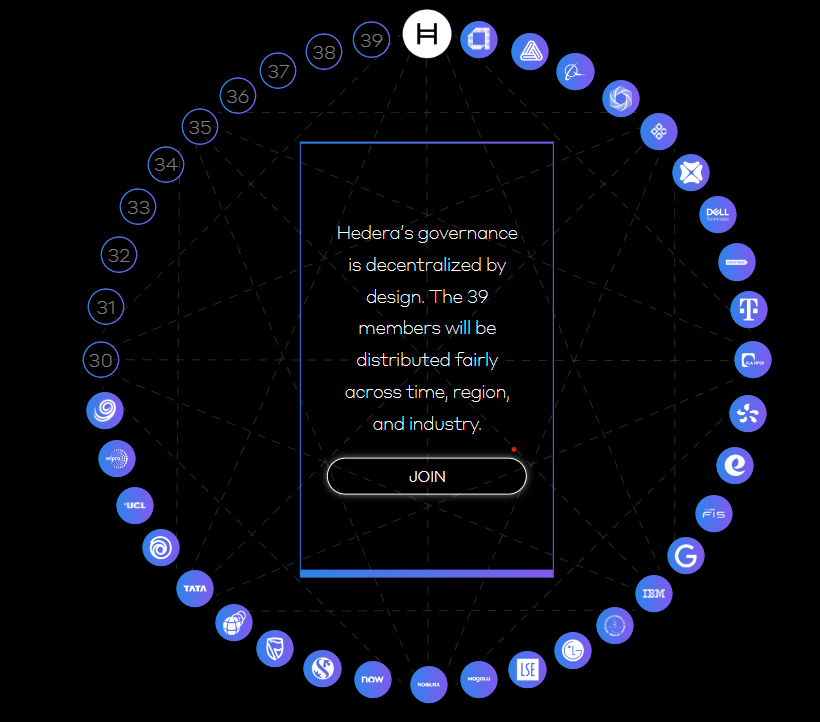
- The governing council includes 39 companies from the world spread across different sectors.
The Distributed Ledger Technology (DLT) is a decentralized method of storing financial records such that they are immutable and accessible to all. Blockchain is, currently, the most popular way DLT is implemented, but it’s not the only way.
Another rising technology which leverages DLT is Hashgraph. Hedera is the only company that uses Hashgraph to implement DLT networks.
What is Hashgraph?
Blockchains were developed on the Proof of Consensus model, which required users to perform some computational work as proof of authenticity. However, when the number of users increased rapidly, and mining turned to a business, this led to damage to the environment.
Hashgraph is a Distributed Ledger Technology, but differs from the blockchain. The latter stores data on blocks which are then joined together to form chains and miners who validate the transactions. Instead, here data is stored in Direct Acyclic Graphs.
Directed Acyclic Graphs:
1
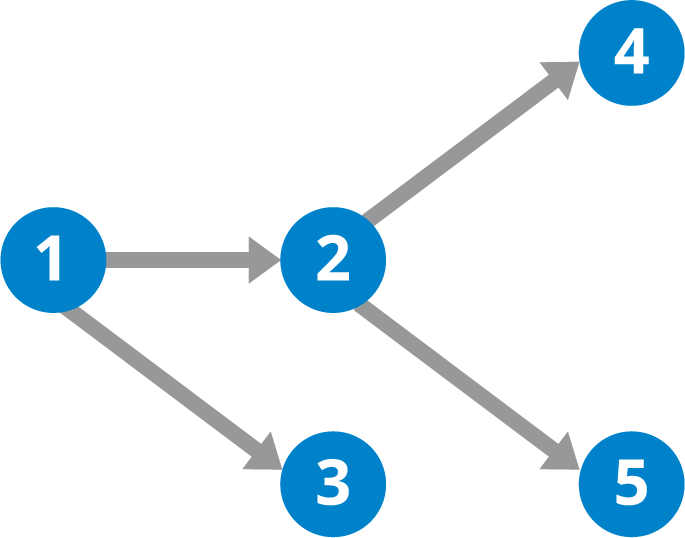
Here, Fig1 is an example of Directed Acyclic Graphs (DAG). Each line is called an Edge, and each circle represents a Vertex. The edges represent a unidirectional flow, hence, Directed. Following these edges will never form a loop or circle, i.e., you’ll never reach the genesis vertex, hence Acyclic. This graph is common to represent family trees.
Hashgraph Protocols:
Hedera Hashgraph uses two protocols for its consensus mechanism.
Gossip Protocol: (Gossip about Gossip)
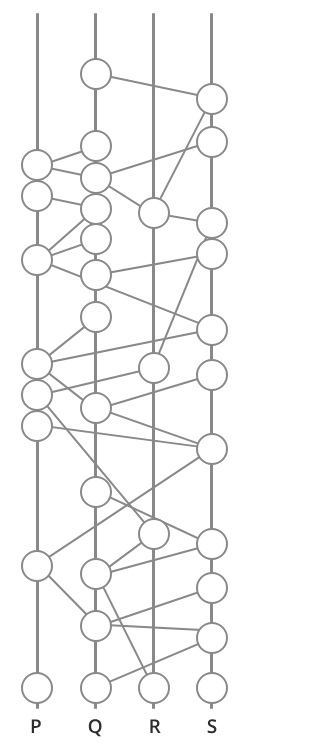
In reality, gossiping means spreading information from one person to another. Similarly, in Hedera, the different nodes communicate with each other, spreading information of transactions. This rapid communication creates a DAG on which all the data is stored. This graph is stored on all the nodes spread across the network.
2
Fig2 shows what a typical Hashgraph may look like after a series of gossiping between the four nodes P,Q,R, and S.
This graph keeps on growing and when accessed by a node, it can reveal data like transaction history, the parties involved in a particular transaction and the exact moment of transactions.
#Virtual Voting:
This is the consensus method used to verify the authenticity of transactions. For a transaction to be valid, ⅔ nodes need to be witness to the data. Hedera runs on a BFT mechanism, thus, even if some nodes are malicious, the system will still progress.
In short, the nodes need to verify that they received the same information from the same node and not different, i.e., they are all descendants of the same Vertex.
Hedera Governance
The governance model of Hedera gained popularity because of its uniqueness. The Hedera governing council includes 39 major world-leading organizations from different sectors spread across the globe.
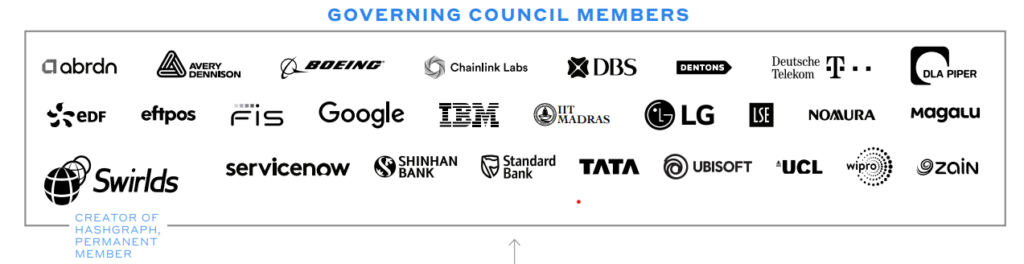
Out of 39 seats available, presently, 29 seats are filled by companies which include Google, LG, Dell, Boeing, and TATA Communications. Swirlds, a company by Dr. Leemon Baird, who also owns the patent for Hahgraph Technology, holds a permanent seat in the governing council.
4
These governing bodies have 3 years term on the body and can be a member for 2 consecutive times only. This provides completely decentralized governance to the Hedera Hashgraph.
Council Goals:
All the members are committed to network innovation, stability, and increasing decentralization. They do not earn any profit in doing so.
1+ member from each GICS (Global Industry Classification Standard) sector.
1+ members are universities and come under the top 10 in their region.
1+ members who are leading international NGOs
3+ members from each global region NA, SA, EMEA, APAC.
HBAR
Similarly to other DLT networks, Hedera has launched its native currency HBAR. Nodes that participate in transaction validations are incentivized with these tokens. Further, these tokens can be exchanged for other tokens or fiat currencies.
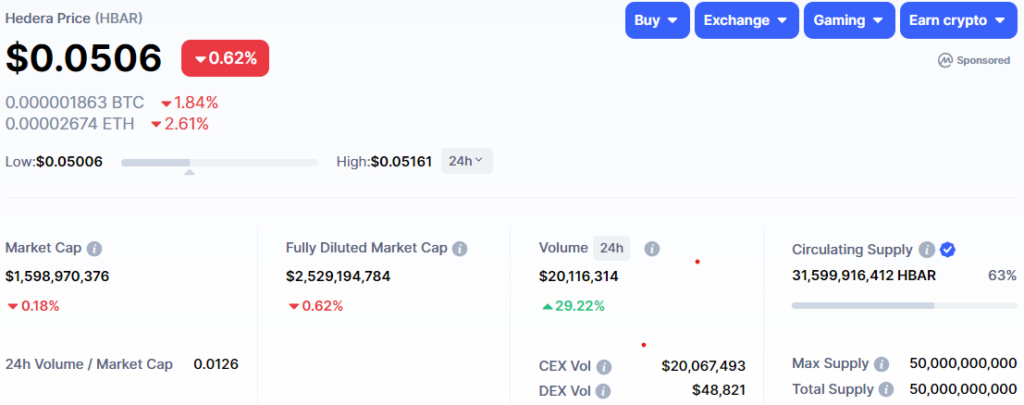
The max supply of HBAR is limited to 50 Billion, with approx 31.6 Billion currently in circulation.
5
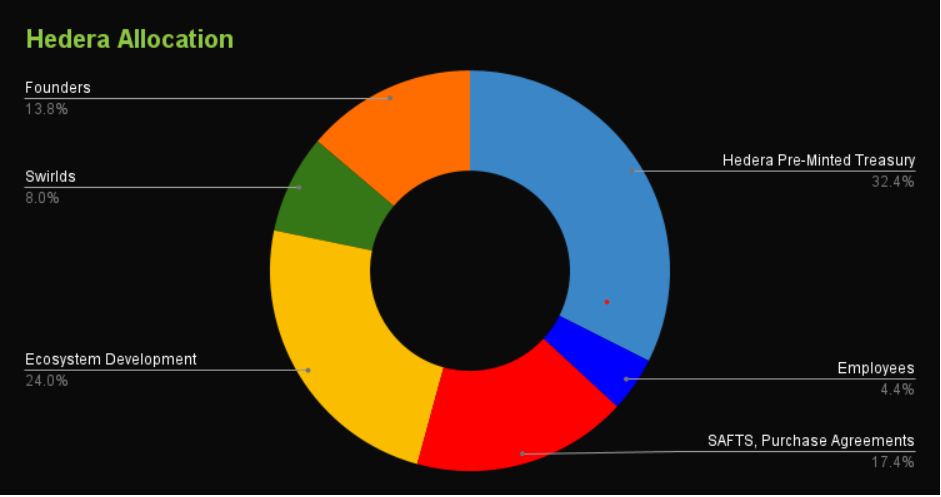
Fig 5 shows the token distribution for the Hedera tokens.
| Party concerned | % Allocated |
| Hedera Pre Minted Treasury | 32.41 |
| Employees | 4.44 |
| SAFTS, Purchase Agreements | 17.4 |
| Ecosystem Development | 23.99 |
| Swirlds | 7.96 |
| Founders | 7.96 |
Final Thoughts
Bitcoin and Ethereum currently process only 5 TPS and 13 TPS, respectively. Hedera boasts 10,000 TPS, improving the performance of the network. Hedera charges only a network fee of $0.00001, making it cheaper than other blockchains, which charge hefty gas fees.
With these features and a carbon-positive footprint, Hedera finds itself a bright future. Nonetheless, as the number of users increase, the potential flaws and challenges will also come to light.