
 Minter
 Quack AI
 NEAR Protocol
 Pearl
Pearl Sui
Sui Pons
Pons Quantus
Key Insights:
- DOJ investigates $400M Coinbase breach linked to insider bribery.
- Hackers demanded a $20M ransom after stealing sensitive user data.
- Senate advances GENIUS Act to regulate stablecoin issuers.
The U.S. Department of Justice (DOJ) has opened a criminal investigation into a $400 million data breach at Coinbase. The inquiry follows allegations that overseas employees were bribed by cybercriminals to leak sensitive customer data.
According to Bloomberg, the DOJ’s criminal division in Washington is leading the probe. Hackers reportedly used this data to demand a $20 million ransom in an email sent to Coinbase on May 11.
Coinbase confirmed the breach on May 16. The company revealed that the attackers targeted its customer support division through a social engineering campaign aimed at offshore agents. These agents were allegedly bribed to extract internal customer records.
Rogue Staff Bribed, Sensitive Data Leaked
Coinbase disclosed that attackers compromised a limited set of personal information, including names, email addresses, masked Social Security numbers, and bank account details. However, no wallet access, passwords, or private keys were leaked.
Internal investigations revealed that the attackers failed to breach hot or cold storage systems. Coinbase Prime clients were not affected, the exchange added.
Coinbase terminated the agents involved and began notifying affected users. In a statement, Chief Legal Officer Paul Grewal said the company is cooperating with both U.S. and international law enforcement agencies. “We welcome the pursuit of criminal charges against these bad actors,” he stated.
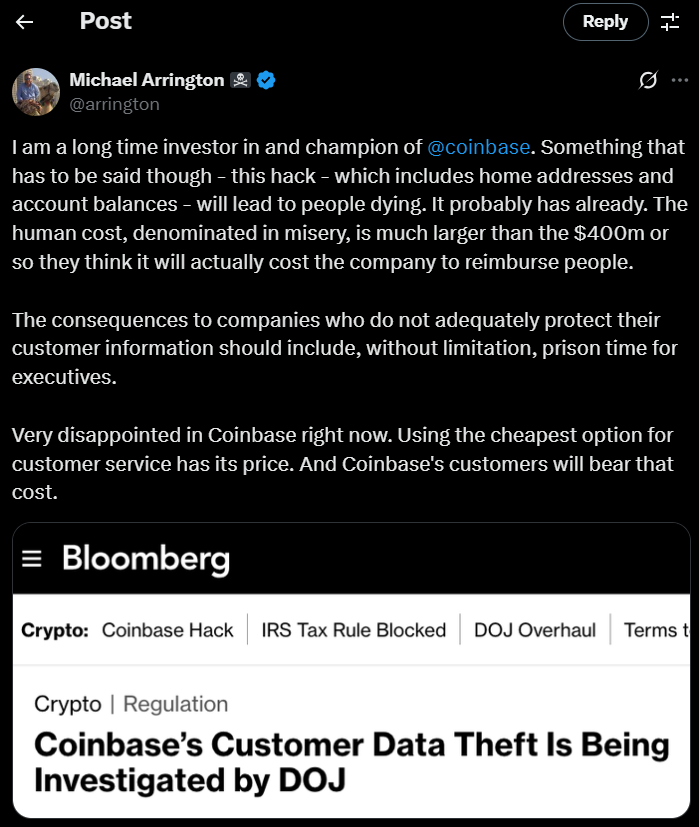
Michael Arrington, founder of Arrington Capital, expressed outrage over the human cost of the breach. “This hack – which includes home addresses and account balances – will lead to people dying,” he posted on X (formerly Twitter). “The human cost, denominated in misery, is much larger than the $400M.”
Coinbase Took Preemptive Action, But Attack Still Landed
In the months before the breach, Coinbase had flagged suspicious activity involving offshore support agents. These individuals were found accessing customer systems at odd hours and copying data irregularly.
Despite internal safeguards and preemptive measures, hackers managed to bypass restrictions through a coordinated bribery and extortion operation. The ransom demand arrived via email but was not paid, the firm said.
While no customer funds were lost, the breach triggered deeper concerns about centralized exchanges’ vulnerability to internal threats.
Meanwhile in Washington: GENIUS Act Advances in Senate
The DOJ’s investigation into Coinbase comes as the U.S. Senate advanced the GENIUS Act—a bipartisan bill that seeks to regulate payment stablecoins.
On Monday, the Senate cleared a key procedural hurdle, voting 66–32 to move the bill forward. Sixteen Democrats joined Republicans in supporting the motion, crossing the 60-vote threshold.
The bill proposes a regulatory framework for fiat-backed stablecoins and includes provisions to limit tech company participation and enforce ethics standards for public officials.
Democratic concerns had stalled the bill two weeks earlier. But a new amendment, secured by Sens. Mark Warner, Kirsten Gillibrand, Bill Hagerty, and Cynthia Lummis, unlocked bipartisan support by enhancing consumer protections and tightening oversight.
Crypto Ties to Trump Add Fuel to Legislative Tensions
Although the GENIUS Act does not address meme coins directly, it arrives amid growing scrutiny over President Donald Trump’s crypto activities. Trump recently hosted a dinner for holders of his meme token and maintains ties with firms like World Liberty Financial.
Sen. Elizabeth Warren, a vocal crypto skeptic, criticized the bill’s loopholes. “Basic flaws remain unaddressed,” she said. “Congress should not choose to enable the president’s egregious corruption.”
Sen. Michael Bennet has proposed a separate STABLE Act amendment to prohibit elected officials from issuing or endorsing digital assets.
Crypto’s Regulatory Crossroads
Coinbase’s breach and the ongoing DOJ probe underscore rising risks tied to insider threats and data misuse. At the same time, the GENIUS Act reflects Washington’s growing urgency to establish oversight frameworks for stablecoin issuers.
Kara Calvert, Coinbase’s VP of Public Policy, called the bill a win for everyday users. “Passing this bill is a win for them,” she said. “It’s not just a win for the industry.”
Still, with public trust rattled and political scrutiny rising, exchanges like Coinbase may face greater pressure to overhaul security and transparency before regulation hardens.
Disclaimer
In this article, the views and opinions stated by the author or any people named are for informational purposes only. And they don’t establish the investment, financial, or any other advice. Trading or investing in cryptocurrency assets comes with a risk of financial loss.