Zerebro
 Bitcoin
 Aerodrome Finance
 ZKsync
 Pearl
Pearl Pudgy Penguins
 Bitway

Key Insights
- Singapore tightens crypto regulation with no grace period for overseas-facing firms.
- All DTSPs must cease unlicensed operations abroad by June 30, 2025.
- $250K capital, local compliance officer required for DTSP license approva.
Singapore’s regulator has set a June 30 deadline for crypto firms without a DTSP license to stop serving overseas clients, warning of criminal penalties under the FSM Act.
Unlicensed DTSPs must halt foreign operations by June 30 under MAS ruling
Singapore has escalated its crypto regulation push, ordering all unlicensed digital token service providers (DTSPs) to stop serving overseas clients by June 30, 2025.
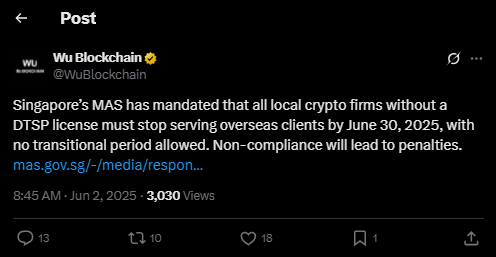
The Monetary Authority of Singapore (MAS) confirmed there will be no transitional period. Crypto firms formed or operating from Singapore that lack a DTSP license must exit international markets or face penalties under the Financial Services and Markets Act 2022.
“The key risk DTSPs pose to Singapore would be reputational,” MAS stated in its final regulatory response, published May 30.
Crypto Regulation Tightens With Zero Tolerance for Delays
MAS said the move targets money laundering and terrorism financing risks tied to cross-border crypto activity. The new regime extends licensing requirements to all individuals and corporations operating from Singapore, even if they serve only foreign customers.
Licensing will be granted only in “extremely limited circumstances.” The regulator rejected calls for grace periods or exemptions, stating the four-week notice period ending June 30 offers ample time to cease operations.
Failure to comply is a criminal offense under Section 137(6) of the FSM Act.
Industry Pushback Fails to Loosen Crypto Regulation
Respondents to the Oct.–Nov. 2024 consultation, including the Blockchain Association of Singapore and firms like Circle and Baker McKenzie, requested a three-month grace period. They cited the need to prepare compliance documents, submit financial data, and meet staffing requirements.
MAS refused.
“DTSPs must suspend or cease providing DT services outside Singapore by 30 June 2025,” the agency reiterated, dismissing industry concerns over timeline, cost, and operational disruption.
All firms will pay a $10,000 annual license fee regardless of size or service scope.
DTSP License Requires $250K Capital, Local Compliance Officer
Applicants must meet minimum capital thresholds of $250,000 and appoint a compliance officer based in Singapore. The officer must be at the management level, responsible for enforcing anti-money laundering and terrorism financing rules.
MAS warned that compliance cannot be outsourced entirely to overseas parent firms. Licensees must also pass annual audits and report suspicious transactions or cyber incidents under new FSM Notices.
Technology risk management, cyber hygiene, and customer disclosures are mandatory.
Remote Workers Not Spared Under Expanded Crypto Regulation Scope
MAS clarified that individuals working from home in Singapore while serving foreign crypto clients could still fall under DTSP rules. The determining factor is whether the individual is “carrying on a business of providing DT services” from Singapore.
Employment alone does not trigger licensing. However, the use of Singapore as a base of operations does.
Respondents raised concerns over vague definitions, particularly in cases of remote employees or Singapore-based consultants. MAS said it would assess such cases individually.
Singapore Follows FATF Standards as Global Scrutiny Rises
The regulatory framework aligns with Financial Action Task Force (FATF) standards requiring oversight of virtual asset service providers (VASPs), even those without domestic customers.
While MAS acknowledged the burden on smaller players, it said the risks posed by unregulated overseas-facing crypto operations outweighed commercial concerns.
As of July 1, unlicensed crypto firms based in Singapore must shut down their foreign-facing businesses or leave the jurisdiction entirely.
Disclaimer
In this article, the views and opinions stated by the author or any people named are for informational purposes only. And they don’t establish the investment, financial, or any other advice. Trading or investing in cryptocurrency assets comes with a risk of financial loss.