
 Bitcoin
 Ondo
Ondo Pudgy Penguins
 Walrus
 Pons
Pons Quantus
 NEAR Protocol

Stablecoins are being considered by Uber as a way to cut down on cross border payment costs and increase global transaction efficiency. At the moment, the company is in the study phase which is aimed at understanding how blockchain based digital currencies could simplify its operations across its international markets..
Uber Evaluates Stablecoins for Global Cost Efficiency
Stablecoins are an option that Uber is exploring to make global payments easier and cheaper across its operations. We are in the study phase of how we can use stablecoins in our financial workflows, Dara Khosrowshahi, CEO of the company, said at the Bloomberg Tech Summit on June 5.
As international transfers are a key part of Uber’s daily operations, the company is in search of faster, cheaper and more scalable alternatives to traditional banking rails.
Digital tokens pegged to fiat currencies like the U.S. dollar are known as stablecoins, which are designed to have a stable value. Companies operating across multiple jurisdictions find their consistent pricing and rapid settlement capabilities attractive.
Eliminating currency conversion fees and banking delays could be a measurable financial efficiency for Uber, which serves users and partners in over 70 countries.
The company had previously indicated interest in crypto, but had held back from implementing it because of concerns about volatility and high exchange costs.
Stablecoins offer consistency in value, unlike Bitcoin and other volatile crypto assets and enable companies to leverage blockchain infrastructure without the speculative risk. Uber’s move to stablecoins represents a more utility driven approach than a market driven investment one.
Corporate Interest Grows as Stablecoin Use Cases Expand
This is in line with the wider corporate momentum toward blockchain-powered payments. Cross-border transactions are seen as a practical financial instrument for removing friction with the help of stablecoins.
More and more companies in finance, e-commerce, logistics and fintech are researching how they can use them in their day-to-day operations.
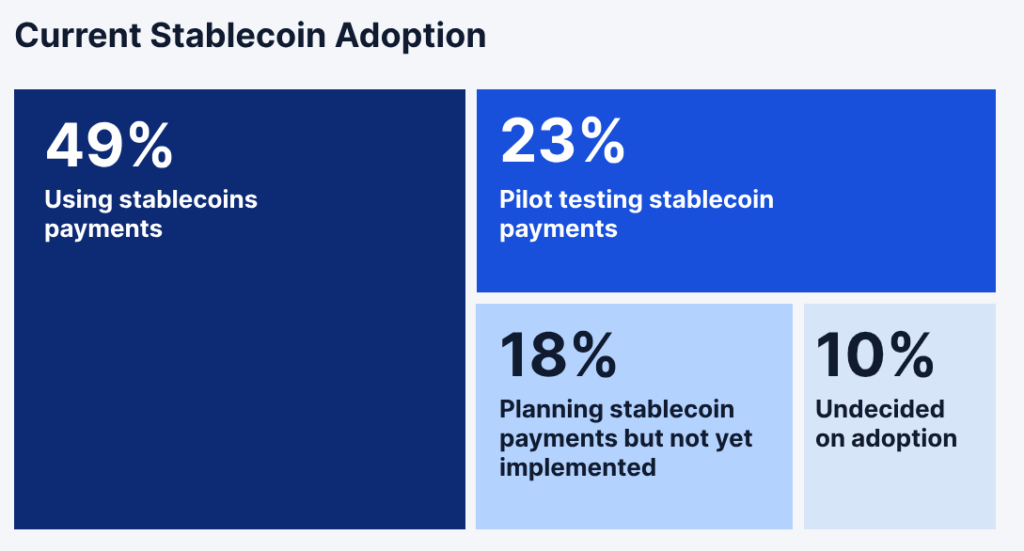
According to a recent survey by Fireblocks in 2025, 90% of global financial institutions are either using or testing stablecoins. Speed, cost savings and liquidity were cited as the main reasons for the shift. Stablecoin integration is also confirmed by major players like Stripe which is in active discussions with banks to integrate stablecoins.
But regulatory progress is also driving enterprise interest at the same time. The GENIUS Act in the United States creates a clear legal framework for the issuance and use of stablecoins with standards for transparency, reserve backing and issuer licensing.
MiCA is also a regulation that the European Union has implemented which defines how digital assets and stablecoins must operate within member states.
Similar regulatory guidance has been introduced in jurisdictions in Asia, including Singapore, Hong Kong and Pakistan. With this global alignment on digital asset policy, companies like Uber have a stronger foundation from which to evaluate stablecoins without taking undue legal risk.
Regulatory clarity gives confidence that adoption of stablecoin can happen in a predictable and lawful manner.
Uber Takes a Strategic and Risk-Aware Approach
While stablecoins are exciting, there is no Uber commitment to launch or live pilot at this stage. Khosrowshahi, CEO, said the company was taking a careful and measured approach. At present, Uber is evaluating the technical, regulatory and operational requirements that need to be met before any implementation.
The company is especially focused on making sure that it is compliant with the law in the jurisdictions where it operates. Since it is a global service, introducing a new payment method needs to be harmonized with different financial regulations and licensing conditions.
Stablecoins are being consideredby Uber to see if they can be safely introduced without impeding the current payment infrastructure or creating compliance gaps.
This is a methodical strategy that mirrors a wider trend in the way traditional enterprises are approaching blockchain.