Pearl
Pearl Walrus
 Bitway
 Bitcoin
 Quantus
 Quant
Quant Pudgy Penguins

Key Insights:
- Bitcoin’s critical support levels stand at $106,738 and $98,566 amid heightened speculative futures activity.
- Aging coins remain inactive, indicating reduced long-term holder selling pressure.
- Bitcoin miners report lower production in June due to power curtailments and market pressures.
Cryptocurrency prices stalled following the July 4th holiday as Bitcoin slipped by nearly 1% the next day. BTC dropped to a low of $107,268 from a high of $110,590 before recovering to $108,125 over the weekend.
Ethereum followed suit, recovering to $2,503 after falling to $2,488. However, both assets showed limited momentum for a breakout.
Although the broader crypto market saw a slight rebound, Bitcoin continues to face strong resistance at $108,200. On-chain analytics indicate heavy accumulation zones between $98,566 and $106,738. This now acts as a key support level.
Whale Walls at $106K and $98K May Decide the Next Move of Bitcoin
Over 3.4 million addresses have acquired Bitcoin between $95,247 and $108,190. The most concentrated buying activity centers around the $96,901 mark. At that price level, 1.25 million BTC are held across 1.71 million addresses.
Another large cluster lies between $104,982 and $108,190. This range contains 1.28 million BTC held by 1.68 million addresses. These volume clusters suggest strong support zones for BTC.
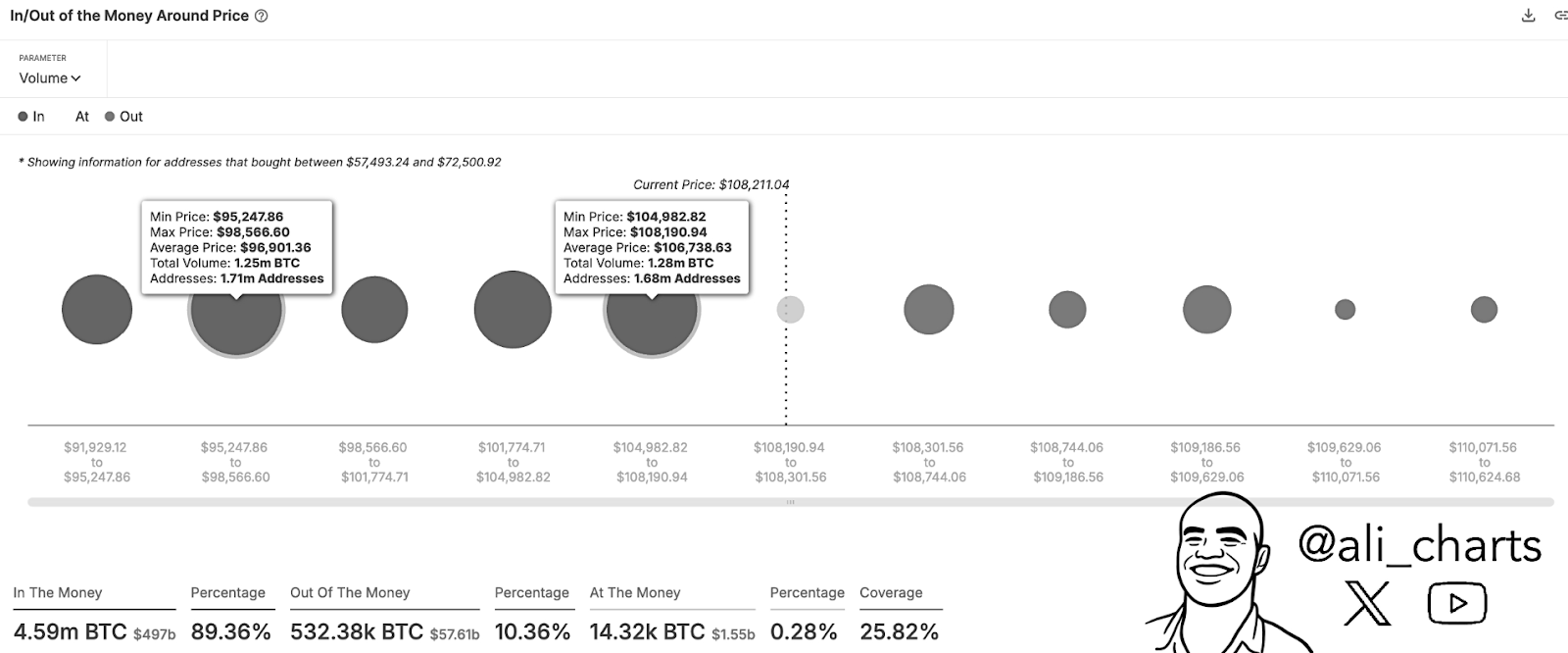
These levels now serve as immediate support, especially $106,738 and $98,566. If Bitcoin breaks below these, more selling could follow. The price hovers just above these zones, indicating ongoing accumulation or cautious holding.
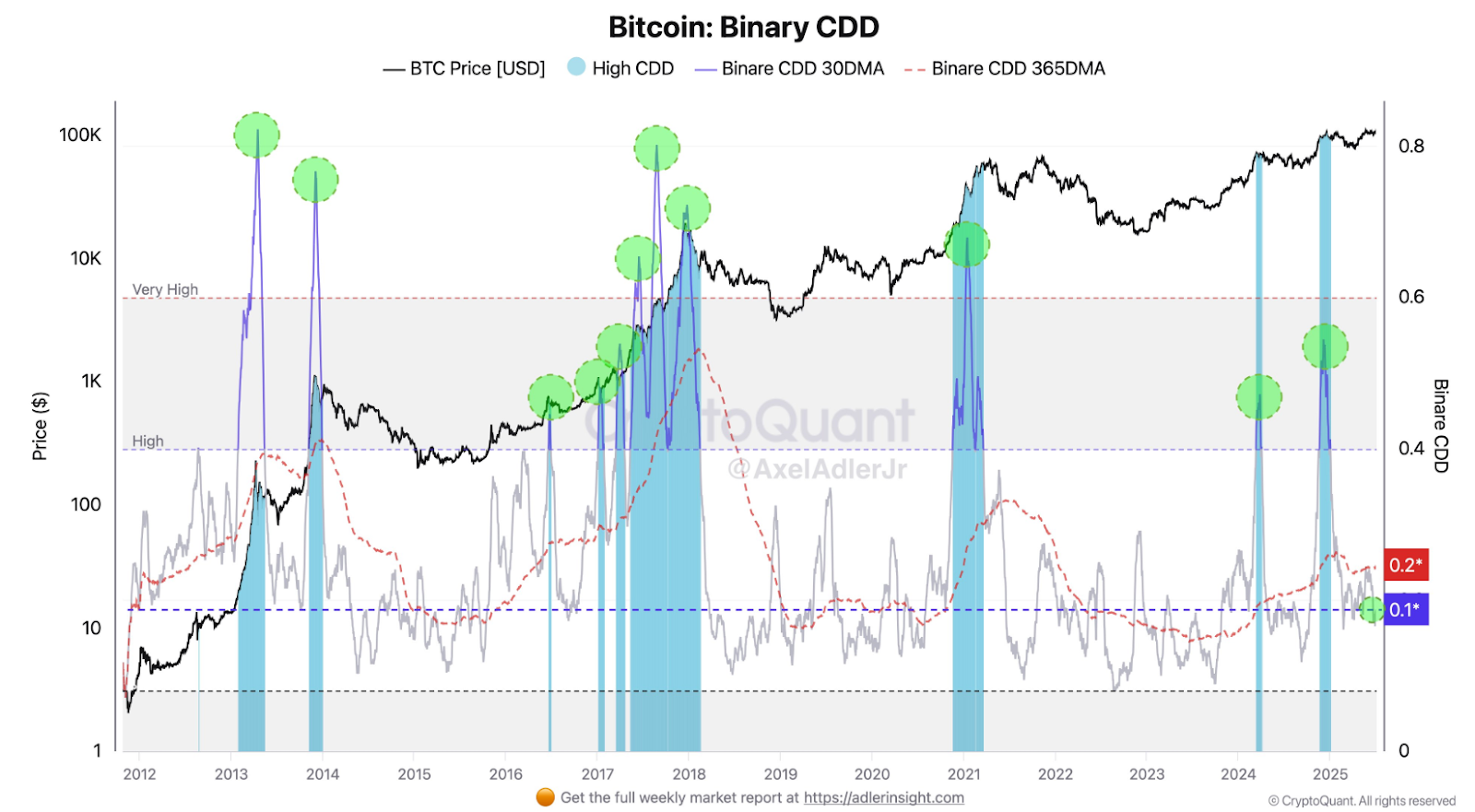
At the same time, Coin Days Destroyed (CDD) data from CryptoQuant shows low movement of long-held coins. Binary CDD is sitting well below its 365-day average, suggesting that long-term holders remain inactive.
Previous market tops, marked by CDD spikes, occurred at $70K and $100K, but such signals are absent today.
Speculators Rule as Futures Volume Overshadows Spot
Meanwhile, recent data shows Binance has processed over $650 Trillion in BTC futures volume since 2019. During the same period, spot volume reached just $168 Trillion, underscoring a four-fold difference. This shift highlights growing speculation and fast trading cycles.
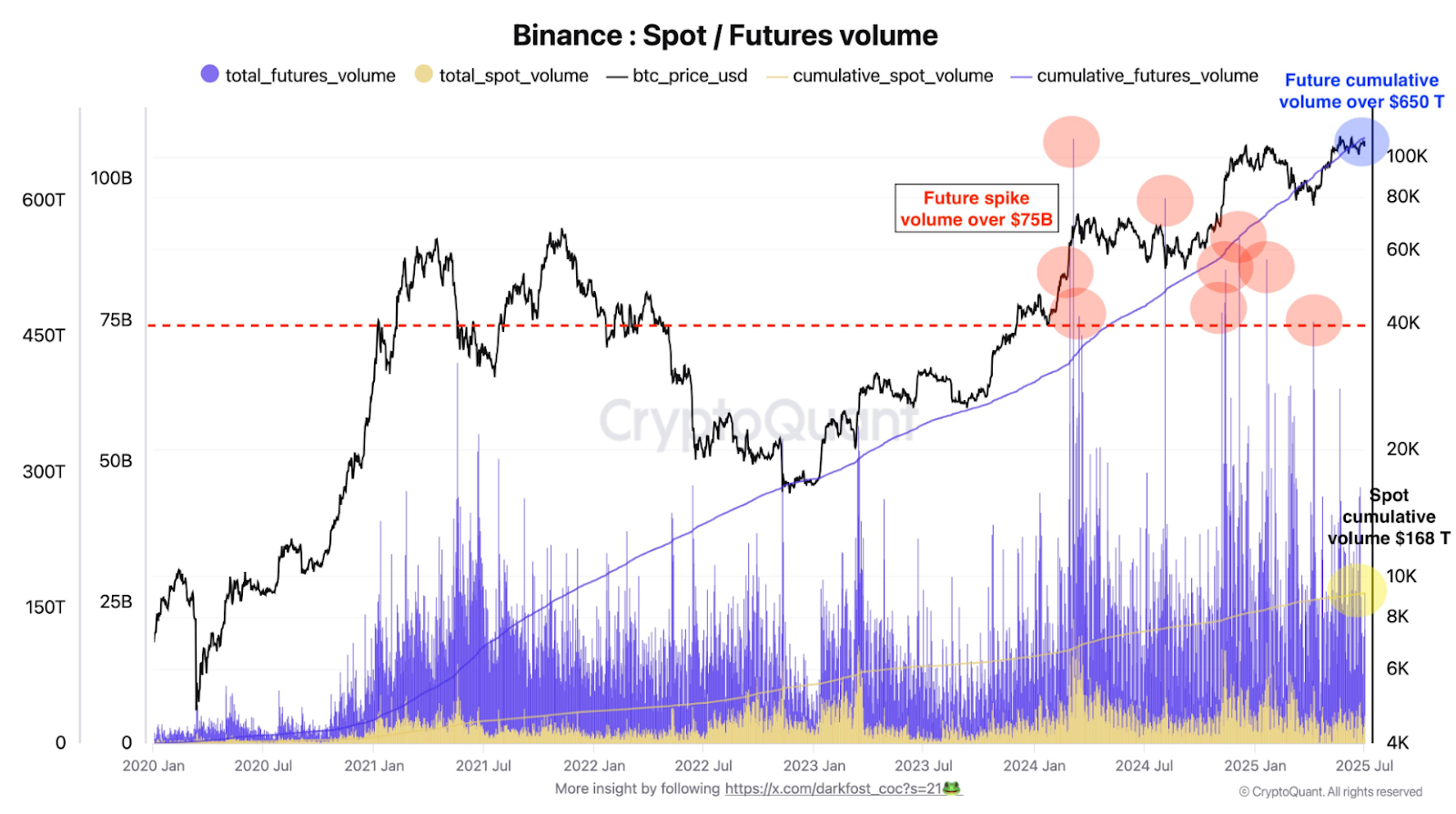
Futures activity regularly spikes above $75 Billion daily, creating significant volatility. As a result, the market has become increasingly influenced by short-term derivatives rather than long-term investment flows.
This is also confirmed by the current spot-to-futures volume ratio, which stood at 0.21. This indicates that over 75% of activity is driven by futures.
While derivatives attract traders due to leverage, they also magnify price swings. This dominance makes the Bitcoin price more sensitive to liquidations, funding rate shifts, and macro events.
All Eyes on the Fed as Bitcoin Tracks Wall Street Moves
Federal Reserve policy expectations are still in flux as economic data are mixed. Markets are now pricing a 20-25% probability of a July rate cut, but Fed Chair Jerome Powell is unsure.
He emphasized that the Fed will not hurry to make cuts unless there are indications of a slowdown in inflation. Should incoming data on jobs or inflation surprise the upside, traders may reverse their dovish bets quickly.
This would cause a sudden surge in the US dollar. This would reduce the demand for Bitcoin and other risk assets. A hawkish pivot from the Fed would create downside pressure for BTC in the short term.
Nevertheless, Bitcoin can also enjoy macrifism if equities continue to increase. The S&P 500 and Nasdaq recently reached record highs, with some analysts expecting BTC to follow.
The history of the currency has indicated that Bitcoin tends to trail behind major indices. After that, it makes significant upward movements.
Mining Curtailment and ETF Demand Shape Supply Dynamics
On the supply side, several Bitcoin mining firms reported decreased production in June. Riot Platforms mined 450 BTC during the month, down 12% from May’s 514 BTC output.
The company attributed this drop to voluntary participation in Texas’s grid management programs under ERCOT’s 4CP initiative. CEO Jason Les confirmed the firm strategically reduced power usage to stabilize the grid and avoid transmission charges.
These power strategies also position Riot competitively by lowering operational costs during peak energy periods. Riot sold 397 BTC in June for $41.7 Million and currently holds 19,273 BTC in reserves.
In the meantime, the institutional demand is strong. US-based Bitcoin ETFs added 7,133 BTC last week, with net inflows totaling $769.5 Million.
Ethereum ETFs saw inflows of $219.1 Million recently. Traditional financial firms remain invested in the asset’s potential despite stagnant prices.
Disclaimer
This article is for informational purposes only and provides no financial, investment, or other advice. The author or any people mentioned in this article are not responsible for any financial loss that may occur from investing in or trading. Please do your research before making any financial decisions.