Zylo Ecosystem
 Walrus
 Bitcoin
 Sui
Sui Quantus
 Quant
Quant Starknet

Key Insights:
- BlackRock sold 101,975 ETH worth $375 million on Monday.
- Ethereum ETF ended a 21-day inflow streak with sharp outflows.
- Bitcoin and Ethereum ETFs saw combined $798 million in outflows.
BlackRock offloaded 101,975 Ethereum (ETH) on Aug. 5, triggering $375 million in outflows from its U.S.-listed ETHA fund. The sale marked the ETF’s largest single-day outflow since its launch and ended a 21-day inflow streak. Bitcoin ETFs also posted losses, with BlackRock’s iShares Bitcoin Trust (IBIT) shedding $292.5 million.
The combined losses across spot Bitcoin and Ethereum ETFs topped $798 million. The pullback followed a broader decline in digital asset prices over the weekend as Bitcoin dropped 8.5 percent from its July peak. Traders reacted to ETF reversals and weakening sentiment as inflows dried up across institutional channels.
BlackRock Ethereum ETF Outflow Was the Largest Yet
BlackRock’s $375 million ETH sale represented a 3 percent drawdown from its total holdings. Coin Bureau confirmed the number of ETH dumped and flagged it as the biggest Ethereum ETF exit since January. The move sparked a wave of reactions across trading platforms as the news circulated rapidly on X.
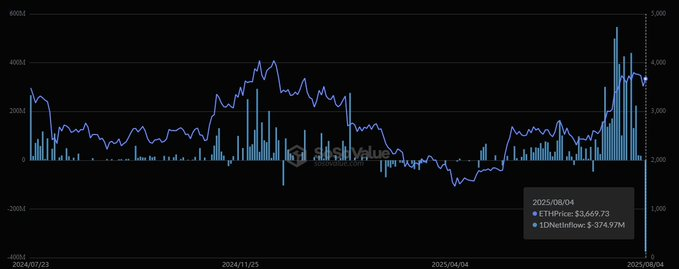
Wu Blockchain also confirmed the exit, citing SoSoValue data. “Ethereum ETFs recorded $465 million in net outflows, with BlackRock accounting for $375 million,” the post read. That followed $812 million in outflows from U.S. Bitcoin and Ethereum ETFs on Friday, suggesting growing institutional caution.

CryptoGoos added that the ETHA outflow reflected direct selling pressure. “BlackRock just sold $375M worth of ETH,” it posted, tagging the event as a break from the bullish inflow streak seen through July.
That Martini Guy also shared the numbers in real-time, calling it a “breaking” moment. While spot markets did not collapse, ETH traded sideways after the dump and failed to regain weekend highs.
BlackRock Bitcoin ETF Losses Deepened After Weekend Dip
Bitcoin ETF flows also reversed course after a strong July. BlackRock’s IBIT posted a $292.5 million outflow on Monday, ending a 37-day inflow streak, according to CoinGlass data, which marked its largest exit since May.
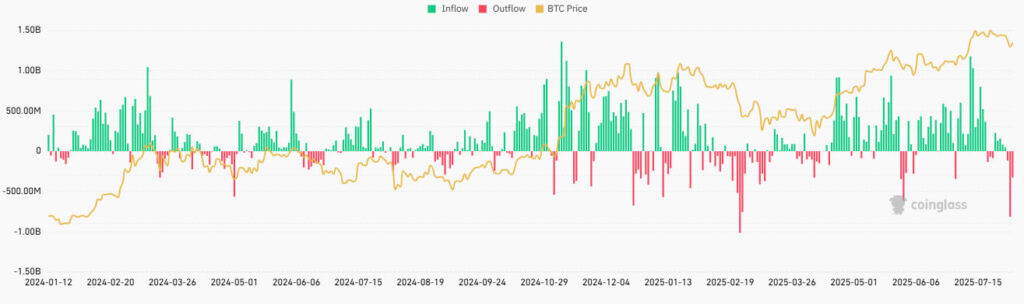
Fidelity’s Wise Origin Bitcoin Fund saw $40 million in outflows. Grayscale’s Bitcoin Trust dropped $10 million. The only inflow came from Bitwise, which added $18.7 million. The day ended with $333 million in Bitcoin ETF outflows, capping three consecutive red sessions.
The drop followed Bitcoin’s steep weekend correction. BTC fell to $112,300 on Sunday, down 8.5 percent from its July 14 all-time high. It rebounded slightly to $115,000 by late Monday, but failed to reclaim momentum. Volume remained thin across major exchanges during the recovery.
Crypto analyst Merlijn The Trader noted that Bitcoin needed to reclaim $118,500 to reset the trend. “As long as it stays below $115,000–$118,000, I expect more downside,” he posted Monday.
July Inflows Gave Way to August Reversals
BlackRock’s July performance stood in stark contrast to this week’s flows. IBIT recorded $5.2 billion in net inflows last month, accounting for 9 percent of all inflows since its launch in Jan. 2024.
Ethereum also attracted strong institutional attention through late July, with ETHA logging multiple eight-figure days. That reversed quickly in Aug., as ETF buyers pulled capital from both funds.
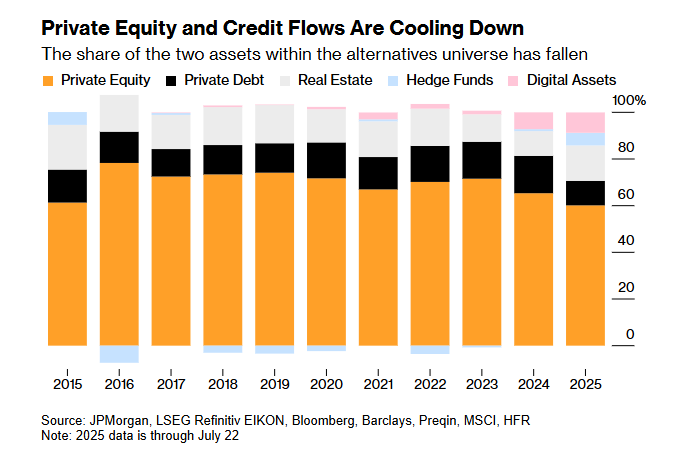
Bloomberg ETF analyst Eric Balchunas said digital assets still led inflows among alternative assets. He noted that digital asset products saw $60 billion in flows through July 22, trailing only hedge funds.
JPMorgan’s Nikolaos Panigirtzoglou added that digital assets gained market share at the expense of private equity. “Digital assets and hedge funds saw an acceleration of inflows this year,” he said, pointing to growing institutional appetite despite short-term volatility.
That context made this week’s reversal more abrupt. Ethereum price action remained tied to ETF momentum, and Monday’s dump dented bullish positioning across DeFi tokens.
Ethereum Price Slid But Held Above $3K
The Ethereum price dropped alongside ETF outflows but held key support levels. ETH bottomed near $2,950 after BlackRock’s sale, then rebounded toward $3,100 on Tuesday. That level acted as a resistance barrier across 4-hour and daily charts.
Crypto analyst CryptoJelle noted the $3,000 level as a pivot. “Break below $2,950 and we’ll revisit $2,800 fast. Hold $3,000 and we bounce,” he posted.
Open interest on ETH futures also dropped as the ETF sell-off spooked leveraged longs. CoinGlass data showed a $230 million drop in ETH futures open interest on Monday, confirming lower appetite for aggressive bets.
Spot market sentiment weakened as retail traders reacted to the ETF exits. ETH/USD volumes fell on Coinbase and Binance, with whale wallets reducing net transfers during the New York session.
The Ethereum price tested its 50-day moving average, and traders awaited macro catalysts to determine direction. The next U.S. Consumer Price Index (CPI) reading due Friday may shift risk appetite again.
Outlook Hinges on Support Zones and CPI Print
The crypto market entered the second week of Aug. facing heightened volatility and macro pressure. Ethereum price levels near $2,950–$3,000 acted as short-term support, while $3,300 was a key resistance target. The ETF outflows, particularly BlackRock’s $375 million ETH exit, shifted sentiment and narrowed the risk window for bulls.
If ETHA sees further withdrawals this week, the Ethereum price may lose its grip on the $3,000 zone. However, if CPI data beats expectations and inflation cools, risk assets may recover into the weekend.
Crypto analyst Rekt Capital said, “ETH needs to hold $3,000 to avoid cascading dips. The ETF outflow was heavy, but if macro supports, ETH can stabilize.”
At press time, Ethereum traded near $3,060. Traders watched for inflows or stabilization in ETHA to determine next moves.
Disclaimer
This article is for informational purposes only and provides no financial, investment, or other advice. The author or any people mentioned in this article are not responsible for any financial loss that may occur from investing in or trading. Please do your research before making any financial decisions.