
 no crying in the casino
 NEAR Protocol
 Starknet
 Pyth Network
 Pearl
Pearl Quantus
 Pudgy Penguins
The S&P 500 Index has been in a strong bull run this year and is now hovering at its all-time high. It recently jumped for the last six consecutive weeks, and is up 37% from its lowest level this year. This report explores whether the SPX Index will rise or fall after the Federal Reserve cuts interest rates this week.
S&P 500 Index Soared Ahead of Federal Reserve Interest Rate Cut
The S&P 500 Index has had several bullish catalysts in the past few months. One is that the second-quarter earnings were much better than analysts expected.
Data compiled by FactSet showed that the average earnings growth of the S&P 500 Index was about 11.7% in the second quarter, much higher than the average estimate of below 5%. These results showed that Donald Trump’s tariffs did not significantly impact Canadian companies.
The other major tailwind for the S&P 500 Index was the rising odds that the Federal Reserve would cut interest rates in the September meeting. Odds of a Fed cut have jumped to 92% on Polymarket, with many analysts citing the weak jobs market.
Historically, the stock market normally thrives when the Fed cuts interest rates and then plunges when it hikes. A good example is during the pandemic, when it surged to a record high as the Fed slashed interest rates. It then plunged in 2022 as the bank hiked rates.
The S&P 500 Index rises when the Fed cuts rates because of the potential rotation from the bond market to equities as rates fall. Indeed, data shows that bond yields have continued falling this year, with the 10-year falling to 4% and the two-year plunging to 3.5%. The 30-year, which is rarely affected by Fed cuts, has also moved to 4.68%.
Falling bond yields may lead to more inflows in the stock market, especially from the funds in money market funds, which currently stand between $7.3 trillion and $7.5 trillion.
Potential Risks that May Hurt the SPX Index
Still, potential risks may drag the S&P 500 Index after the Federal Reserve cuts interest rates.
The first one is that investors may sell the news when the rate cut happens. This is a situation where market participants buy an asset before a major news event and sell it when it happens.
In this case, investors have bought US shares ahead of the upcoming interest rate cuts and may cut them when the cuts happen. One reason is that the Fed may deliver a hawkish cut, where it promises that rates will remain higher for longer.
The other main risk is that the S&P 500 Index rally has been driven by technology stocks benefiting from the artificial intelligence tailwinds like Nvidia and Broadcom. A reversal may likely happen if the sector starts slowing.
S&P 500 Technical Analysis Points to a Pullback
The other main risk is that the S&P 500 Index has formed a rising wedge pattern on the daily timeframe chart. The upper side of this pattern connects the highest swings since July this year, while the lower one links the lowest levels since June. These two lines are now about to converge, which may lead to more downside over time.
The S&P 500 Index has also formed a bearish divergence pattern as the MACD and the Relative Strength Index (RSI) have continued to pull back.
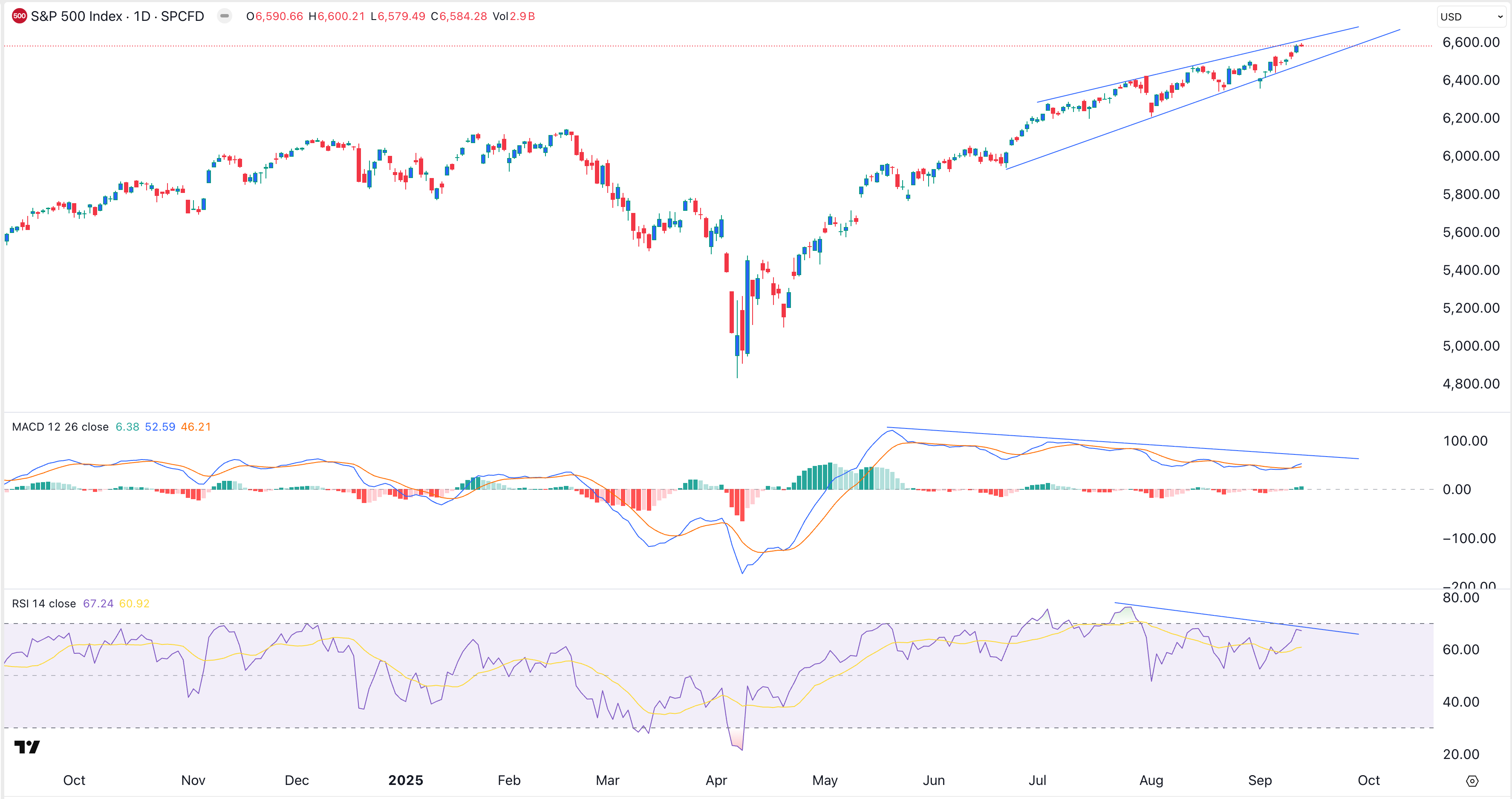
Therefore, these technicals suggest that the S&P 500 Index may retreat after the Federal Reserve decision this week. However, history shows that any pullback on the S&P 500 Index is normally a good buying opportunity.
The index has always rebounded whenever it crashes, including during the pandemic and the Global Financial Crisis of 2008.



