Bitcoin
 Solana
 Pearl
Pearl Zerebro
 Aerodrome Finance
 LayerZero
 NEAR Protocol

For a long time, Bitcoin (BTC) has been attempting to surpass gold as the world’s hedge asset. Gold maintained its standard as a traditional asset, but Bitcoin seems to be changing this narrative. In fact, Bitcoin has been termed “Digital Gold,” indicating the similarities between the two.
From institutional adoption to governments building Bitcoin Reserves, it meant a new shift in global finance. Bitcoin, and by extension crypto, has proven invaluable financially and for solving real-world problems.
A detailed expansion of the post-Fed price performance, year-to-date (YTD) price changes for Bitcoin and Gold. Also, an analysis of the BTC supply could offer some insights into the world’s hedge assets.
Post-FOMC Performance: Nasdaq, S&P 500, Bitcoin, Gold
When writing, both the traditional and new assets appeared to be performing similarly after the FOMC meeting. The meeting turned out as expected by the majority, as the Fed decided to lower interest rates. This sparked a short rally in some assets.
Stocks and cryptos moved minimally, but currency pairs were robust in reaction to the news. On the charts, these primary asset classes varied from negative 0.15% to 1.72%, according to Maartunn.
Specifically, Nasdaq was the highest gainer with 1.72%, followed by the S&P 500, up 0.97%. Meanwhile, Gold was flat while Bitcoin declined by 0.15%.
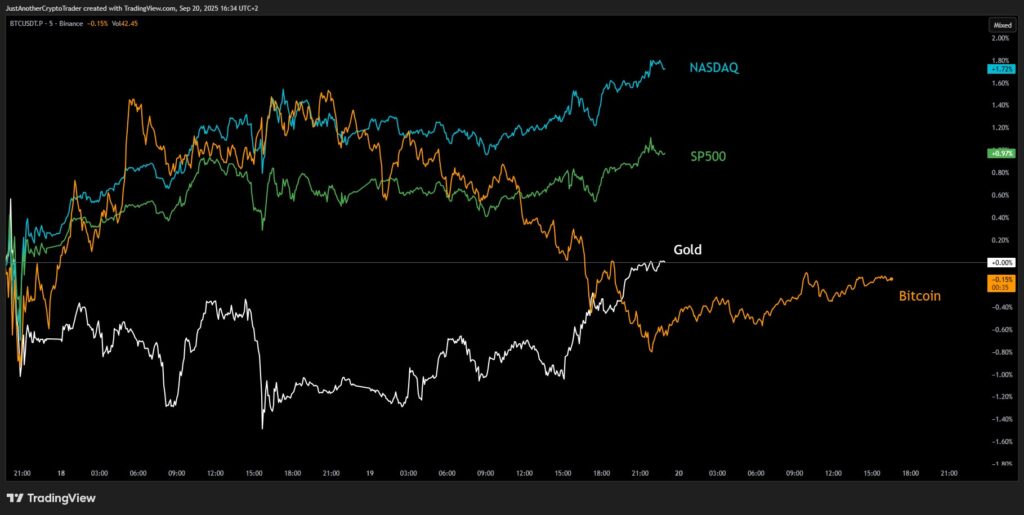
Gold was closely related to Bitcoin in terms of movement and as a store of value. However, its market cap was twelve times that of BTC. BTC was capped at $2.32 trillion, while gold was at $24 Trillion.
Bitcoin’s market capitalization remains relatively small compared to major traditional assets. This suggests its adoption is still in the early stages of mainstream acceptance.
YTD Price Change for Bitcoin and Gold: Is Bitcoin the “New Hedge Asset” or “Not Yet”?
Looking at the YTD price change for the two assets, Gold was up by 39.4% and Bitcoin by 23.8%. From the charts reported by CryptoRus on X, Gold was outshining the markets when accounting for this year’s data.
On the other hand, Bitcoin was lagging behind Gold. However, it still registered modest gains, only 15.6% apart, with some months remaining to year-end. The debate focused on whether Bitcoin could replace gold as the world’s hedge asset.
The lagging question played a minor role in shaping investor sentiment. The analyst noted that history was rhyming. That way, CryptoRus argued that it was now a matter of when, not if. Still, this task was difficult.

For now, Bitcoin was yet to replace Gold as the world’s hedge asset. However, noticing this gap and capitalizing on it before the explosion would be wise.
Bitcoin’s price may seem stable, but its history of sharp swings still poses risk. Investors should remain cautious due to the asset’s inherent volatility.
What Makes Bitcoin BTC the Potential World’s Hedge Asset to Overtake Gold?
Strong conviction in Bitcoin’s supply metrics signaled a shift toward a new financial era. Analysts relied on these data-driven predictions to forecast long-term growth and scarcity. Crypto Rand predicts over 40% of Bitcoin’s supply could become illiquid by 2032.
Long-term holders and corporate treasuries are steadily accumulating BTC, tightening market availability. At the time of writing, the graph showed an upward trend since 2016, with about 5 million BTC locked.

Altogether, the call was bold. With the institutional and government backing, the overtaking of Gold as the world’s hedge asset by Bitcoin looked possible. However, it would need a lot of time and massive capital.