Covenant x402
 hi
hi Pearl
Pearl Pons
Pons Claudia
 Bitcoin
 Injective

The U.S. government is on its way to confiscate 127,271 Bitcoin (BTC) attributed to LuBian. This is a Chinese man suspected of having staged one of the biggest crypto frauds of all time.
The U.S. Attorney’s Office for Eastern New York issued a recent statement. It says the forfeiture stems from a civil complaint. The complaint targets a transnational criminal network. This group allegedly stole billions in cryptocurrency using forced labor and online scams.
If forfeited at current prices, the U.S. government’s Bitcoin holdings, about 324,625 BTC, could yield roughly $36.48 Billion. This underscores the massive scale of crypto assets tied to legal actions.
It is one of the most extensive crypto asset confiscations in history. This indicates the further integration of Washington into crypto-related law enforcement and asset recovery.
Bitcoin News: BTC Seizure Tied to December 2020 Theft
The stolen 127,271 BTC, allegedly stolen in December 2020, was transferred across various wallets approximately 12 months ago. LuBian’s wallets show up in blockchain records. He had reportedly been involved in a broader scam network operating across Southeast Asia.
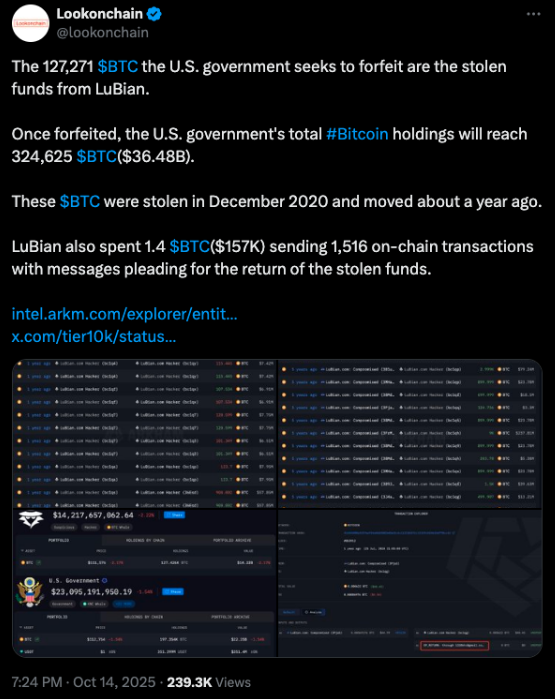
Researchers found over 1,500 on-chain messages sent to demand the recovery of funds. These messages included 1.4 BTC, worth around $157,000. These are considered pleas of desperation by the victims or insiders who needed restitution.
The trend of micro-transfers, as observed by blockchain movement analysts, provided substantial evidence that enabled the identification of wallets connected to LuBian’s network.
Bitcoin News: DOJ Calls It the Largest Forfeiture Action in U.S. History
The DOJ identified the LuBian seizure as the largest forfeiture action in the department’s history. The case was brought in coordination with the National Security Division. It involved collaboration with several global agencies.
These included the U.S. Department of the Treasury and FinCEN. The Office of Foreign Assets Control (OFAC) also played a role. Authorities say LuBian was part of the Prince Group Transnational Criminal Organization.
He allegedly played a role in leading the group. The organization was involved in large-scale investment scams. They claim the body was also involved in online extortion and forced labour on an industrial scale.
The Treasury worked with foreign partners on the case. One key collaborator was the UK’s Foreign, Commonwealth, and Development Office (FCDO). Together, they issued blanket sanctions against 146 individuals and companies tied to the group.
Treasury Secretary Scott Bessent emphasized the importance of addressing the issue of international fraud networks. He stated that transnational scams have robbed the life savings of millions of Americans in mere minutes.
He confirmed that the level of global coordination would deepen in Washington to break such activities. Court documents identified Chen Zhi as the mastermind behind the network. He is a former Chinese national who allegedly gave up his citizenship.
Zhi is accused of conspiracy to commit money laundering and wire fraud. Prosecutors say he oversaw large-scale trafficking operations. Victims were subjected to torture and extortion. They were forcibly recruited to work in at least ten scam compounds in Cambodia.
The indictment states that Zhi was involved in fraudulent schemes. These included soliciting and blackmailing for sexually explicit content, often involving minors.
The DOJ said the scale and complexity of these activities were immense. They reveal a growing link between organized crime and crypto-driven finance.