
 Minter
 Bittensor
 Hyperliquid
 NEAR Protocol
 Monero
 Pearl
Pearl Quantus
In a subtle Ethereum news update, Vitalik Buterin has explained an important safety rule in blockchain systems after new discussions surfaced online.
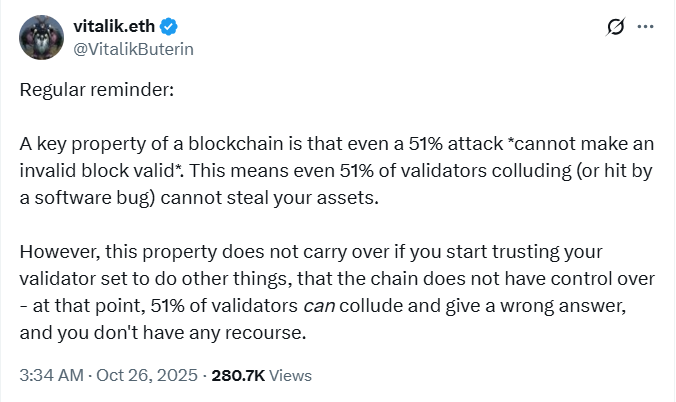
He said that even a 51% attack cannot turn an invalid block into a valid one.
His comments sparked broader discussions about Layer 2 networks, bridges, and the fundamental features that enable a blockchain to function.
Ethereum News: Vitalik Buterin’s View On Blockchain Safety
In a recent social media discussion, Vitalik Buterin highlighted a crucial rule that helps blockchains remain secure.
He said that even if 51% of validators work together or face the same bug, they still cannot make an invalid block become valid.
He pointed out that this rule protects individuals who hold assets on a blockchain. It prevents bad actors from modifying the chain to steal user funds.
He also stated that this rule only applies to actions that the blockchain can verify independently.
If people start trusting validators to make decisions outside the chain, then the safety rule does not apply.
In that case, 51% of validators could give a wrong result because the blockchain has no way to confirm it. Users would have no support from the main chain.
Someone asked Buterin if he was talking about EigenLayer. He replied that EigenLayer uses slashing with its own token when choices depend on judgment.
This indicates that some systems deviate from what the base chain can fully control. When this happens, there is a greater risk if validators act in a way that is detrimental to the network.
Anatoly Yakovenko Points To Bridge Control On L2s
To weigh in on the Ethereum news, Solana co-founder Anatoly Yakovenko also shared a separate point of view on the nature of blockchains.
He talked about Layer 2 networks that sit on top of Ethereum.
He said that most current L2s use a permissioned multisig system. That small group has the power to change bridge contracts at any time.
He explained that this means the bridge, not the Layer 2 itself, controls how safe the assets are.
He said that the escape system, which allows users to move their assets back, is a bridge feature.
It is not a property of the actual L2 network. Because of this, he argued that more work should focus on how bridges are built.
Yakovenko also stated that there are no engineering limitations that would prevent building a bridge from Solana to Ethereum L1.
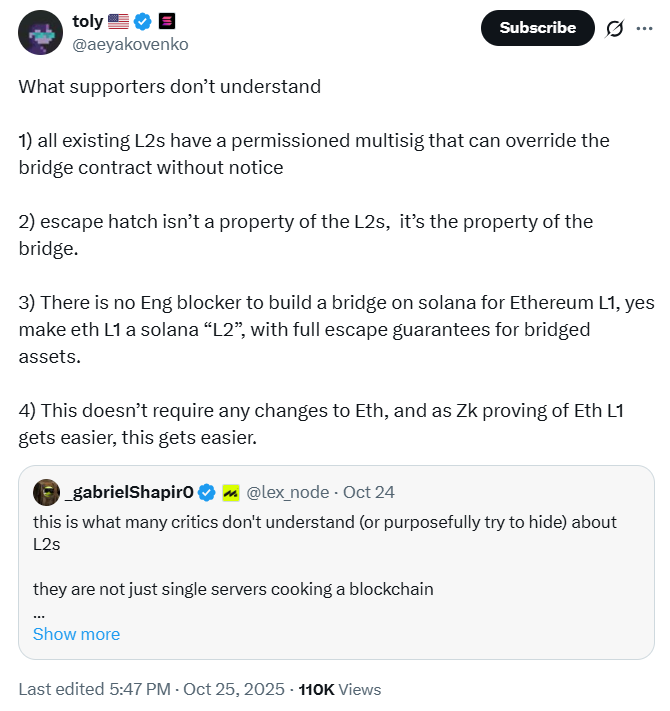
In his view, Ethereum L1 could function like a Layer 2 on Solana, with robust asset safety rules. He also stated that it would not necessitate changes to the Ethereum codebase.
He added that as zero-knowledge proof tools improve, this type of design could become easier.
His statements indicate that various chains are considering ways to enhance trust.
The goal is to allow growth without losing the safety that users expect. These talks point to the balance between scaling and control.
Key Features Of Blockchains Guide The Debate
The broader Ethereum news trend also shifted back to the fundamental features that define a blockchain.
People pointed out common ideas such as decentralization, immutability, transparency, and the use of a shared ledger.
Blockchains rely on many nodes to keep the same records. This reduces the likelihood of one group gaining complete control. Once a block is added, it stays in place, which supports trust and a clear history.
Meanwhile, some have noted that blockchains utilize cryptography to safeguard data. They use a network agreement to check each transaction.
Many systems also utilize smart contracts to execute actions when certain predefined rules are met. These points help explain why blockchain is used in many areas today.
It is worth mentioning that Gabriel Shapiro added his own view. He said that because L2s connect to Ethereum, the main chain can force certain actions if needed.
This means Ethereum can help provide fairness, even if the L2 does not have its own high level of decentralization.