
 Quantus
 Injective
 NEAR Protocol
 Sei
Sei Derive
 Bitcoin
 Zcash
Zcash

Bitcoin price fell below the $86,000 mark after facing strong resistance near the $88,000–$90,000 zone earlier today. Traders on X warned that the level now acts as a pivot for short-term momentum. Several metrics also indicated growing downside risk as long-term holders exited strength while short-term holders entered a deep state of capitulation.
The move came as futures traders monitored the unfilled Chicago Mercantile Exchange gap near $85,100. Some analysts argued that the zone could attract a temporary stabilizing reaction if price retests it soon.
Rejection Near $90K Sparks Fresh Bitcoin USD Bearish Pressure
Ted (@TedPillows) noted that Bitcoin price faced a clear rejection at its resistance level around $88,000–$90,000. He warned that Bitcoin “could drop towards a new monthly low” if bulls fail to reclaim the zone.
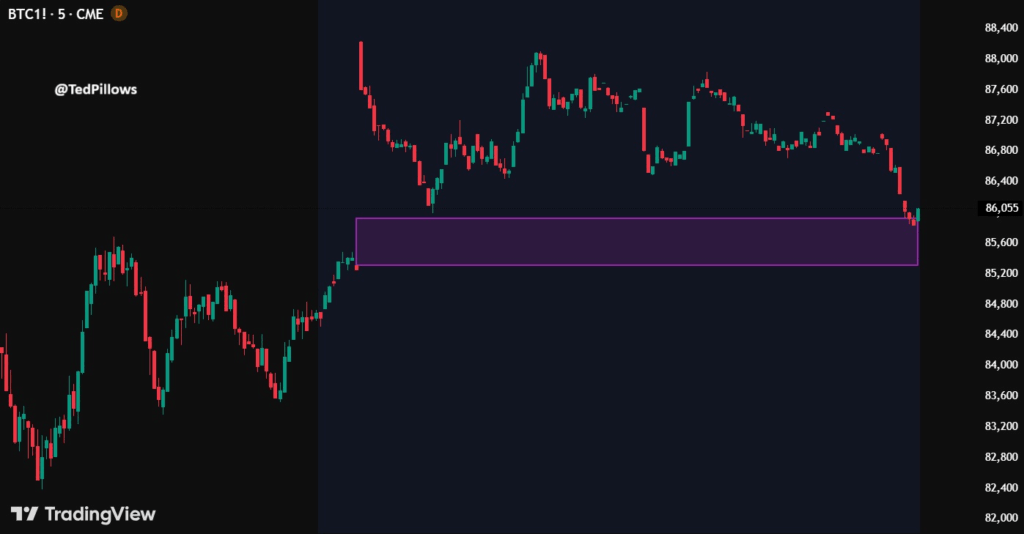
Minutes later, Crypto Rover reported that Bitcoin price dropped “below $86,000,” adding that the $85,100 CME gap was now in view. His comment aligned with intraday sentiment, where traders increasingly referenced the gap as the next logical test.
Michaël van de Poppe echoed the outlook. He said he expected Bitcoin to “stabilize and consolidate around this area,” adding that “a test at the $85.5K area” would help close the CME gap before any move toward the 20-Day Moving Average near $95,000. His view suggested a controlled pullback rather than broad panic.
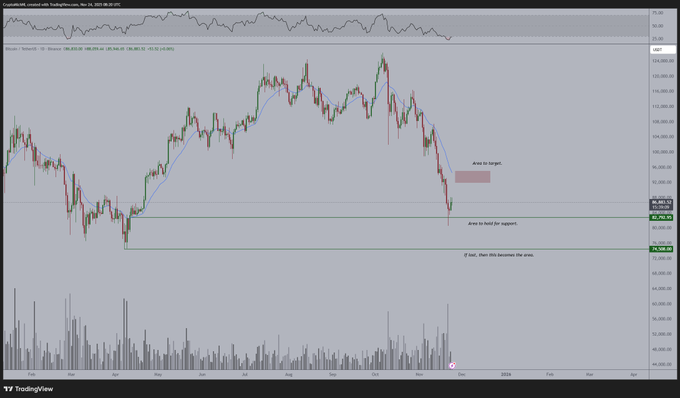
The combined commentary showed cautious optimism but acknowledged that the failed reclaim of $90,000 strengthened short-term bearish conditions.
Macro Signals Point to Deeper Correction Risks
Several analysts pointed to broader cycle signals that hinted at potential downside. Whale Insider reported that market traders on prediction platform Kalshi priced a Bitcoin low of $78,000 for the year. The platform’s data reflected how traders positioned around macro uncertainty rather than a sudden structural breakdown.
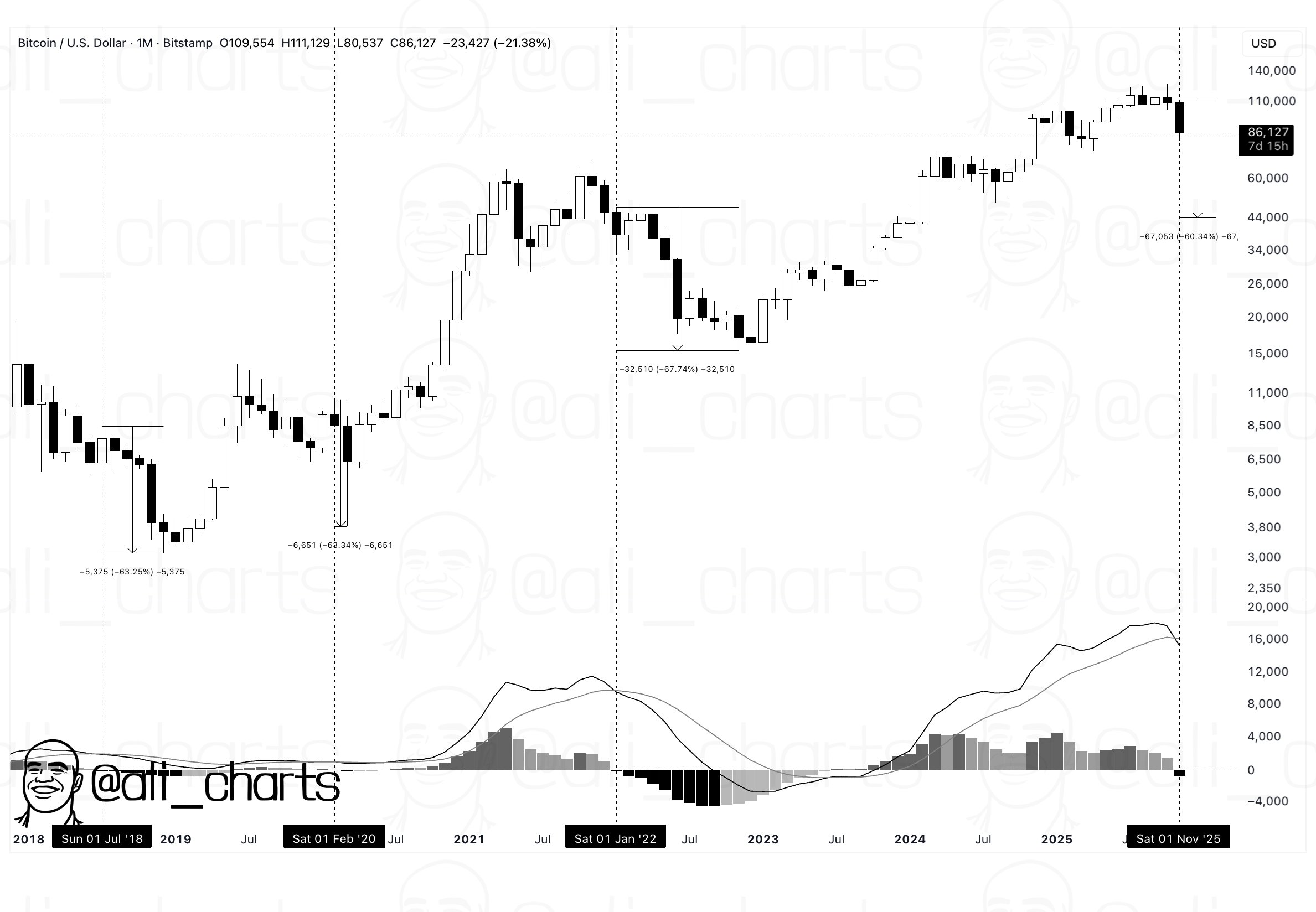
Ali (@ali_charts) highlighted a longer-term risk through the monthly Moving Average Convergence Divergence indicator. He noted that the last three bearish MACD turns triggered average declines of roughly 60 percent. He said the historical pattern “points to $40,000” if it repeats. His comment sparked debate on X but matched the historical data shown on his chart.
These macro signals did not guarantee repeat outcomes but added weight to near-term caution. Traders interpreted them as reminders that Bitcoin price enters high-volatility phases whenever long-term indicators flip.
Whale Accumulation Nears Completion, Analysts Say
Despite the broader correction, another source argued that the accumulation trend among new whales was “almost over.” The analyst said the spent-output-profit-ratio (sSOPR) indicator had been forming a near-two-year convergence since 2024. A rebound started at the lower line of the structure, signaling improving conditions for a later bullish wave.
The writer noted that there “hasn’t been a true bullish rally” in the cycle because ETF launches and whale accumulation slowed natural upside. He argued that this phase was ending and that Bitcoin may soon “break through the convergence” toward the top red line that marked previous cycle peaks.
While the outlook leaned optimistic, it still depended on the market defending key demand areas and breaking resistance zones. Analysts agreed that Bitcoin price remained in a delayed rally phase rather than an impulsive one.
Distribution From Smart Money Meets Capitulation From Retail
A separate behavioral study pointed to a notable shift among long-term holders. According to the analysis, Bitcoin’s Binary Cumulative Distribution Days indicator revealed that long-term holders distributed coins “quietly into strength” near recent highs. The pattern matched earlier cycle tops, where smart money offloaded coins while liquidity surged.
Three upward spikes marked distribution events. Each aligned with either local or macro tops, reinforcing the idea that experienced holders took profits while retail buying accelerated.
At the same time, short-term holders entered deep capitulation. Spent-output-profit-ratio readings fell below 1.0 for weeks as traders booked losses. This produced what the analyst described as a “deep capitulation band,” a feature often seen near the later stages of corrections.
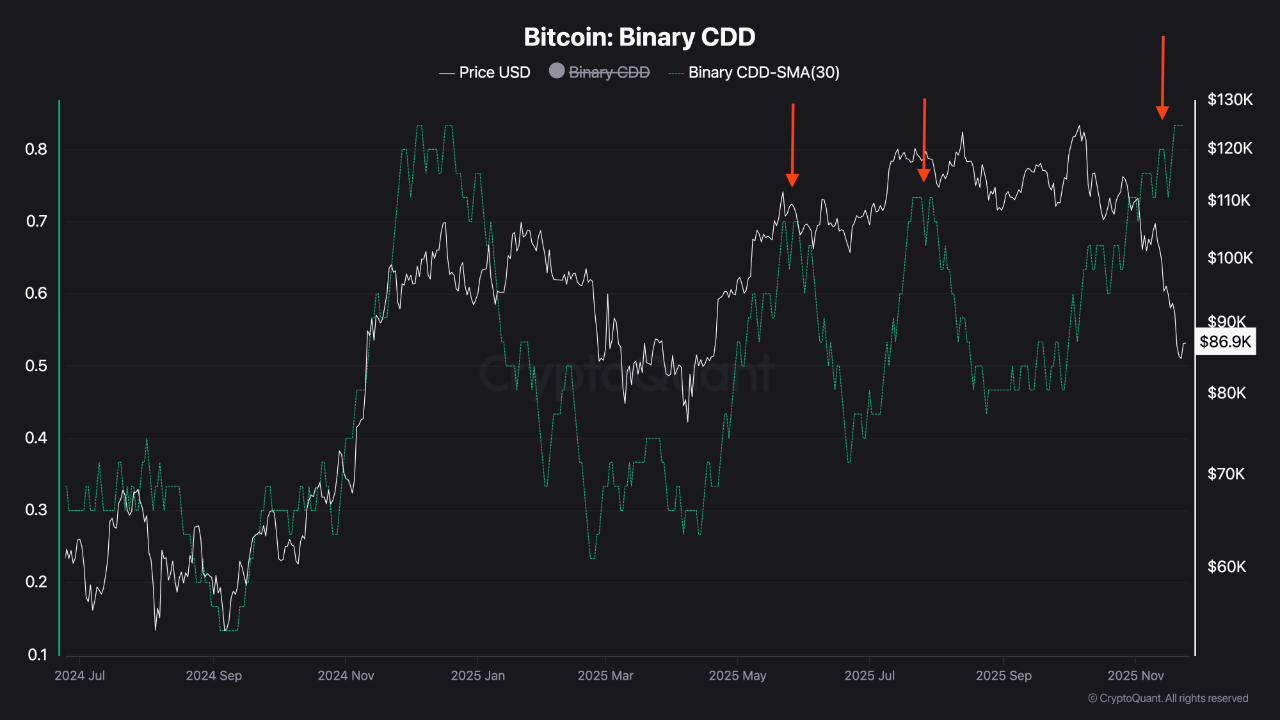
The combination of smart-money distribution at the top and reactive selling at the bottom suggested an evolving clearing phase. Historical cycles have shown that such transitions often precede accumulation windows rather than extending early-stage declines.
The key zone now sits between $80,000 and $83,000. Sustained defense of this realized-demand area would support a narrative of stabilization. A clean breakdown below it, however, would imply that the market still had unfinished downside cleansing.
Bitcoin Price Outlook: Support Zones in Focus
The Bitcoin price now trades between the commonly referenced CME gap at $85,100 and heavy resistance at $88,000–$90,000. Analysts differ on which zone breaks first but agree that both levels define the next directional move.
Short-term recovery requires reclaiming the $88,000–$90,000 area. Failure to do so keeps $85,100 and the $80,000–$83,000 region open for further testing.
Long-term narratives remain mixed. Some analysts warn of deeper MA-based risk, while others point to late-cycle accumulation as a bullish foundation. Traders now wait for confirmation from volume, liquidity, and whale behavior as the market enters a turbulent week.