
 streamoors
 IGNITION
 Sword Inu
 no crying in the casino
 Altai the Tiger
 Pearl
Pearl Pudgy Penguins

Upbit, South Korea’s leading crypto exchange, reported a major breach of its Solana-based assets. It discovered unauthorized withdrawals from one of its hot wallets.
Hackers stole tokens worth about $38 million. They drained Solana (SOL), Official Trump (TRUMP), Bonk (BONK), and Jupiter (JUP). They also targeted many other Solana ecosystem assets.
The incident marks another major crypto hack this month. It has drawn wide attention because of Upbit’s key role in Korea’s digital asset market.
Solana Ecosystem Hit as Upbit Loses $38M in Crypto Hack
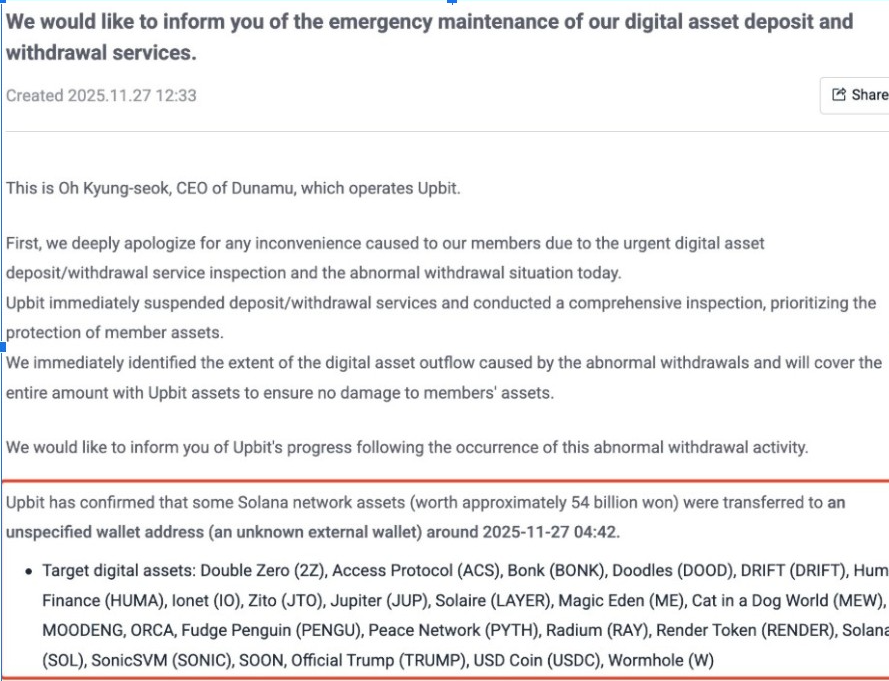
Upbit confirmed that abnormal outflows were detected on the Solana network early on November 27. This prompted an immediate shutdown of deposit and withdrawal services.
Upbit reported that about 54 billion won, worth $38 million, was moved in one transaction. The funds were transferred to an unidentified external wallet.
A wide range of Solana-based tokens have been affected. These include projects like BONK, JUP, ORCA, PYTH, RAY, and USDC. Others impacted are 2Z, ACS, DOOD, DRIFT, HUMA, IO, JTO, LAYER, MEW, MOODENG, PENGU, RENDER, SONIC, SOON, and TRUMP.
Upbit stated that the breach was isolated to assets held in a hot-wallet address linked to the Solana network. The exchange initiated a full inspection of its infrastructure once the unauthorized transfer was identified. This moved unaffected funds into cold storage for additional safety.
The team said internal monitoring systems detected the event quickly. This allows security teams to begin coordinating with on-chain investigators to follow the movement of stolen funds.
Moreover, the exchange revealed that it would cover all user losses using company assets. This assurance was issued shortly after security partners began freezing some tokens, including a portion of the Solayer (LAYER) holdings.
Upbit assured customers that their accounts would not suffer losses in the crypto hack. It contained the unauthorized withdrawals before they spread across other networks.
Exchange Responds With Emergency Security Measures
After the compromised wallet had been discovered, the Korean crypto exchange started an emergency review of all associated networks. Analytics companies in the blockchain were hired to trace the depleted tokens.
Also, some Solana-based project teams started evaluating the possibility of freezing or marking the transferred assets. The exchange said that the priority was to stop additional abnormal outflows. It also ensures that the remaining cold storage digital assets are secured.
The team also initiated coordination with investigative authorities, stressing that wallet systems and network interfaces would undergo verification before services reopen.
The exchange moved all Solana-related assets to safer environments. This was part of its emergency response. Investigations will reveal how the hot-wallet address was compromised. They will also check if the exploit came from external or internal mismanagement.
Deposits and withdrawals will remain paused until the review of the entire system is completed. The company noted that preventing repeat incidents requires a renewed approach to wallet isolation and transaction authentication.
Rising Security Concerns with Upbit in Global Crypto Markets
The crypto hack led to instant decisions in the prices throughout the Solana ecosystem. SOL price reversed some of its new gains and traded at about $142 after previously reaching highs at $144.
Market volatility eased quickly. BONK, JUP, RENDER, and PENGU tokens still fell by over 1.5% within hours of the breach. Traders attributed the pullback to concerns about potential liquidations or sell-offs linked to the hacked wallet.
Upbit said real-time data from Solana explorers flagged the issue quickly. Security dashboards also helped detect the abnormal withdrawals early.
The crypto hack also comes on the heels of other recent DeFi and exchange-related security incidents. That adds pressure to markets already watching liquidity flows.
Security concerns are rising across global crypto markets. Countries such as Japan are working to strengthen investor protection frameworks.
Japan’s Financial Services Agency is preparing new rules. These rules would require exchanges to hold liability reserves to safeguard users from hacks or operational failures.
Corporate Developments Add Pressure to the Situation
The incident occurred during a period of major corporate transition for Upbit’s parent company, Dunamu. The firm is currently undergoing a $10.3 billion absorption by Naver Financial. It’s one of South Korea’s largest tech and financial groups.
This shift has already subjected the exchange to regulatory and operational oversight. The Financial Intelligence Unit fined Upbit $25 million. It also banned the exchange from introducing new clients for three months due to AML and KYC breaches.
Industry observers have been interested in the timing of the hack as the industry anticipates more compliance implementations in South Korea. Governments recently signaled plans to intensify surveillance on domestic exchanges.
They aim to impose sanctions on non-compliant platforms. They also intend to block services temporarily. These measures target exchanges that fail to meet compliance standards.
The recent event at Upbit was seen as influential for future regulatory deliberations. Wallet security standards were highlighted as a key concern.
Centralized custody practices were also placed under scrutiny. It was stated that no customer assets would be deducted to cover losses. A full technical report was promised once the investigation was concluded.