 Minter
 Quack AI
 NEAR Protocol
 Sui
Sui Hyperliquid
 Cardano
 Raydium

The Ethereum Fusaka upgrade will roll out on December 3rd. The update will bring changes to network capacity, Layer 2 data handling, and wallet use.
Developers aim to make the chain faster and smoother for users as activity grows across the ecosystem.
Ethereum Fusaka Upgrade to Improve Core Network Capacity
The Ethereum Fusaka upgrade will arrive in a few days. One of the core aims to raise the gas limit to 60 million.
This change could help the network handle more activity during busy periods. It also targets better protection against denial-of-service risks.
Developers say the chain will coordinate validator tasks in a clearer and more stable way.
Fusaka includes changes for Layer 2 networks as well. These changes focus on blobs, which help store short-term data for rollups.
The plan is to increase blob throughput by eight times. More blobs per block will also be added over time.
This shift could support chains that rely on cheaper data storage. It may also help keep fees in a steady range for users who depend on rollups.

User experience is another part of the upgrade. Passkey support will allow people to sign in without long seed phrases.
This method is already common on many mobile devices. Users may find it easier to move between apps and wallets without extra steps.
As detailed, Fusaka will also improve pre-confirmations, giving users quicker feedback on pending actions.
A set of opcode changes may reduce gas use during contract execution. These small changes can add up during large periods of activity.
New Wallet Features Could Help More Users Come On-Chain
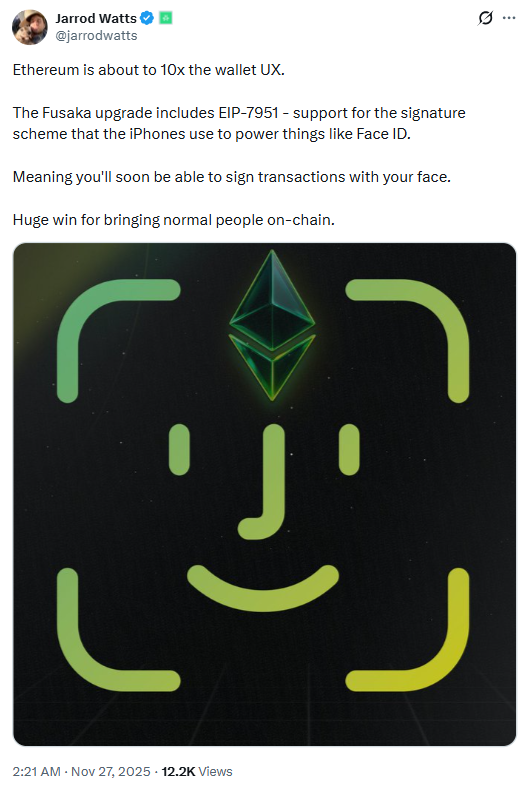
One feature drawing attention is EIP-7951. This change adds support for the signature format used on iPhones.
It is the same system that powers Face ID. With this update, users could sign transactions with device-level tools.
This step may remove friction for people who are used to simple phone-based actions.
Some community members say that strong privacy tools and simple access should be standard in modern networks.
They noted that bringing familiar login methods to the blockchain could lower the learning curve.
A smoother entry point may help new users interact with the chain without long setup processes.
Observers also believe that everyday users look for clear steps when handling digital assets.
Notably, when tools match what people already know, adoption may follow faster.
The upgrade does not guarantee immediate growth, but it may set the stage for wider use over time.
These changes arrive as interest in secure and simple digital tools continues to rise.
Market Outlook Remains Mixed Before the Upgrade
Ethereum price is holding above $2,900 as the upgrade date draws near. As of writing, it was trading at $2,995.10.
The Relative Strength Index has risen to 41 after touching the oversold zone.
This move shows that sellers are losing some control. Buyers may try to lift the price toward the 50-day Exponential Moving Average at $3,468 if momentum stays steady.
The Moving Average Convergence Divergence indicator gave a buy signal on November 26. Some traders view this as a sign that momentum could shift.
A firm move above the zero line would support that view. Even so, the chart still shows two Death Cross patterns.
It is worth noting that a Death Cross appears when a shorter moving average drops below a longer one.
This pattern often signals weakness in price action and because of this, traders may stay cautious.
The upgrade could shape sentiment in the short term. Some traders may expect higher activity once the new tools go live. Others may wait to see how the network responds.
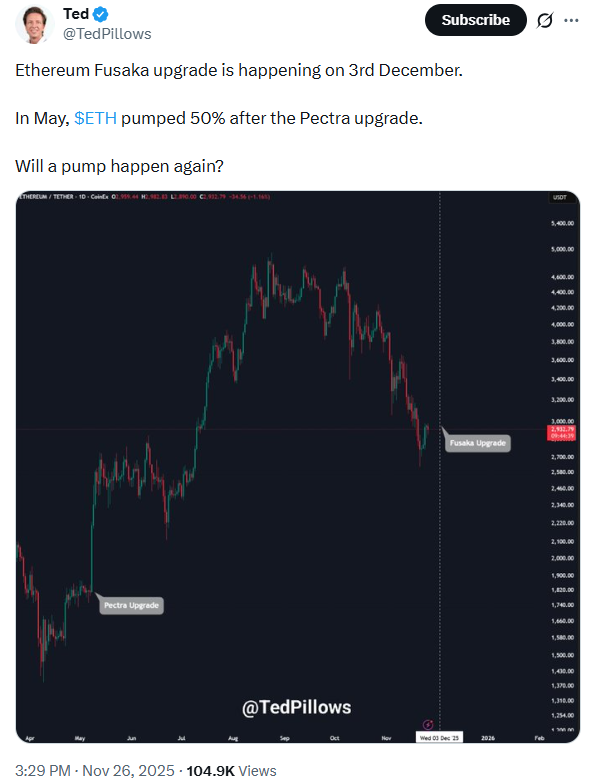
For example, crypto analyst Ted Pillows believes that the upgrade could drive the price up, just as it surged 50% after the Pectra upgrade.
With mixed signals on the chart, the market may take time to find a clear direction. The impact of Fusaka will likely become clearer in the weeks after rollout.