
 Bitcoin
 Ondo
Ondo Pudgy Penguins
 Walrus
 Pons
Pons Quantus
 NEAR Protocol
South Korea’s crypto sector came under renewed scrutiny after a $30–37 million hack hit Upbit in Nov. 2025. The theft of Solana-based assets from hot wallets triggered regulatory changes as officials blamed lax exchange controls. Now, Seoul is pushing for rules that would require traditional banking exchanges to repay users by law.
Upbit Crypto Hack: What Happened
The crypto hack struck Upbit on November 27, 2025. Hackers targeted hot wallets, which store assets for quick access, and drained them rapidly. Upbit operates under Dunamu, which merged with Naver Financial that same day.
The delay in notifying the Financial Services Commission (FSC) sparked debate. FSC rules require quick reports. However, current laws cap fines at 5 billion won, or $3.4 million, which seems too low for large exchanges.
Investigations suggest a security flaw allowed hackers to access private keys. Authorities suspect North Korea’s Lazarus Group may be involved. Police are now investigating. Upbit has over 10 million users in South Korea, and the crypto hack damaged trust.
It adds to a troubling record: since 2023, exchanges have suffered 20 failures, causing 5 billion won in damages. Upbit alone has faced six incidents.
Regulatory Overhaul After Crypto Hack
The FSC acted quickly after the crypto hack. They propose “no‑fault liability” for exchanges, meaning firms must compensate users for losses even without proven fault. The rule mirrors bank laws.
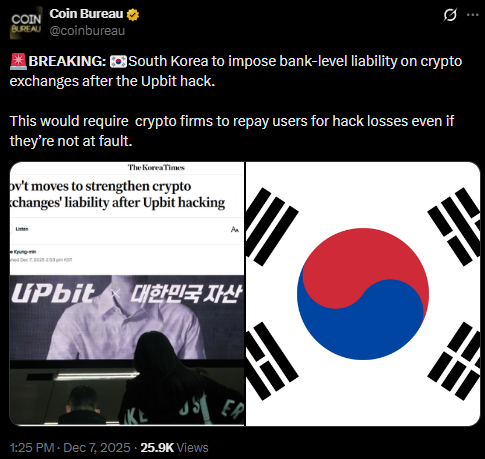
Under the Electronic Transactions Act, banks are required to compensate for data breaches. Now, crypto firms would follow suit. Fines could reach 3% of annual revenue, scaling with exchange size. Major platforms, such as Upbit, Bithumb, and Coinone, face stricter IT rules.
They must submit detailed security plans, and staff standards will rise. The FSC is revising the Act on the Protection of Virtual Assets Users.
Drafts will be released soon, with public input beginning in early 2026. FSC Governor Lee Chan-jin called the crypto hack serious and noted the limitations of existing rules.
Broader Impacts of the Upbit Breach
This crypto hack could reshape the industry. Costs may rise for exchanges, and smaller firms may struggle. But user trust could grow under stronger protections.
South Korea has a large crypto market, with over 10 million active traders. Past hacks, such as Youbit in 2018, led to shutdowns. New rules aim to prevent similar outcomes.
Globally, the breach sets an example. Other countries are watching closely. Crypto hacks occur frequently worldwide, prompting a push for enhanced security. Exchanges may invest more in technology.
Cold wallets, which store assets offline, could become standard. The incident highlights risks in hot wallets and fuels user demand for stronger safeguards.
Regulators now balance innovation with safety. Treating crypto like traditional finance ends light rules for digital assets. Future breaches may face harsh penalties, deterring hackers.
The Upbit breach may become a regulatory benchmark, influencing not just Korea but global crypto oversight. Whether it rebuilds trust or pushes smaller players out remains to be seen.
Yet challenges remain, as North Korean groups continue to evolve their tactics. South Korea’s reforms mark a turning point. The crypto hack at Upbit shows both the risks and the urgency of stronger protections.