
 Minter
 Quack AI
 NEAR Protocol
 Pearl
Pearl Monero
 Pons
Pons Sui
Sui

Crypto tax reporting is expanding as 48 jurisdictions begin collecting crypto data in 2026. The data will support the OECD Crypto Asset Reporting Framework (CARF). Information sharing will start in 2027.
Tax authorities want crypto reporting to mirror the transparency used in banking. Officials describe CARF as a tool to reduce underreporting, improve compliance checks, and support anti-money laundering work.
Crypto Tax Data Collection Begins
Since January 1, 2026, crypto service providers of participating jurisdictions have been required to gather CARF-related data for crypto tax.
The sphere involves centralized exchanges, brokers, dealers, crypto ATM operators, and certain decentralized platforms that provide the intermediary functions.
Providers must record activity that creates taxable events, including crypto-to-fiat conversions and trades between different tokens. Many regimes also require records for transfers to self-hosted wallets, since authorities can treat these movements as part of gain tracking.
OECD guidance links the rollout to work inside the G20 and member states. G20 finance leaders pushed for coordinated action from 2021, and the OECD finalized core CARF rules in 2022.
An OECD update in November said many early adopters already have legislation in place or are close to enforcement.
What Platforms Must Report Under CARF Rules
CARF sets a common reporting model that connects transactions with user identity and tax residency. Service providers must collect verified user details and residency information. This can include taxpayer identifiers under domestic rules.
Reporting covers transaction values, asset types, timestamps, and counterparties where applicable. The framework targets broad coverage across crypto activity. Records include exchanges with fiat currencies and swaps between cryptoassets.
Some jurisdictions also require documentation for large crypto payments. Under rules described in market guidance, providers must record crypto-based payments exceeding $ 50,000 and maintain supporting details for tax authorities.
The first formal reports for the 2026 calendar year are expected in 2027, with some regimes targeting May 2027 for submissions.
Crypto Tax Phased Implementation to 2027
The first batch of 48 jurisdictions will gather data during 2026 for exchange and processing in 2027. Another 27 jurisdictions will follow a later path and will begin exchanging information in 2028.
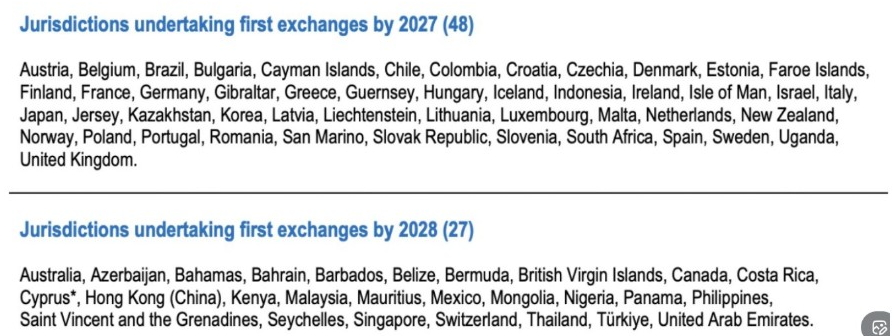
The second group includes Australia, Canada, Mexico, and Switzerland. They must start collecting data by January 1, 2027. Hong Kong also belongs to this batch. It sought public input on implementation steps and reporting standard changes.
CARF focuses on cross-border transactions where taxpayers can trade through offshore platforms. Authorities plan to exchange standardized information so residency-based taxation works even when activity occurs outside a home country.
The framework aims to close gaps created by fragmented reporting rules across exchanges and wallet providers.
United Kingdom Enforcement and Broader Use of Shared Data
Domestic enforcement began in the United Kingdom on January 1. HM Revenue and Customs expanded reporting requirements for crypto platforms. Providers must obtain verified personal details, including National Insurance numbers or other taxpayer references where applicable.
UK rules also cover trades between tokens and transfers to self-hosted wallets, along with crypto payments that cross reporting thresholds. Platforms that fail to comply can face penalties that reach 300 pounds per user under cited enforcement guidance.
At the same time, individuals can face investigations for deliberate non-disclosure. CARF data is designed for tax administration, but authorities may analyze patterns that support compliance and risk screening.
Crypto tax compliance firms state that combined records enhance visibility into ownership links. Users reveal connections when they transfer funds across multiple platforms.
Crypto tax software companies also reported that standardized reporting is capable of linking identity data to on-chain activity. There, service providers already have verified data.
Exchanges will begin exchanging data in 2027. Regulators can liaise with financial intelligence units. They act if they suspect criminal activity.