
 Celestia
 Pearl
Pearl Quantus
 Zcash
Zcash Hyperliquid
 Aerodrome Finance
 NEAR Protocol

US Bitcoin miners have curtailed operations amid the massive Arctic storm that has hit the country. The move has led to miners producing Bitcoin.
Bitcoin miners curtail operations to ease grid stress. They act to balance soaring energy demand. The winter storm Frenan drives this urgent response. Most Bitcoin miners voluntarily power down to reduce their load on the grid during extreme weather events.
According to CryptoQuant data, many of the major US Bitcoin miners have seen their production drop significantly. For instance, CleanSpark’s daily production dropped from 22 BTC to 12 BTC. RIOT also fell to 3 BTC from 16 BTC, while IREN declined to 6 BTC from 18 BTC.
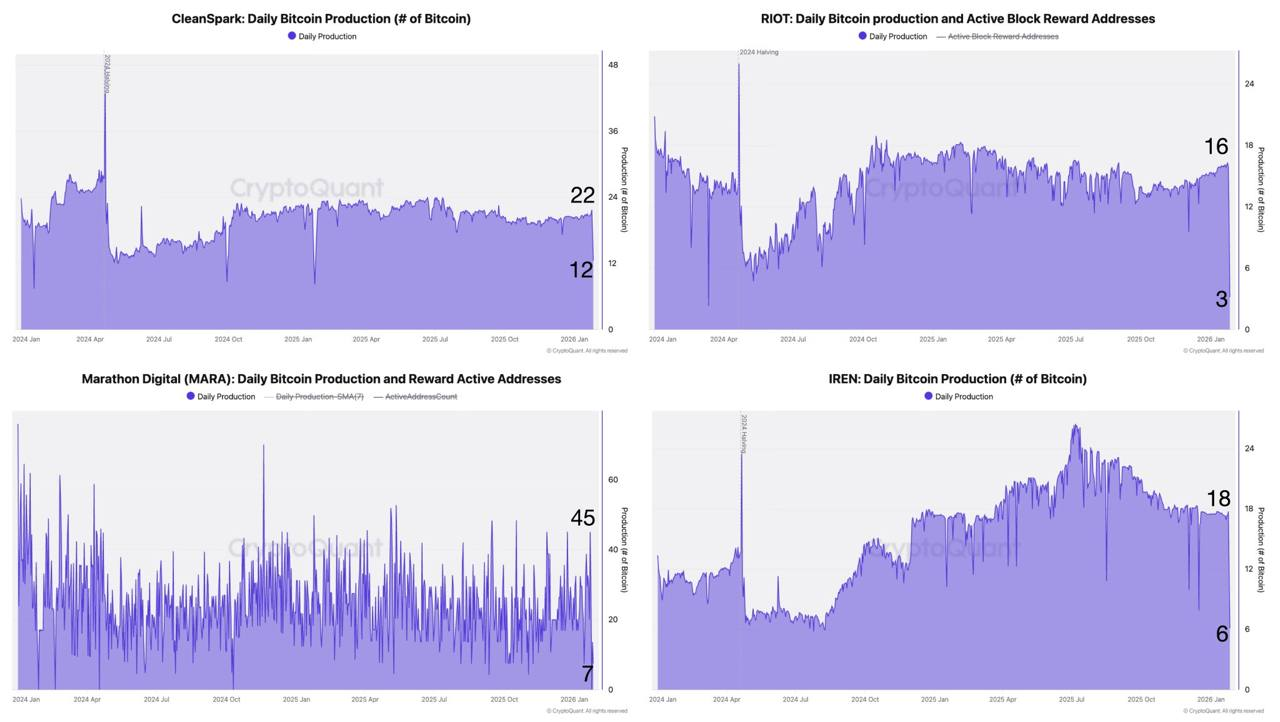
Interestingly, it was MARA Holdings that had the most decline, falling from 45 Bitcoin to 7 Bitcoin. CryptoQuant’s head of research, Julio Moreno, explained that this is because MARA mines solo.
Sharp Decline Among US Bitcoin Miners, Global Pools Stay Resilient
The sign of the curtailing was most evident with the leading mining pool, FoundryUSA. The pool saw its network hashrate fall from around 340 exahash per second (EH/s) on Friday to 197 EH/s by Monday.
This represents over 150 EH/s drop, a sign that multiple US Bitcoin miners unplugged their machines. The same scenario played out with another North America-based mining pool, Luxor. The hashrate dropped from around 38 EH/s on Friday to 25 EH/s by Monday.
Interestingly, other mining pools did not experience a similar sharp decline. Other major pools, such as Antpool, F2Pool, and Viabtc, only recorded slight declines in hashrate during the same period.
These pools operate miners worldwide. Their global reach keeps them stable. US curtailment alone cannot disrupt them.
Bitcoin Hashrate Falls to Lowest Level in Over 6 Months
Unsurprisingly, US Bitcoin miners powering down affected the total network hashrate. The Bitcoin hashrate, which is the amount of computing power on the network, fell to 670 EH/s on January 25. That’s the lowest level in more than six months.
It has now risen to 866.15 EH/s according to CoinWarz. However, it is far from the 1.1 zetahash per second (ZH/s) earlier in the week. Bitcoin block times have also increased to around 12 minutes per block, higher than the 10-minute target.
Interestingly, a positive to the declining hashrate is that mining difficulty is expected to adjust significantly. It is currently at 141.67T after recent slight declines, but is set to drop 16.9% by the next adjustment on February 8. This could push the mining difficulty to 117.73T.
Meanwhile, the potential drop in mining difficulty could be a positive development for Bitcoin miners who have been struggling with profitability. Hashprice is currently at $39.27/PH/s, near the all-time low.
This is partly down to Bitcoin’s performance. The flagship asset has continued to struggle despite a recent positive bounce, falling as low as $86,000 on January 26.
It climbed back to $88,000. Sentiment stays bearish despite the rebound. Gold and silver still outshine it.