Pearl
Pearl Zylo Ecosystem
 Bitway
 Walrus
 Starknet
 Quantus
 Pudgy Penguins

Asian stocks fell sharply on Tuesday, Oct. 13, as semiconductor companies faced renewed selling pressure. South Korea’s KOSPI dropped 5.5% following reports of technological progress by Chinese chipmaker ChangXin Memory Technologies (CXMT).
Samsung Electronics and SK Hynix led the decline, losing 7.4% and approximately 10%, respectively. The sell-off extended to Japan and Taiwan, reflecting concerns about competition and artificial intelligence (AI) investment returns.
Meanwhile, U.S. Treasury yields eased as investors assessed weaker technology shares and upcoming inflation data. The 10-year yield approached 5.19%, according to Barron’s.
South Korea’s KOSPI Leads Asian Stock Losses
MSCI’s broad index of Asia-Pacific shares outside Japan fell nearly 3%, reaching its lowest level since late July. An index tracking emerging Asian equities lost nearly 3.5%, touching its lowest point since early August.
Chipmakers accounted for much of the pressure because several major regional indexes carry large semiconductor holdings. The downturn also reached companies involved in chip manufacturing equipment, memory production, and AI infrastructure. Samsung and SK Hynix together represent roughly 16% of the MSCI Emerging Asia Index.
South Korea’s KOSPI dropped as much as 7.4% during trading before recovering part of its losses. The benchmark closed about 5.5% lower, its weakest finish since July 30. The Korea Exchange temporarily restricted program selling after the sharp intraday fall.
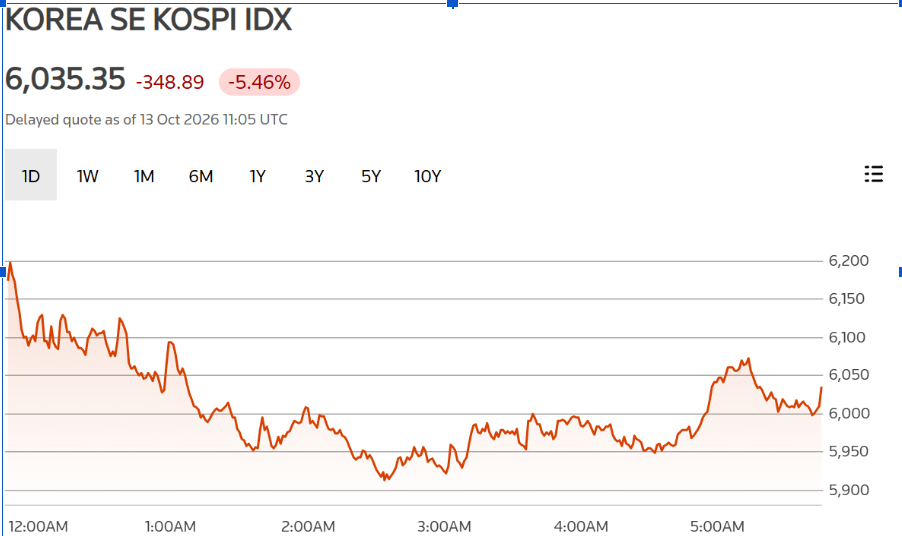
Samsung Electronics finished down 7.4%, while rival SK Hynix lost around 10%. Both companies supply memory chips to major technology manufacturers and AI computing systems. The latest close extended the KOSPI’s losing streak to five sessions, with cumulative losses nearing 14%.
China’s CXMT Raises New Memory Chip Competition Concerns
China’s CXMT reported progress with a memory design called 4F², which aims to store more information within a smaller chip area. The company plans to introduce server-grade DDR5 memory using the design before the end of 2026.
However, CXMT has not demonstrated that it can manufacture the new chips at commercial scale with competitive production yields.
Samsung, SK Hynix and Micron remain established suppliers across these markets. Investors reacted to the possibility of greater competition in chip sales or market share. Commercial production still requires consistent yields, acceptable costs, and customer qualification.
Japan and Taiwan Follow Wall Street Chip Declines
Selling extended to other Asian technology markets. Japan’s Nikkei 225 closed around 1.8% lower after an earlier fall of roughly 2.5%. Memory producer Kioxia lost about 13%, while technology investor SoftBank also came under pressure.
Taiwan’s main equity benchmark declined nearly 2%, and chip manufacturing company TSMC fell by a similar amount. Mainland China’s Shanghai Composite, however, ended slightly higher.
The Asian losses followed Monday’s 2.7% decline in the Philadelphia Semiconductor Index in the United States. Shares of Micron Technology fell nearly 4% during that session. On Tuesday, Nasdaq futures declined around 0.7% as traders continued selling technology shares.
Bond Yields and US Inflation Data Draw Attention
Investors also turned toward government bonds as technology stocks weakened. The US benchmark 10-year Treasury yield eased to around 5.19%, after reaching 5.364% the previous week.
Bond yields had risen as higher energy prices, inflation concerns and government borrowing increased pressure on debt markets. Higher financing costs also matter for companies funding large data centers and other AI projects.
Global markets now await Wednesday’s US consumer inflation report for September. Interest-rate futures indicated an 80.6% probability that the Federal Reserve would leave rates unchanged later in October, compared with 51% a month earlier.
This article is for informational purposes only and does not constitute financial or investment advice.