 Bitcoin
 Chunkee The Manatee
 Hyperliquid
 Solana
 EVAA Protocol
 Sui
 BNB


Ethereum price fell below $1,700 on Friday, Nov. 20, extending losses across cryptocurrency markets. Bitcoin also dropped under $60,000 as investors faced renewed selling pressure.
The decline coincided with another session of cryptocurrency exchange-traded fund (ETF) withdrawals. Meanwhile, Ethereum developers considered further delays to the Glamsterdam network upgrade over technical concerns.
The developments raised questions about ETH’s next support levels, with analysts monitoring a possible decline toward $1,500.
Ethereum Price Falls as Bitcoin Drops Below $60,000
Ether traded near $1,649 on Friday, down 5.23%, while Bitcoin fell to $59,381. During the crash, Bitcoin crossed below $60,000 for the first time since July, and selling extended across major digital assets.
The decline followed another difficult session for crypto investment funds. U.S. spot Bitcoin ETFs recorded $582.19 million in net withdrawals on November 19, while Ethereum funds lost $131.24 million. Those figures followed several sessions of fund outflows, adding another measure of selling pressure.
Recent coverage of Bitcoin ETF withdrawals showed three consecutive sessions of redemptions totaling about $1.13 billion. Meanwhile, weaker technology stocks and concerns over borrowing costs weighed on investor demand for risk assets. Bitcoin’s move below $60,000 added another reference point for traders monitoring broader crypto market weakness.
Ethereum’s decline also followed a month of lower prices. ETH crypto traded near $2,399 one month earlier, compared with its much lower level on Friday. The latest slide left traders watching whether the former $1,700 support area could become a barrier during any recovery.
Glamsterdam Upgrade Faces Further Delays Into 2027
Ethereum developers discussed the Glamsterdam upgrade during their November 19 All Core Developers meeting. The upgrade’s launch is now expected in 2027, although developers have not confirmed a mainnet activation date.
The delay stems from concerns about changes to how Ethereum charges gas for some network operations. According to the report, the proposed changes under EIP-8037 and EIP-8038 could disrupt existing smart contracts that depend on current fee calculations. Developers must address those compatibility concerns before agreeing on the next testing steps.
The Ethereum Foundation confirmed on November 6 that developers had postponed further testing on Hoodi while investigating those issues. The foundation said affected projects needed more assessment before the upgrade could proceed safely.
Developers have contacted dozens of affected application teams as they consider whether to retain or revise the proposals. A January 2027 release remains possible under the existing specifications, but further changes could push activation toward May. The timetable remains subject to technical work and another developer decision.
ETH Price Prediction: Can $1,500 Become the Next Target?
Analyst Ted Pillows warned on Friday that Ethereum had revisited the 1,700–1,750 support zone. He said another breakdown could send ETH toward fresh lows, although he did not specify a price target. The latest trading levels now place that former support zone above the market.
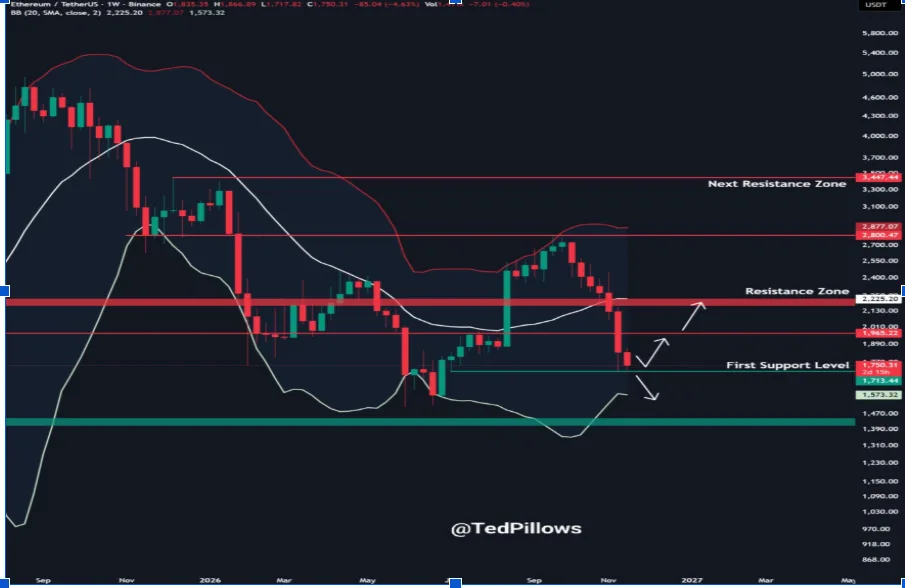
The latest fall placed Ethereum price below that area, leaving $1,700 as an immediate level to recover. If sellers retain control below $1,650, $1,600 becomes the next round-number area to watch. However, a brief move through one level would not establish whether selling pressure will continue.
A recent Ethereum price analysis identified $1,710 as a downside threshold before a potential move toward $1,500. For a recovery, ETH crypto would first need to regain $1,700 and then hold above $1,750.
Analysts had previously marked $1850 as resistance, while ETF withdrawals continued through Thursday. As a result, further fund-flow figures and trading around $1,700 will help show whether demand is returning.
This article provides general financial information, not investment advice. Cryptocurrency markets carry substantial risks, and technical forecasts cannot guarantee future returns. Investors should conduct independent research before making investment decisions.