Walrus
 Bitcoin
 Quantus
 Pearl
Pearl Quant
Quant Pudgy Penguins
 Sui
Sui

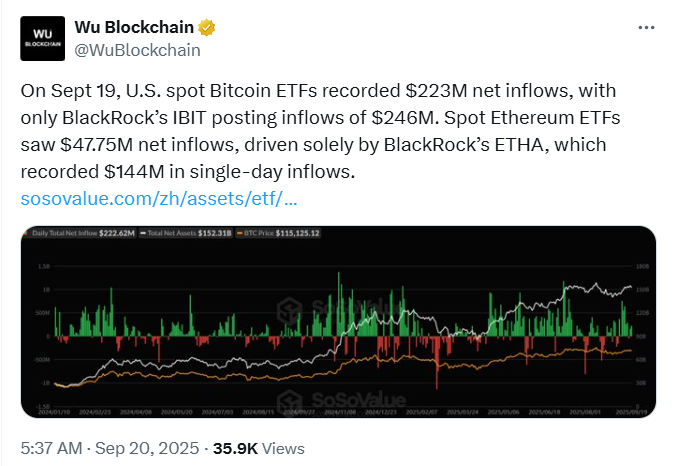
On September 19, U.S. spot Bitcoin and Ethereum exchange-traded funds (ETFs) recorded strong net inflows, led by BlackRock.
Bitcoin ETFs added $223 million, while Ethereum ETFs gained $47.75 million. The market data highlights growing investor demand for regulated crypto investment products.
BlackRock Leads Bitcoin and Ethereum ETFs Inflows
Bitcoin ETFs in the United States brought in $223 million in net inflows on September 19, according to SoSoValue.
This raised the cumulative total to $57.72 billion. Total net assets for Bitcoin ETFs reached $152.31 billion, while the price of Bitcoin was listed at $115,130.
The largest inflow came from BlackRock’s iShares Bitcoin Trust (IBIT). IBIT drew $246 million in a single day.
This makes it the top performer in the category, and its assets under management now stand at $88.45 billion.
In contrast, Grayscale’s GBTC recorded outflows of $23.5 million, showing a continued shift of investor funds away from older products toward BlackRock’s offering.
Ethereum ETFs also saw inflows, though smaller compared to Bitcoin. The daily inflow was $47.75 million, with total assets across Ethereum ETFs at $29.64 billion.
The price of Ethereum was reported at $4,440. BlackRock’s Ethereum ETF, known as the ticker symbol ETHA, brought in $144 million, which accounted for the entire positive flow in the Ethereum category.
In addition, other Ethereum funds recorded withdrawals, with Fidelity’s FETH losing $53.4 million.
Grayscale’s ETHE and ETH products lost more than $17 million, while Bitwise and VanEck also reported outflows.
This shows that while overall numbers for Ethereum were positive, it was BlackRock that carried the results.
Investors Move Toward Large Providers
The figures from September 19 point to a clear trend. Investors are directing funds toward the biggest and most established providers.
BlackRock’s name recognition and size may explain why its products continue to draw new money, while many others are flat or losing assets.
On the Bitcoin side, Fidelity, Ark 21Shares, and Bitwise reported no inflows, while Grayscale posted significant outflows.
Fidelity, Grayscale, Bitwise, and VanEck all showed red numbers for Ethereum ETFs.
BlackRock’s IBIT and ETHA posted strong inflows that outweighed losses seen across competitors.
This shows that investors may prefer the security and management of larger firms.
BlackRock’s leadership also shows how traditional financial companies are gaining ground in digital assets.
For years, many investors had limited options for regulated exposure to cryptocurrencies.
Now, ETFs have become the main tool for that purpose, and the flow of funds shows which providers are most trusted.
What the Numbers Could Mean for the Market
The inflows come when Bitcoin has struggled to break above previous price levels.
The addition of $223 million in one day suggests that demand for Bitcoin exposure through ETFs is still strong.
This could stabilize the broader market, as more institutional money is committed through regulated products.
Ethereum’s inflows were smaller, but still notable given the mixed performance of its ETFs.
BlackRock’s ETHA was the only driver of growth, showing that some investors see value in Ethereum beyond just short-term price moves.
The steady addition of funds may reflect confidence in Ethereum’s wider use in decentralized finance, staking, and applications such as NFTs.
Overall, the data shows two main points. First, demand for crypto ETFs remains steady, even in periods when prices are not breaking new highs.
Second, BlackRock has become the main entry point for investors looking for regulated access to Bitcoin and Ethereum.
While other providers continue to compete, the numbers show that one firm is currently setting the pace in both markets.