astronaut
 Walrus
 Pearl
Pearl Bitcoin
 NEAR Protocol
 Zcash
Zcash Hyperliquid

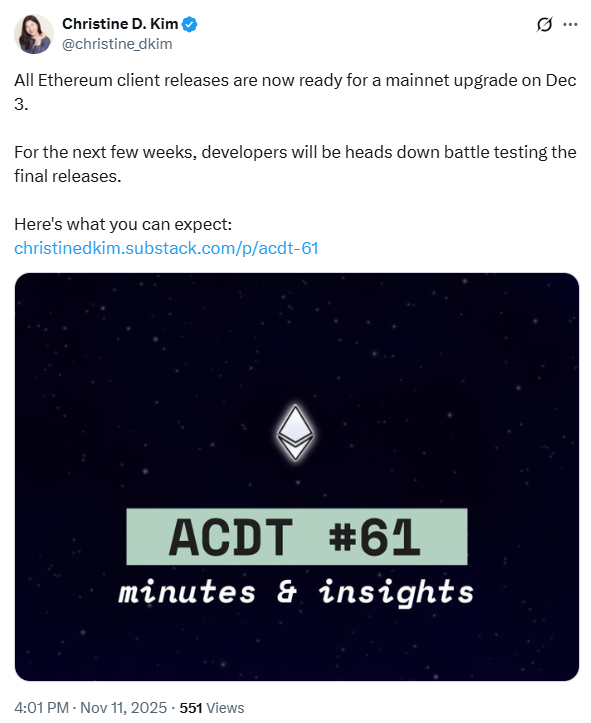
In recent Ethereum news, developers report that nearly all client teams are ready for the Fusaka mainnet upgrade, scheduled for December 3.
As detailed, final testing focuses on fixing bugs, improving performance, and ensuring network stability before the launch.
Fusaka Mainnet Testing Nears Completion
According to a recent update, developers are completing the final rounds of testing before the Fusaka mainnet upgrade.
Christine D. Kim, in her ACD After Hours report, said all client teams except one are ready for release. The upgrade is planned for December 3.
The final tests include the second blob parameter-only (BPO) hard fork on the Hoodi testnet, scheduled for November 12. Developers are issuing hotfixes to ensure stability.
Nethermind released version 1.35.2 after removing changes that were not fully tested. The Reth client team released version 1.9.1 to fix minor issues.
However, it is worth noting that some issues remain under review. Lighthouse developers are addressing a non-critical bug, and Teku developers are investigating unusual RPC requests on testnets.
The update mentioned that Nimbus nodes stalled on Fusaka Devnet-3, and engineers are investigating.
Per the Ethereum news, the Fusaka Devnet-3 will be removed after the upgrade goes live.
Developers said they are focusing on strengthening existing code rather than adding new features.
More importantly, this approach reduces the risk of introducing new problems before activation.
Ethereum News: Scaling, Gas, and Consensus Updates
It is also important to note that developers are working on Ethereum’s scaling and performance ahead of the Fusaka upgrade.
Nethermind is benchmarking Geth and Nethermind clients for EIP 7904, which covers general gas repricing.
Meanwhile, no additional meetings on gas repricing are scheduled until after Devconnect.
The first multi-client devnet for block-level access lists (BALs) is now scheduled for late November.
Ethereum Foundation STEEL team introduced a broader set of tests, which caused some client teams to fail. The team is working on these fixes before launch.
Developer Mario Vega asked teams to review Hive test results for their BAL implementations and report any errors.
At the same time, Ethereum researchers are making minor adjustments to the consensus specifications for enshrined proposer builder separation (ePBS).
Client teams are expected to incorporate these updates before the ePBS Devnet-0 launch, which is likely to occur in mid-January.
Meetings Paused and Institutional Interest
Developers agreed to cancel the next two ACD Testing calls due to Devconnect travel and the upcoming holidays.
In the Ethereum news, it was mentioned that regular meetings will resume on December 1, just before the Fusaka mainnet upgrade.
Meanwhile, Ethereum news also shows growing institutional activity in the network.
In a recent post on X, Analyst Joseph Young said Ethereum’s economic zone has surpassed $100 billion.
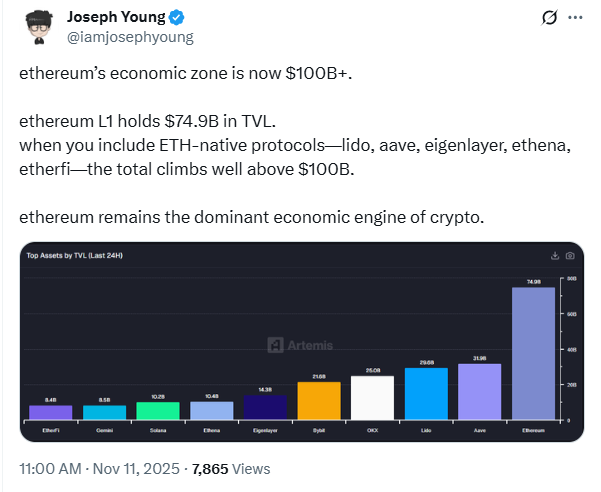
The Layer-1 chain holds $74.9 billion in total value locked (TVL), and ETH-native protocols such as Lido, Aave, Eigenlayer, Ethena, and EtherFi bring the total above $100 billion.
Young reported that Republic, a publicly listed Canadian firm, raised $100 million to stake in Ethereum.
This follows similar moves by SharpLink and BitMine. Institutions are accumulating ETH for long-term staking rather than speculation.
These developments reinforce Ethereum’s role as a major asset for investors.
Developers continue to organize tests for non-finality, pending blob transactions, and private blob transaction processing on Fusaka Devnet-3.
New MEV-Boost releases with bug fixes will also be tested before the December 3 upgrade. These steps aim to ensure the network is fully prepared for the Fusaka mainnet launch.