streamoors
 Sword Inu
 Altai the Tiger
 IGNITION
 no crying in the casino
 NEAR Protocol
 Pudgy Penguins
- Due to the recent issuing of Class A shares, Michael Saylor no longer owns most of the votes at MicroStrategy.
- Saylor’s control is now less than 50% since the number of Class A shares has overtaken that of Class B shares.
- It is no longer a “controlled company” as defined by NASDAQ. As a result, independent governance reforms must be put into place.
MicroStrategy’s market capitalization has neared $100 Billion today. It comes with a steady stream of new debt issuances to fund additional Bitcoin acquisitions. CEO Michael Saylor held most of the voting control over the company for years. However, that is no longer the case.
Although Saylor remains the largest shareholder, recent share issuances have reduced his voting power below 50%. The fact that there are now more Class A shares than Class B shares caused this change. As a result, Saylor’s power within the organization is diminished.
This change comes from the company’s bold fundraising efforts and Bitcoin purchasing strategy. It has notably transformed its corporate governance structure.
Diluted Influence: Michael Saylor’s Grip on MicroStrategy Lossens
Under Saylor’s leadership, MicroStrategy has pioneered the adoption of Bitcoin as a critical asset. However, recent stock issuances to finance further cryptocurrency purchases have led to Saylor losing his majority voting control.
Traditionally, MicroStrategy operated with a dual-class share structure. There, Saylor’s Class B shares carried 10 times the voting power of the Class A shares.
This allowed Michael Saylor to retain control of the company despite owning a smaller portion of the stock. As of October 21, Saylor held 51.7% of the total voting power in MicroStrategy’s common stock.
The company issued many Class A shares to fund additional Bitcoin acquisitions. It has diluted the influence of the Class B shares. As a result, Saylor’s voting control has now fallen below 50%.
As a result of this change, MSTR no longer qualifies as a “controlled company” under NASDAQ’s regulations. This triggered the need for new governance practices.
The company will now be required to establish independent boards. It will also need independent compensation and nominating committees. Michael Saylor’s influence over decision-making, including Bitcoin acquisitions, will face increased scrutiny with these new rules.
Earlier this month, Carl J. Rickertsen, chair of MicroStrategy’s nominating committee, revealed the formation of a governance reform committee. Future SEC filings will provide more information about the committee’s responsibilities and powers.
These developments signal a significant shift in the company’s governance structure. It has evolved from a software business to a Bitcoin-focused firm.
MicroStrategy Secures $2.6 Billion to Accelerate Bitcoin Strategy
MicroStrategy has invested billions through debt and equity to grow its Bitcoin portfolio. By the end of October, the company disclosed it had taken on $42 billion in debt in addition to its Bitcoin assets.
Driven by high investor demand, MicroStrategy raised its most recent funding round to $2.6 Billion. That is a significant increase from the $1.75 Billion it had planned just a day before.
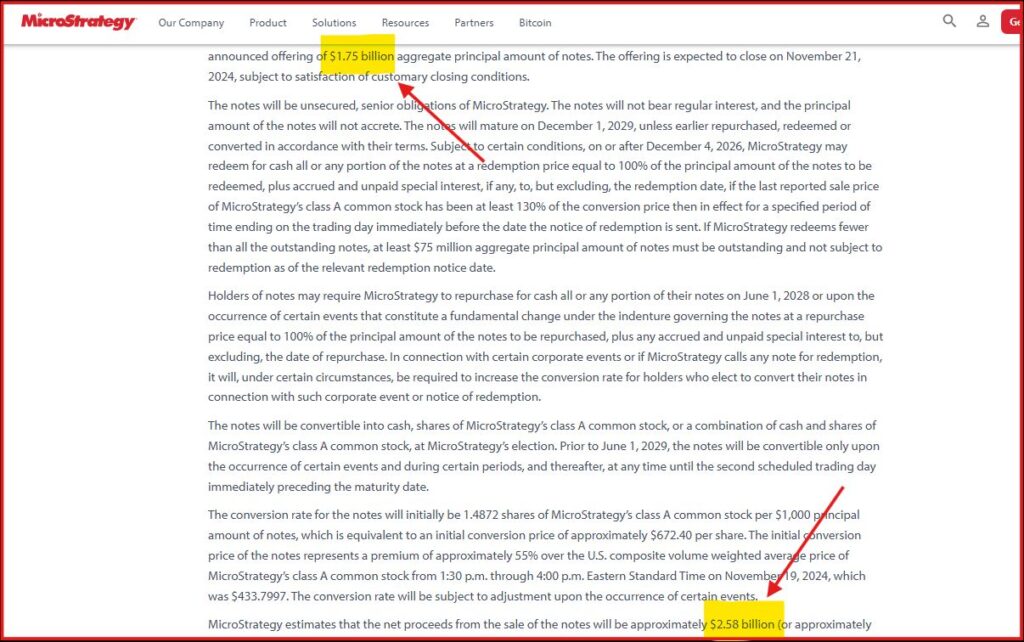
The latest debt issuance comes with a 0% coupon. This means investors stand to profit only if MicroStrategy’s stock price increases.
This setup aligns investor interests with the company’s aggressive growth strategy, which relies heavily on the appreciation of Bitcoin. While this approach has sparked debate, MicroStrategy’s market value has surged to $111 billion, with its bitcoin holdings now worth 3.55 times the company’s annual revenue.
With $31 Billion in bitcoin assets, MicroStrategy is now among the largest corporate holders of the cryptocurrency globally. The company’s valuation underscores investor confidence in its bitcoin-focused model. However, this strategy is exposed to the risks of market volatility.
Meanwhile, with Michael Saylor’s influence waning, the company faces new governance challenges related to this approach.
Changes in MicroStrategy’s Governance and Michael Saylor’s Role
Michael Saylor’s additional voting authority adds more checks and balances to MicroStrategy’s decision-making and operations.
These changes will increase the openness of executive compensation and strategic choices within NASDAQ’s rules. Adding independent directors may also impact the company’s aggressive future bitcoin acquisition strategy.
These modifications may indicate a move toward increased corporate responsibility and stability. MicroStrategy has also formed a new nominating committee with more general market governance guidelines.
Although he continues to play a vital role as executive chairman, Michael Saylor no longer has the same control over the company’s course. This change may impact investor trust in the company’s Bitcoin-focused strategy.
Disclaimer
In this article, the views, and opinions stated by the author, or any people named are for informational purposes only, and they don’t establish the investment, financial, or any other advice. Trading or investing in cryptocurrency assets comes with a risk of financial loss.