streamoors
 IGNITION
 Injective
 NEAR Protocol
 Pearl
Pearl LayerZero
 Hyperliquid
- The court chastised the FDIC for severely suppressing information related to its legal battle with Coinbase.
- The Judge ordered the FDIC to give a detailed explanation for its redactions to encourage more transparency.
- The deadline for the FDIC to provide Coinbase with new documentation is January 3, 2025.
Coinbase, a well-known platform for cryptocurrency exchange and wallet services, holds a prominent position in the crypto market. Through its role in innovation and the future, it also attracts attention from both industry participants and investors in its COIN stock.
Online discussions about its legal dispute with the Federal Deposit Insurance Corporation (FDIC) have recently gained momentum. The FDIC has faced criticism for handling documents related to this case.
These criticisms are particularly for overusing redactions in materials requested under the Freedom of Information Act (FOIA). On December 12, Judge Ana C. Reyes condemned the agency’s actions.
The Judge described the redactions as excessive and made in bad faith. The court ordered the FDIC to examine and update the withheld records to improve transparency in its disclosure standards.
The FDIC has time till January 3, 2025, to provide the revised documents to Coinbase. However, Coinbase’s CLO, Paul Grewal, expressed skepticism by not obeying the court. He suggested that the FDIC might also withhold information critical to the broader crypto industry.
How It Began? & What Coinbase Asked FDIC?
In a Coinbase lawsuit filed in June, it successfully pushed the FDIC to release 23 heavily redacted letters. These documents have intensified Paul Grewal’s concerns. He has criticized what he perceives as a targeted effort against the cryptocurrency industry.
“The FDIC undertook a very concerted effort to deny regulated institutions, primarily banks, the right to offer legal services to the crypto community,” Coinbase Chief Legal Officer Paul Grewal said. “If it’s crypto today, it could be any other business tomorrow.”
The controversy surrounding Coinbase’s legal battle has become part of a broader narrative within the crypto industry. It was often labeled as “Operation Choke Point 2.0.”
This alleged campaign mirrors the original Operation Choke Point. Initially, it was a regulatory effort during the Obama administration.
It targeted industries like payday lending and firearms by pressuring banks to cut ties with them. However, in its modern iteration, crypto insiders claimed that regulators were focusing their efforts on cryptocurrency businesses.
Coinbase’s legal actions are a key component of the industry’s resistance. Prominent figures in the crypto space have taken to social media to allege that U.S. regulators. That includes executives from Custodia Bank and Andreessen Horowitz,
The FDIC and other federal agencies have been implicated in the alleged “Operation Choke Point 2.0,”. They are accused of instructing financial institutions to deny banking services to crypto businesses. Recently released FDIC documents appear to substantiate these claims.
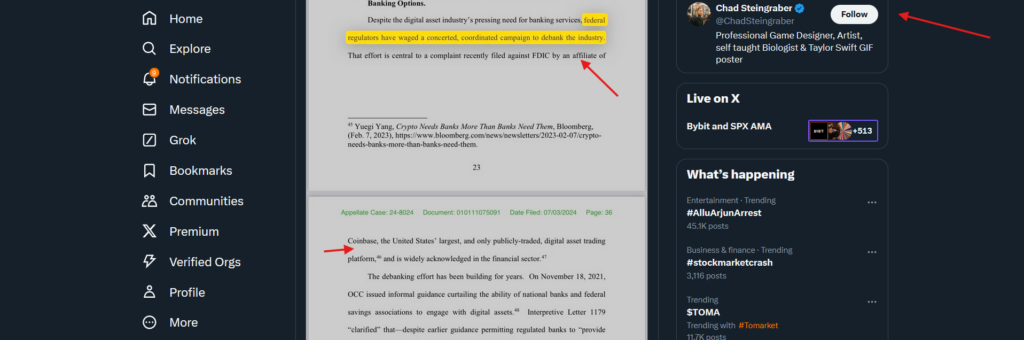
This has shown instances where federal agencies pressured banks to restrict access to certain crypto companies. These revelations have reinforced long-held suspicions within the crypto industry about a coordinated effort to suppress digital asset firms.
Coinbase and other crypto firms have pursued legal action to compel federal agencies to disclose their practices. These efforts come amid a broader industry push for fairer regulatory treatment.
Federal agency shakeups started in the wake of Trump’s victory
The Coinbase lawsuit, also interpreted as a FOIA case, could mark a pivotal moment for transparency. It may pave the way for greater regulatory accountability.
Adding to this shifting landscape, Trump’s recent electoral victory in November has already begun reshaping cryptocurrency regulation expectations. With a more crypto-friendly administration poised to take office, significant changes could be on the horizon.
FDIC Chair Martin Gruenberg and SEC Chair Gary Gensler have stepped down, both seen as regulatory hardliners. Gensler’s replacement, pro-crypto advocate Paul Atkin, has sparked optimism within the industry.
Trump has appointed David Sacks as his “White House AI and Crypto Czar.” That underscores the administration’s focus on fostering innovation in emerging technologies.
Likewise, speculation is growing around Brian Quintenz as a potential candidate to lead the CFTC. These developments hint at a more favorable regulatory environment for the crypto sector under the incoming administration.
Grewal expressed cautious optimism about the incoming administration’s approach. “We’re seeing nominees with a more balanced view of crypto. Nobody is in favor of unregulated crypto—certainly, Coinbase isn’t—but protecting consumers must be balanced against promoting American innovation.”
Paul Grewal is preparing to seek a court order compelling the FDIC to remove its redactions fully. The unredacted documents could expose the names of banks and financial services that regulators allegedly targeted.
The FDIC’s Role Amid Crypto Market Debates
FDIC was established to ensure the banking system’s stability and protect depositors’ savings, even if their banks failed. This safety net was designed to build trust in the financial system and prevent people from losing money during crises.
However, accusations from Coinbase and others regarding regulators’ regulators’ suppression of crypto markets have sparked widespread concern. Trump’s team believes a more lenient regulatory environment could pave the way for the U.S. to become a global leader in decentralized finance.
On the other hand, eliminating the FDIC or reducing its role could have significant repercussions for traditional banks. Pro-regulation advocates warn that without the FDIC, banks could face increased risks. That could lead to financial instability and eroding public confidence.
Consumers might also find themselves more vulnerable to fraud and financial losses without robust protections. Conversely, pro-crypto supporters view such changes as an opportunity to promote Bitcoin adoption and blockchain innovation.
They argue that reducing regulatory barriers could attract global investors to the U.S. This also aligns with Trump’s vision to bolster American competitiveness and innovation on the global stage.
FDIC Released: Quarterly Banking Profile – Third Quarter 2024
In his press release, the FDIC Chair mentioned that the banking industry has faced downside risks.
“The banking industry continued to show resilience in the third quarter. Net interest income and the net interest margin increased substantially this quarter. Asset quality metrics remained generally favorable despite continued weakness in several loan portfolios, which we are monitoring closely. The banking industry still faces significant downside risks from the continued effects of inflation, volatility in market interest rates, and geopolitical uncertainty.
- FDIC Chairman Martin J. Gruenberg
The Q3 of the 2024 Quarterly Banking Profile highlighted mixed outcomes for the banking sector. On the positive side, community banks saw an increase in net income. With this, domestic deposits grew, and the Deposit Insurance Fund balance improved.
However, broader institutional and business prospects presented a less favorable picture. The total number of FDIC-insured institutions declined during the quarter due to closures and mergers.
This trend is attributed to reduced operational performance and waning interest from larger entities. That became more pronounced this year.
Notably, net income for the 4,517 FDIC-insured commercial banks and savings institutions decreased during the third quarter. Per the report, this decline was due to the absence of one-time gains from equity security transactions recorded in the previous quarter.
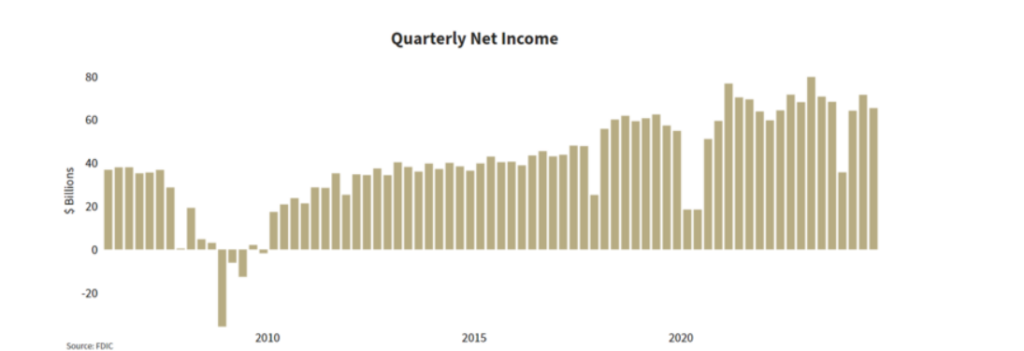
The press release hinted toward a most probable theory that many institutions and firms have shifted focus toward cryptocurrencies. That has caused a ripple effect on traditional banking metrics tracked by the FDIC.
Coinbase’s legal actions include the alleged suppression of crypto markets and insufficient banking support for crypto firms. These allegations have added to the turbulence. This evolving dynamic underscores a growing divide between traditional banking and the rapidly expanding crypto indus
Disclaimer
In this article, the views, and opinions stated by the author, or any people named are for informational purposes only, and they don’t establish the investment, financial, or any other advice. Trading or investing in cryptocurrency assets comes with a risk of financial loss.