
 Quack AI
 NEAR Protocol
 Pudgy Penguins
 Pearl
Pearl Quant
Quant Quantus
 Sui
Sui
- Increasing corporate and government crypto adoption reflects a broader bullish market trend, with Bitcoin potentially reaching $180,000 by 2025.
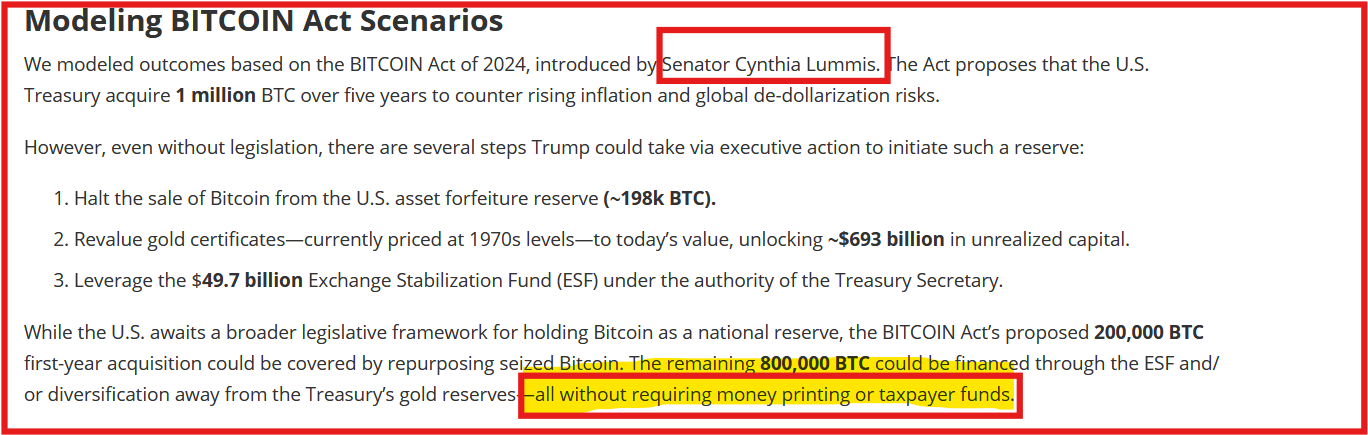
- This report aligns with Senator Cynthia Lummis’s push for the U.S. to acquire 1 million Bitcoins to secure long-term economic stability.
- Additionally, the growing influence of the BRICS nations could further drive Bitcoin’s role as a global currency, boosting its value and usage.
Many experts have already long viewed Bitcoin as a hedge against inflation, but recent reports have added more value to the cryptocurrency. Recently, a report was published by VanEck. This suggests that the Bitcoin Reserve could also provide a solution to a pressing issue for the US debt.
While seen on charts, it is clear that much of Bitcoin’s recent growth can be attributed to discussions surrounding a potential Bitcoin reserve under a future Trump administration. This has helped fuel its price surge to over $100,000.
Continue reading to understand what VanEck report says, and Could Bitcoin (BTC USD) be the answer to the U.S.’s growing debt problem?
Strategic Bitcoin Reserve to Offset U.S. Debt
The firm recently projected that the United States could substantially reduce its US debt by adopting a Strategic Bitcoin Reserve (SBR). This vision aligns closely with Senator Cynthia Lummins’s Bitcoin Act. The act proposes that the U.S. accumulate 1 million bitcoins over the next five years.
Meanwhile, Senator Lummis has already proposed the Bitcoin Reserve bill. It is yet to be reviewed by Congress. The bill suggests that the U.S. could repurpose Bitcoin seized from criminal activities as a strategic asset. Additionally, Lummis believes such a reserve could provide future generations with a more stable financial foundation.
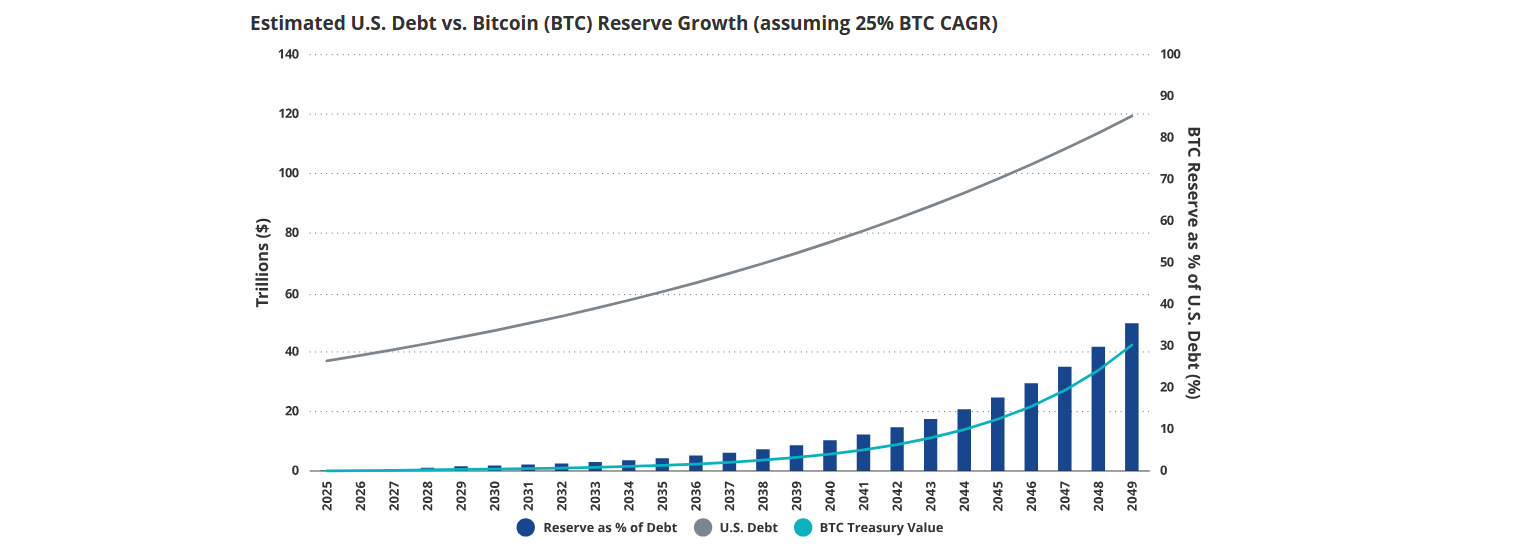
Moreover, VanEck’s analysis further suggests that if the US debt continues to grow at an annual rate of 5% while Bitcoin appreciates at 25% per year, then, the US debt could lower by around $42 Trillion by 2049. By that time, Bitcoin’s market value could exceed $42 Trillion, becoming a dominant force in the global financial system.
Similarly, Mathew Sigel, head of research at VanEck, has highlighted Bitcoin’s potential to fundamentally alter the global financial system. He suggested that it could emerge as the primary settlement currency for international trade.
Likewise, this would offer an alternative to the U.S. dollar, particularly for countries facing U.S. sanctions, including those in the BRICS alliance. They are already actively working to bypass U.S. sanctions and reduce dependence on the dollar.
‘Clearly, the BRICS countries are positioning Bitcoin as a critical component in their broader strategy to de-dollarize and enhance economic resilience.’ The VanEck report noted.
Beyond the BRICS nations, other countries and cities are also accelerating Bitcoin adoption, underscoring its increasing role as both a reserve asset and a tool for financial innovation. Nations like the UK, Poland, Japan, and France, among others, are embracing Bitcoin as a viable part of their economic strategies.
Why VanEck Doesn’t Want the US to Sell Ceased Bitcoins
As the adoption rate rose, many countries fastened their seatbelts and went straight for Bitcoin. VanEck has advised that the U.S. must stop selling seized Bitcoins. Instead, the firm boldly recommends that the incoming Trump administration must revise its policies.
Specifically, VanEck suggests revaluing gold certificates and utilizing the Foreign Exchange Stabilization Fund (ESF) to acquire Bitcoin. The firm has even modeled how Bitcoin purchases could be financed through the ESF or by diversifying away from the Treasury’s gold reserves. ‘That too, without the need for money printing or taxpayer funds.’
This approach would accelerate the U.S.’s goal of accumulating 1 million bitcoins over the next five years, making the process smoother and more efficient.
These actions could swiftly set up the Bitcoin reserve, bypassing the need for lengthy legislative processes. Experts suggest that designating Bitcoin as a strategic asset could bring significant long-term economic advantages. This approach offers a viable solution for managing national debt in a sustainable way through the use of digital assets.
Public Companies Hold Bitcoin on their Balance Sheets to Advance in 2025
As the charts show, Bitcoin has made history this month by surpassing $100k on December 5th, reaching a peak of $108k. The final two months of Q4 2024 have shown impressive gains for BTC.
According to VanEck, the rally’s momentum is driven by Bitcoin’s increasing adoption as a key institutional reserve asset.
This month, corporate and sovereign entities made unprecedented moves to integrate Bitcoin. A landmark event occurred when the Nasdaq-100 added MicroStrategy, the world’s largest corporate Bitcoin holder, to its index.
These kinds of structural changes in Bitcoin’s market are expected to accelerate the long-running trend of corporations and governments accumulating Bitcoin.
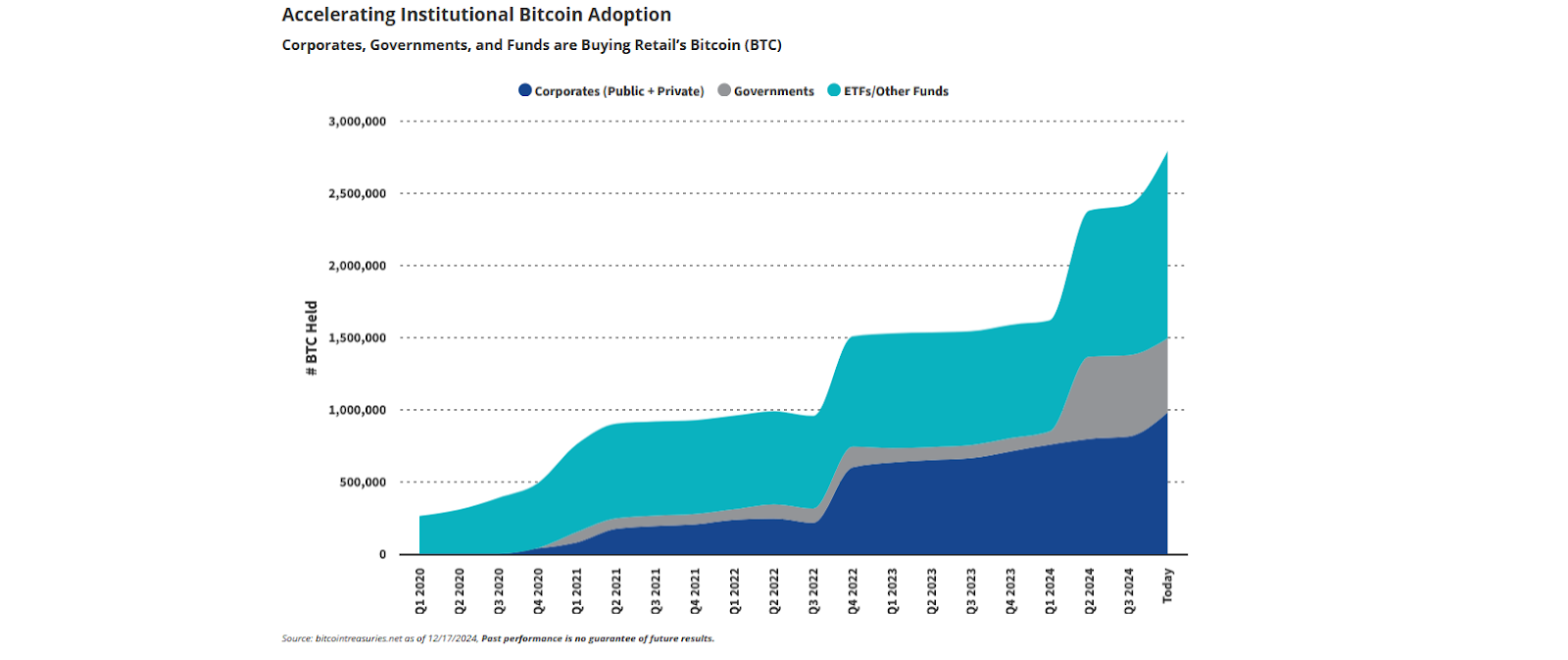
The report also highlights that between Q4 2022 and Q4 2024, corporations accumulated approximately 162,000 BTC. Meanwhile, in the same period, the governments added around 377,000 BTC, and ETFs and investment funds increased their holdings by roughly 329,000 BTC.
Furthermore, the report mentioned that, as of December 17th, only 69 public companies hold Bitcoin on their balance sheets. By 2025, VanEck is expecting to exceed 100 public companies that will hold Bitcoin on their balance sheets.
Notably, on December 9th, Jetking Infotrain became the first publicly traded company to add Bitcoin to its balance sheet. Meanwhile, industry leaders like MicroStrategy, Marathon, and Riot are aggressively accumulating Bitcoin.
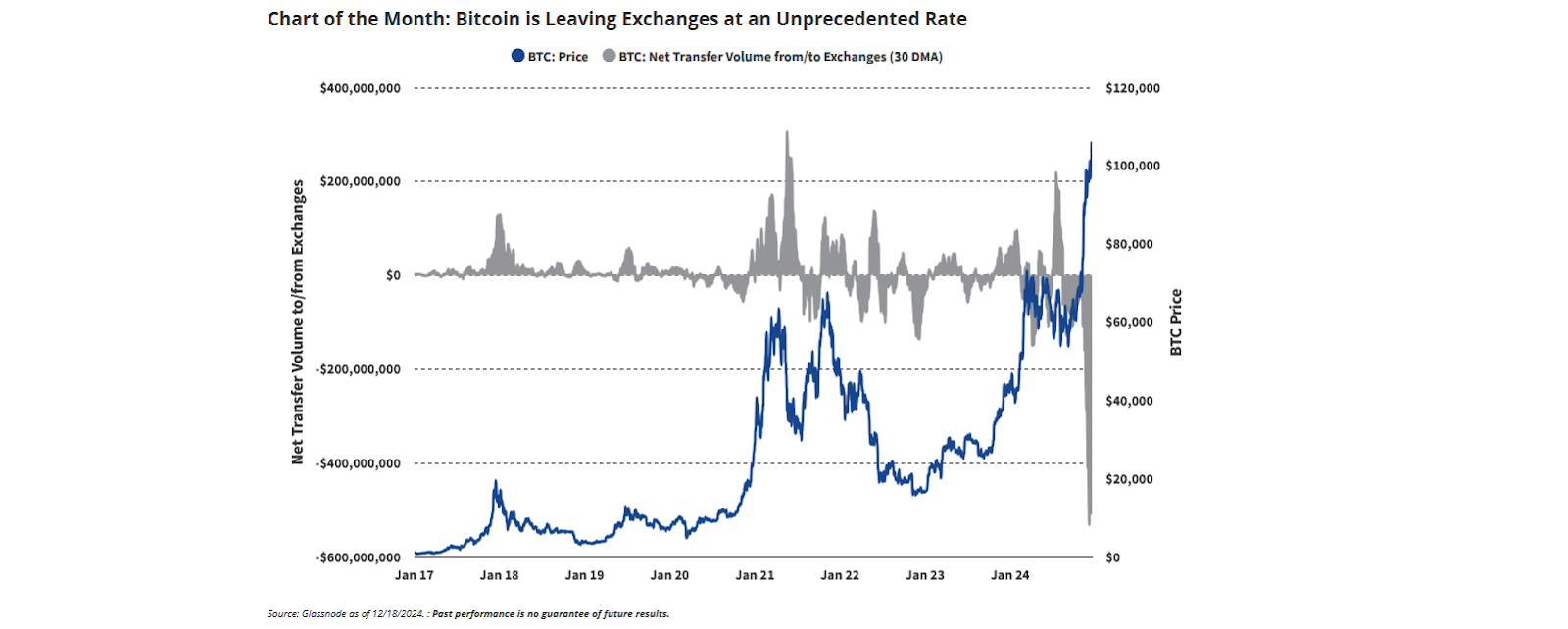
Additionally, VanEck also noted that Bitcoin is being withdrawn from exchanges at an extraordinary pace, signaling increased accumulation. Despite recent fluctuations, with Bitcoin dipping below the $100K mark, VanEck remains optimistic about its long-term prospects.
The report outlined expectations of multiple 20% retracements and potentially a 40% drawdown en route to their $180K price target.
VanEck Says Altcoin Season Began Last Month
VanEck also pointed out that, based on their analysis, the altcoin season began as early as November 27th. They shared a chart illustrating that not only has Bitcoin experienced price growth due to new capital, but the entire cryptocurrency market has entered a bullish phase.
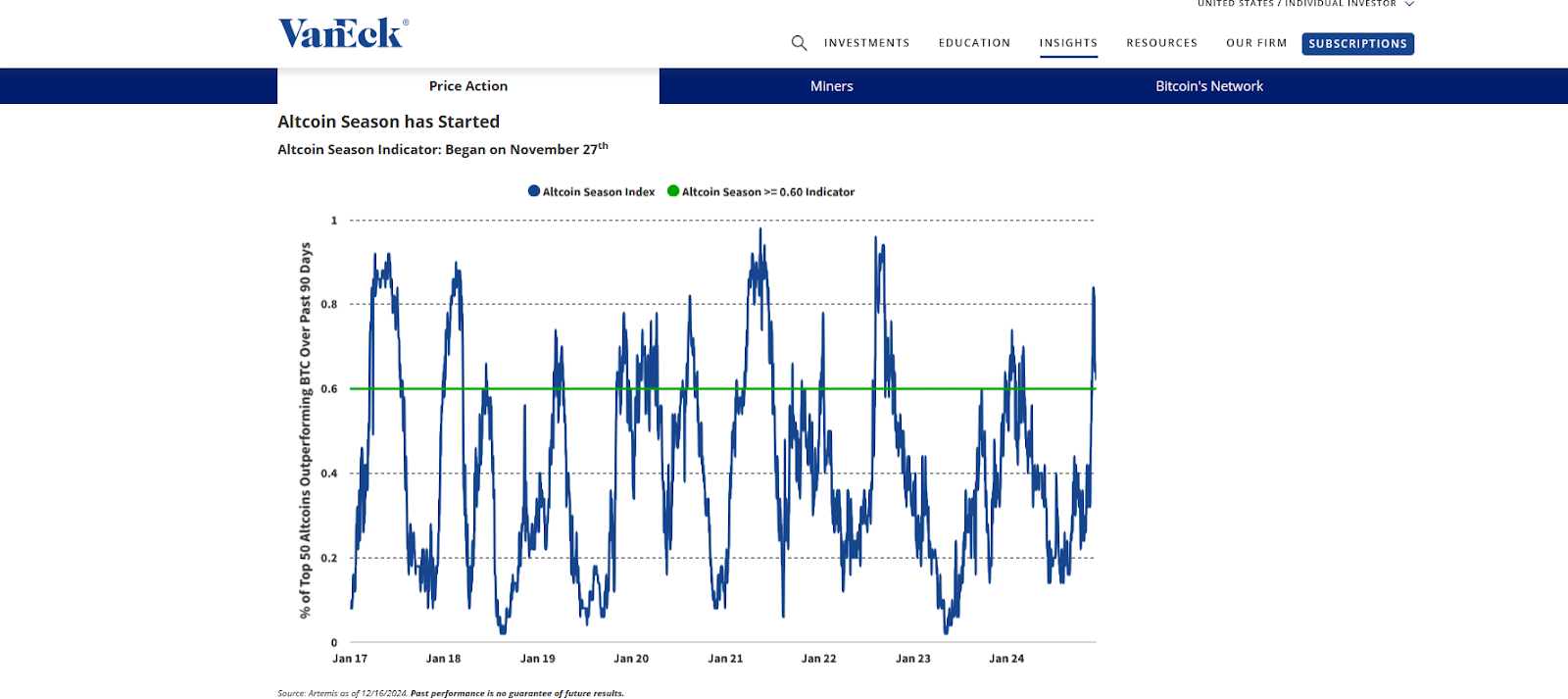
The chart specifically highlights how many of the top 50 altcoins, by market capitalization, have outperformed Bitcoin over the past 90 days. When more than 60% of these altcoins surpass Bitcoin’s performance, it signals the onset of an “alt season”.
Disclaimer
In this article, the views, and opinions stated by the author, or any people named are for informational purposes only, and they don’t establish the investment, financial, or any other advice. Trading or investing in cryptocurrency assets comes with a risk of financial loss.