Zerebro
 Bitcoin
 Pudgy Penguins
 NEAR Protocol
 Quantus
 Pearl
Pearl ZKsync

- Crypto liquidity remains tight, forcing projects to launch at elevated valuations to prevent losses.
- Institutional investors and VCs are hedging against token drops, increasing selling pressure post-listing.
- Many venture funds may dissolve by 2026 due to poor returns and challenges in securing new capital.
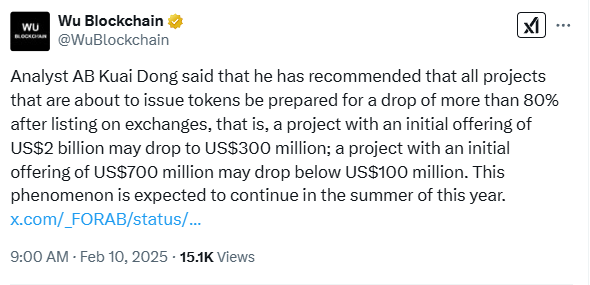
Digital asset launches are expected to see significant price declines following exchange listings, with many projects projected to drop over 80% from their initial valuations.
Market analyst AB Kuai Dong has indicated that liquidity across the crypto industry remains constrained, apart from Bitcoin.
The trend is expected to persist into the summer, affecting projects with high initial market valuations.
Liquidity Shortage and High Market Valuations
The industry’s liquidity conditions are increasingly resembling the pre-pandemic period, with tightening financial conditions impacting token performance.
Unlike 2019, the pressure on new token issuances is greater due to a high volume of projects waiting for market entry.
Many of these projects were valued at elevated levels in previous funding rounds, making it necessary to launch at prices above cost to prevent early investors and community members from selling at a loss.
In response, major exchanges, including BN, Bybit, and BG, are expected to introduce platform token initial public offerings (IPOs).
These platforms determine opening prices by back-calculating expected annualized returns, typically targeting over 40% annualized income and 1-2% single-event returns.
To meet these targets, platforms favor high-market-cap projects or offer greater token allocations for subscription.
Impact on Venture Capital-Backed Tokens
Venture capital-backed tokens are expected to undergo continued market corrections. Per Kuai Dong, analysts advised project teams to anticipate major price declines upon listing, with projects valued at $2 Billion potentially falling to $300 Million and those at $700 million dropping below $100 Million.
Smaller projects with valuations under $100 Million and limited public token sales may experience less selling pressure.
Market conditions suggest that selling pressure originates not only from retail investors but also from institutional participants, node buyers, and shareholders engaging in short selling.
These investors hedge against potential future losses when tokens unlock, ensuring minimal exposure to falling prices.
The persistent downtrend in altcoins contrasts with Bitcoin’s elevated market position, reflecting ongoing volatility in secondary markets.
Venture Capital Funds Facing Structural Shifts
Venture capital remains active in the crypto space, yet its funding dynamics have changed significantly.
Before the pandemic, investments were largely self-financed by fund managers or sourced from mining profits. This period saw limited financial flexibility, with investment managers receiving modest salaries.
Pandemic-driven capital inflows during 2020 and 2021 led to an expansion in fund management practices, driving significant salary increases for investment professionals.
However, the current market environment suggests this trend may reverse by late 2025 or 2026 as five-year funds reach expiration.
Many venture funds are expected to dissolve due to poor investment returns and challenges in securing additional capital. As a result, job cuts and salary reductions for investment managers appear likely.
Disclaimer
The details in this article are for informational purposes. It does not constitute financial or investment advice. Investing in crypto assets carries the risk of financial loss. The data on this page are subject to change without notice.