
 no crying in the casino
 Pyth Network
 NEAR Protocol
 Starknet
 Quantus
 Pearl
Pearl Bitcoin

Key Insights:
- Ethereum price dropped below its realized price, signaling investor losses and increased market fear.
- Analysts noted current sentiment mirrors 2020’s depression phase, suggesting a potential bottom.
- Market uncertainty deepened following Trump’s tariffs, with crypto benchmarks showing weakness.
Ethereum’s price trajectory has taken a sharp turn following a broader crypto market pullback driven by newly imposed tariffs from U.S. President Donald Trump. The price of Ethereum (ETH) had shown signs of momentum earlier in the month, briefly trading above $1,900 around April 1, 2025.
However, by April 7, the digital asset experienced a steep drop, plunging to approximately $1,400 — a decline that has stirred significant market attention. As of today, ETH traded at $1,571.51, reflecting a 3.59% rise in the past 24 hours but a 15.59% decline over the last week.
The fluctuations coincide with growing uncertainty across global markets, which have shown little sign of stability in recent days. Ethereum’s performance has particularly caught the eye of on-chain analysts and market observers, who are closely tracking its alignment with historical patterns.
Ethereum Price Drops Below Realized Value
According to CryptoQuant, Ethereum’s price has now slipped below its Realized Price, a key metric often used to evaluate market trends. The Realized Price represents the average cost at which all circulating ETH last changed hands on-chain. This indicator recalculates Ethereum’s value by factoring in the last transfer price of each coin on the blockchain, offering a more grounded measure of what holders actually paid.
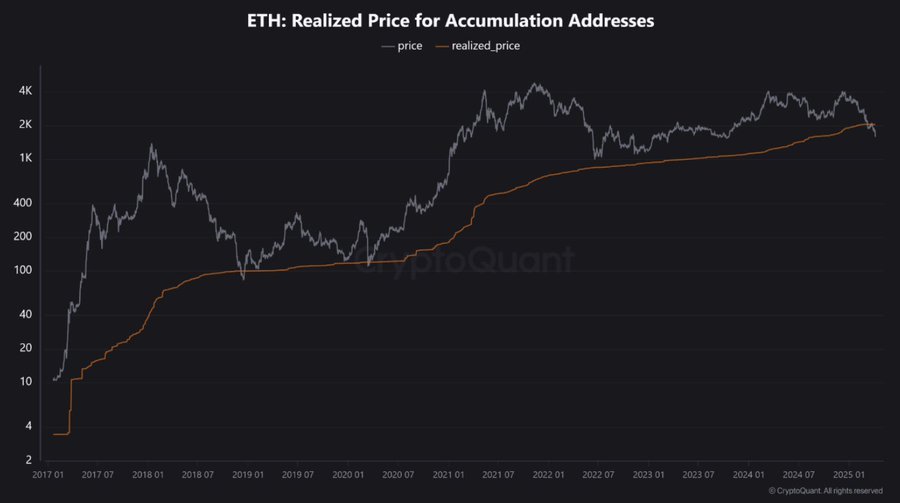
Notably, when ETH trades beneath this metric, it often reflects heightened levels of investor stress. The market tends to react with a wave of sell-offs as holders find themselves in unrealized losses. Analysts highlight that during such moments of fear, panic-driven selling may become more prevalent, further accelerating downward price pressure.
Historically, Ethereum falling below its Realized Price has also aligned with critical market phases. CryptoQuant data suggests that such dips often mark the late stages of prolonged downtrends. These zones have previously acted as springboards for eventual recoveries, though current sentiment suggests traders are treading cautiously.
Market Psychology and Historical Comparisons
Meanwhile, analysts have drawn parallels between the present conditions and previous cycles of Ethereum’s market behavior. CryptoYoddha, a well-followed crypto market analyst, described the current sentiment as one of “depression,” a level only seen once before in 2020.
At that time, Ethereum traded near $130, yet it went on to reach its all-time high of $4,800 in a matter of months.
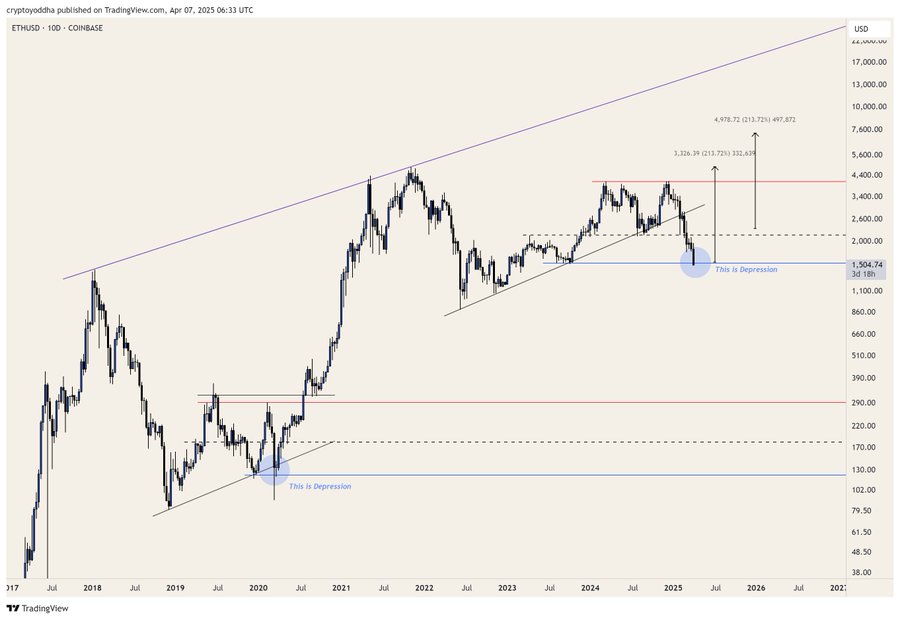
Despite recent losses, CryptoYoddha maintains that ETH could rebound to a range of $5,000 to $7,000 in the coming months. However, he emphasizes that traders are not expecting immediate surges and are instead adjusting their outlooks with more moderate targets in mind.
The analyst also noted that Ethereum’s current setup on the chart signals a bottom may have formed, although market participants await stronger confirmations before resuming confidence.
Elsewhere, the presence of psychological price thresholds has introduced new complexities. Realized Price has typically served as a level of support when the asset remains above it. However, once price falls below this line, it begins to act as resistance — potentially making recovery more challenging.
Diverging Forecasts Raise More Questions
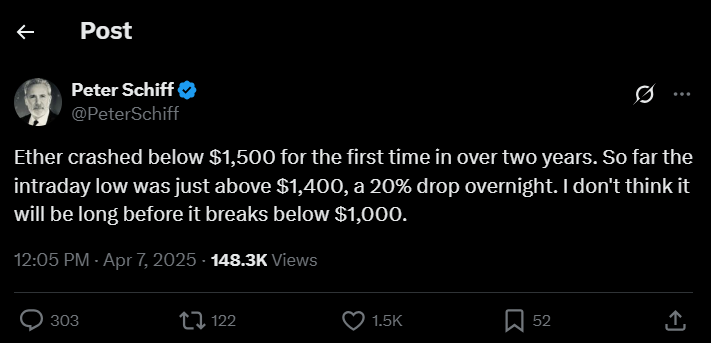
As Ethereum navigates this volatile zone, broader sentiment remains mixed. Long-time crypto critic Peter Schiff shared a bearish view, noting Ethereum’s failure to hold prior support zones. He pointed to the June 2022 dip — where ETH nearly fell below $1,000 — and warned that the current structure lacks strength.
Ongoing tariff policies under President Trump have further rattled global markets, adding pressure to already fragile recovery efforts. Ethereum’s outlook remains uncertain, caught between macro volatility and hesitant on-chain signals.
Broader crypto weakness, in tokens like Solana and Cardano, also mirrors Ethereum’s fragility. As investors try to decipher the impact of Trump’s trade policy, markets remain vulnerable to further dips.
Ultimately, macroeconomic policy and technical breakdowns have created a feedback loop — one that’s driven short-term panic and delayed long-term conviction across Ethereum and the broader crypto market.
Disclaimer
This article is for informational purposes only and provides no financial, investment, or other advice. The author or any people mentioned in this article are not responsible for any financial loss that may occur from investing in or trading. Please do your research before making any financial decisions.



