Bitcoin
 Pearl
Pearl Starknet
 Zerebro
 NEAR Protocol
 Solana
 Quantus

Key Insights:
- Congress introduces principles for precise digital asset regulation.
- Senators push for a tailored regulatory framework for digital assets.
- New bill aims to balance consumer protection with innovation.
Senator Cynthia Lummis confirmed that Congress is pushing ahead with digital asset regulation. New legislation aims to bring clarity to the U.S. crypto market.
In a recent hearing, Lummis and fellow senators outlined key principles. These could form the basis of a whole market structure for digital assets.
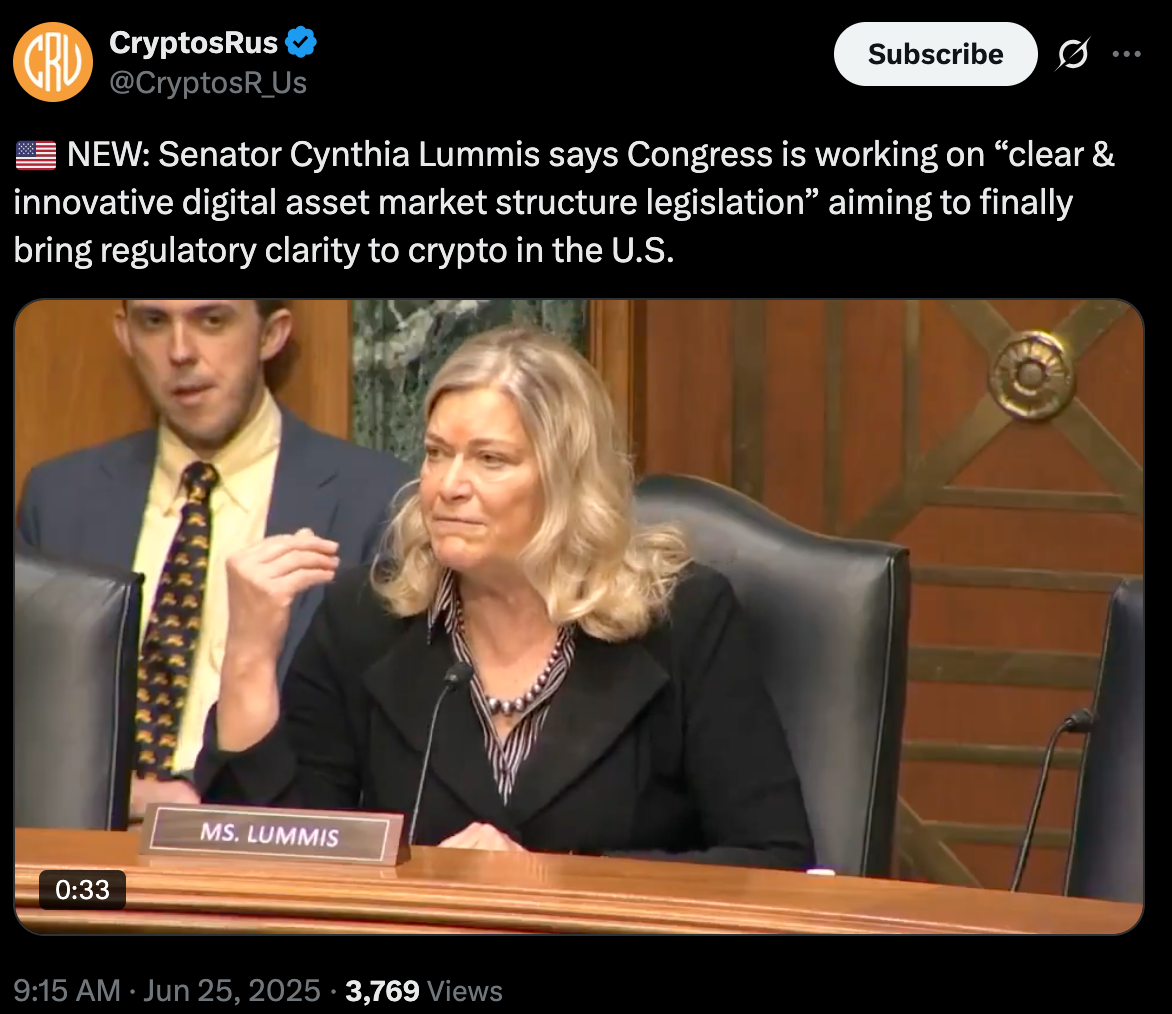
The goal is to clear up regulatory uncertainty in the crypto space. Many in the industry are unsure about current compliance standards. This move aims to provide clarity for future developments.
Bipartisan Effort to Define Digital Asset Regulation
Lummis acknowledged the recent passage of the GENIUS Act. She described this as a significant step in digital asset regulation. The Act marks a pivotal moment in the legislative journey, following months of negotiation.
Lummis, Senators Hagerty, Chairman Scott, and Senator Gillibrand pushed the bill forward. Despite the challenges, Lummis praised the bipartisan approach to finalize the legislation. She noted that such cooperation is essential to maintain momentum.
The committee is now focusing on the next crucial step: developing clear guidelines and principles for market structure legislation. These guidelines, released by Lummis and her colleagues, outline key priorities for future legislation.
Notably, one of the main objectives is to define the legal status of digital assets. This includes distinguishing between assets considered securities and those considered commodities.
The lack of clarity on this front has long frustrated industry stakeholders. They have struggled to identify which regulator holds authority over their operations.
Establishing Clear Jurisdictions
A significant component of the legislation is the allocation of regulatory jurisdiction. The senators argue that digital assets and distributed ledger technology should not be regulated similarly.
The diverse nature of digital assets and their varying risks requires a more tailored approach. Senators have asked industry experts to guide crypto regulation. Their insights will help shape a framework that tackles the sector’s unique challenges.
Another priority is modernizing regulations to keep pace with innovation in the digital asset space. Senators highlighted the need to create a new securities registration pathway for digital asset fundraising.
This would allow regulations to evolve alongside technological advancements while maintaining investor safeguards. Existing custody and record-keeping rules must be revised.
These updates should account for distributed ledger technology’s improved transparency and efficiency.
Meanwhile, consumer protection remains a central focus of the proposed legislation. Senators believe digital asset exchanges should meet the same regulatory standards as traditional financial intermediaries. This ensures consistency and accountability across the financial system.
Furthermore, provisions ensuring consumer priority in bankruptcy proceedings are also under consideration. This would provide greater security for digital asset investors. It ensures they are treated equitably in the event of financial difficulties.
Promoting Responsible Innovation
Lummis also addressed concerns related to illicit finance, which has become a growing issue in the digital asset space. The legislation seeks to introduce targeted measures to combat illegal activities without stifling innovation.
This approach involves establishing digital asset examination standards and exploring how distributed ledger technology can assist law enforcement agencies in preventing illicit activities.
Additionally, the senators are focused on encouraging responsible innovation. They argue that financial regulators should create an environment where new technologies can flourish.
This could include no-action letters, regulatory sandboxes, and improved coordination among regulatory bodies. The goal is to balance regulation and innovation, ensuring that new technologies can evolve without facing undue legal hurdles.
Senator Scott echoed Lummis’s sentiment. Scott emphasized that digital asset legislation is necessary to maintain America’s leadership in the global financial landscape.
Countries like the EU and Singapore have already set clear crypto regulations. The U.S., by contrast, has fallen behind, causing uncertainty for businesses and developers.
Having these new principles, Scott is optimistic that the U.S. can bring a regulatory environment that favors growth. However, at the same time, it safeguards the consumer.
Senators Tillis and Hagerty also recognized that they support the new framework. Tillis emphasised the need for legal clarity without hindering innovation.
Hagerty emphasized the need for the U.S. to boost its global competitiveness. He supports creating a regulatory framework that encourages digital asset innovation. At the same time, it must ensure strong consumer protection.
Disclaimer
This article is for informational purposes only and provides no financial, investment, or other advice. The author or any people mentioned in this article are not responsible for any financial loss that may occur from investing in or trading. Please do your research before making any financial decisions.