streamoors
 IGNITION
 NEAR Protocol
 Injective
 Pearl
Pearl LayerZero
 Quantus

Key Insights:
- RBA will test 24 use cases involving wholesale CBDCs, stablecoins, and tokenized bank deposits.
- ASIC grants regulatory relief to enable testing of digital assets beyond current legal frameworks.
- Hedera forms strong bullish setup as Acacia includes it among trial DLT platforms.
Australia is advancing its wholesale central bank digital currency (CBDC) plans through phase two of Project Acacia. The Reserve Bank of Australia (RBA) confirmed it will pilot real-world settlement use cases involving tokenized assets and programmable money.
The six-month test includes contributions from major banks, fintechs, and global finance players. The goal is to evaluate the benefits of blockchain-based infrastructure in financial markets, settlement layers, and cross-asset interoperability.
Project Acacia Launches 24-Use-Case Trial Phase
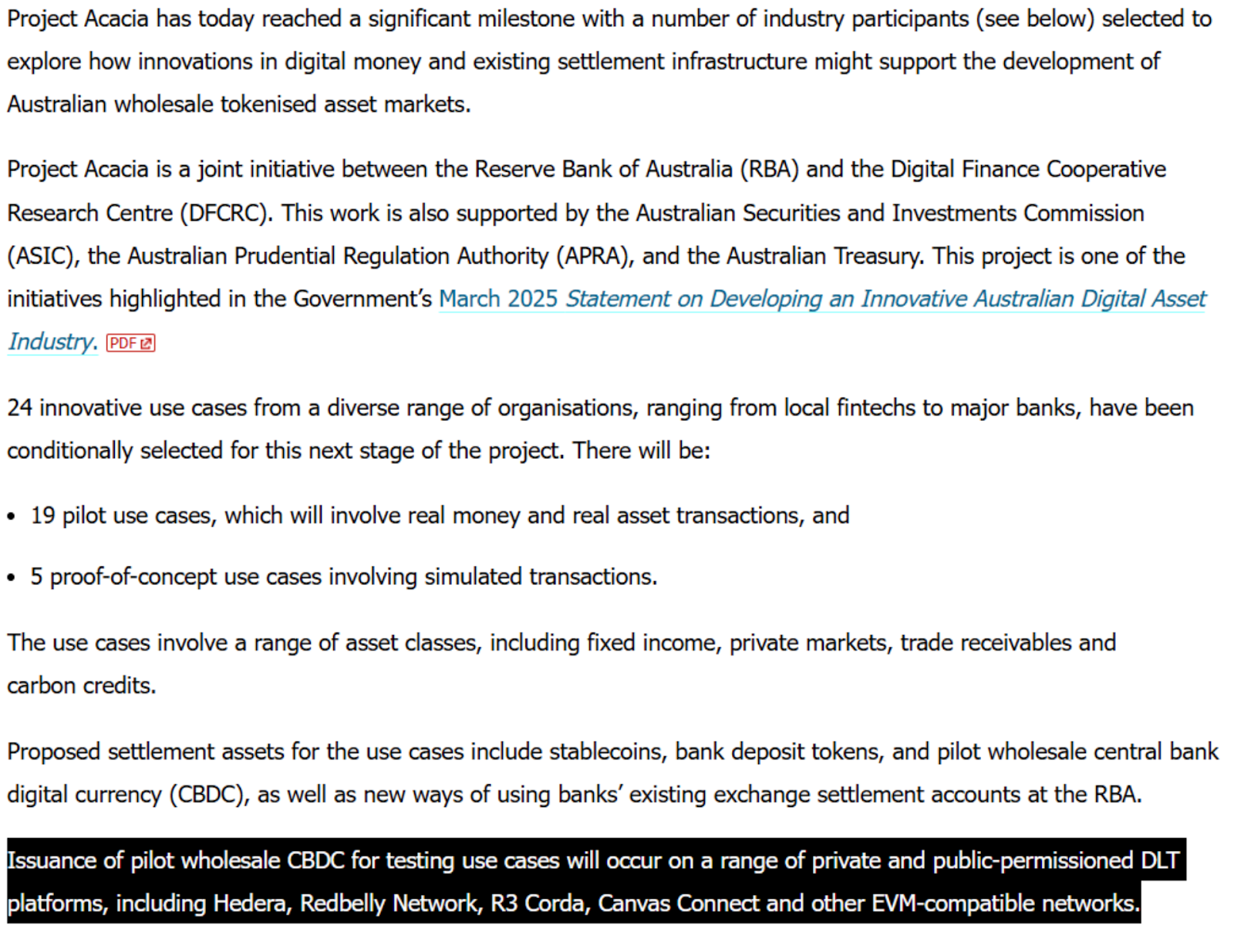
The Reserve Bank of Australia (RBA) announced Thursday it will trial 24 selected use cases in the next phase of Project Acacia. The initiative, launched in partnership with the Digital Finance Cooperative Research Centre (DFCRC), targets the wholesale market through tokenized asset settlement.
The official statement confirms that the pilot includes 19 live transactions and 5 proof-of-concept setups. These will test various digital settlement forms, including a wholesale central bank digital currency (CBDC), stablecoins, and deposit tokens.
Participants include major financial institutions and fintech startups across Australia. Commonwealth Bank of Australia (CBA), Australia and New Zealand Banking Group (ANZ), and Westpac Banking Corporation are among them.
CBA will work with JPMorgan to assess CBDCs and digital collateral in repo market efficiency and liquidity. The firm believes the repo market presents an ideal testing ground due to its role in monetary policy.
ANZ will lead a tokenized trade payables trial addressing working capital challenges for suppliers. It will also test a tokenized fixed-income solution to evaluate CBDC’s ability to enable risk-free settlement.
Westpac and other participants will explore digital money usage across private markets, carbon credits, fixed income, and trade receivables. Each case aims to evaluate how new payment layers interact with tokenized assets in real-time environments.
Regulatory Relief Enables Broader Testing Framework
The Australian Securities and Investments Commission (ASIC) has issued temporary regulatory relief to support this pilot. This move allows participants to trial digital assets not currently permitted under existing Australian financial laws.
In a statement, ASIC Commissioner Kate O’Rourke said the relief will help test the underlying technologies sensibly. It will also ensure emerging risks and opportunities in the wholesale digital asset space are properly identified.
This relief provides a vital bridge between legacy regulatory frameworks and blockchain-enabled asset innovation. By removing legal roadblocks temporarily, the RBA can better understand CBDC application in regulated institutions.
The trials will run over six months, ending in early 2026. According to the RBA, this phase will result in detailed infrastructure, interoperability, and monetary use findings.
Brad Jones, the RBA’s Assistant Governor (Financial System) emphasized the collaborative opportunity. He described the pilot as a public-private effort to explore the future of tokenized asset markets and digital settlement.
The use cases will span several distributed ledger networks, including Hedera, R3 Corda, Canvas Connect, and other EVM-compatible systems. This variety allows the RBA to assess cross-platform efficiencies and performance in realistic market settings.
Hedera Breakout Aligns with Trial Participation
Hedera, one of the distributed ledger technologies selected for Project Acacia, shows strong performance in recent market activity. Its native token, HBAR, has risen more than 40% since forming a double-bottom pattern around the $0.122 level.
Additionally, the asset has just crossed a long-term downward trendline, which shows a change of direction. The current price action is approaching the next key resistance at the local $0.22 top.
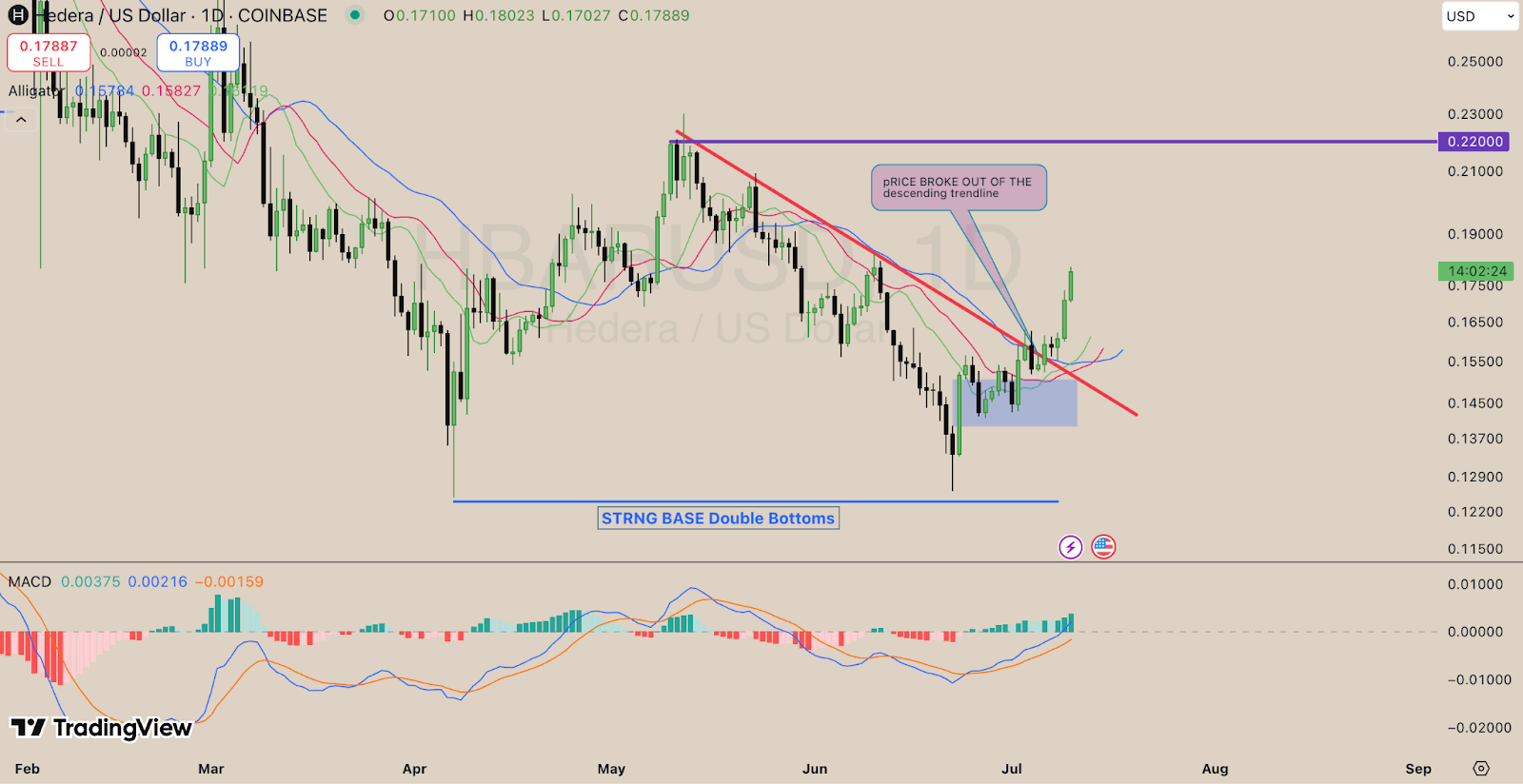
MACD and the Alligator technical indicators are positive, indicating that the bullish sentiment is still in effect. This trend lends credence to Hedera participating in the current CBDC and tokenized settlement tests in Australia.
As Project Acacia progresses, the Hedera integration into institutional testing may further increase its utility case.
Disclaimer
This article is for informational purposes only and provides no financial, investment, or other advice. The author or any people mentioned in this article are not responsible for any financial loss that may occur from investing in or trading. Please do your research before making any financial decisions.