streamoors
 IGNITION
 Quantus
 Sui
Sui Zcash
Zcash Ethereum
 Pearl
Pearl

Ethereum supply on exchanges dropped to record lows as short positions increased.
With a new spotlight on the market, the spot Ethereum ETFs saw heavy outflows, and futures market data showed sellers applying pressure.
Notably, this has brought about speculation over whether the price of Ethereum can sustain a rebound.
Ethereum Exchange Supply Drops to Record Levels
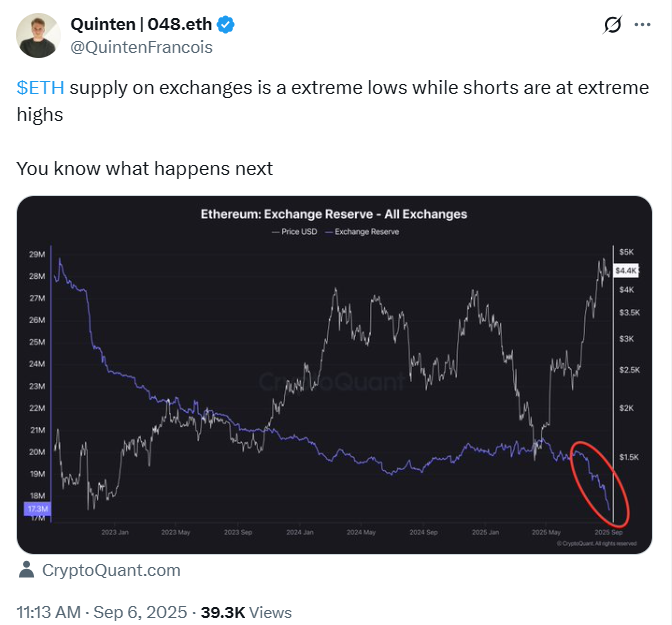
It is worth noting that Ethereum supply on exchanges fell to extreme lows earlier this month.
Data shared by analyst Quinten showed that available ETH on trading platforms had dropped at the same time that short positions reached extreme highs.
Traders noted that this type of market set-up often comes before major price moves. Alongside the drop in supply, long-term holders began to show signs of new activities.
One participant from Ethereum’s initial coin offering, who had been inactive for eight years, staked 150,000 ETH valued at about $656 million.
This investor had originally received 300,000 ETH for only $93,300 at the launch of the network.
The price of Ethereum almost crossed the $5,000 mark in late August. It reached an all-time high of $4,955 on August 24 but could not move higher.
Since then, the price has traded between $4,209 and $4,797. At the time of writing, the Ethereum price was pegged at $4,295, down 2.58% in the past 24 hours.
Market analysts also pointed to futures activity as a sign of pressure.
According to crypto analysts, including Maartunn, sellers were more aggressive than buyers, with $570 million more in net taker volume.
However, it is worth noting that in the past, such levels of selloff often appeared close to local tops.
Traders Shift from Ethereum to Bitcoin
Signs of rotation between the two largest cryptocurrencies appeared in the derivatives market.
Whale address 0xa523 closed all of its long positions in Ethereum. The move resulted in losses of more than $36 million.
Soon after, the same address opened a short position on Bitcoin. The trader used 25x leverage on 1,107 BTC worth $122.4 million.
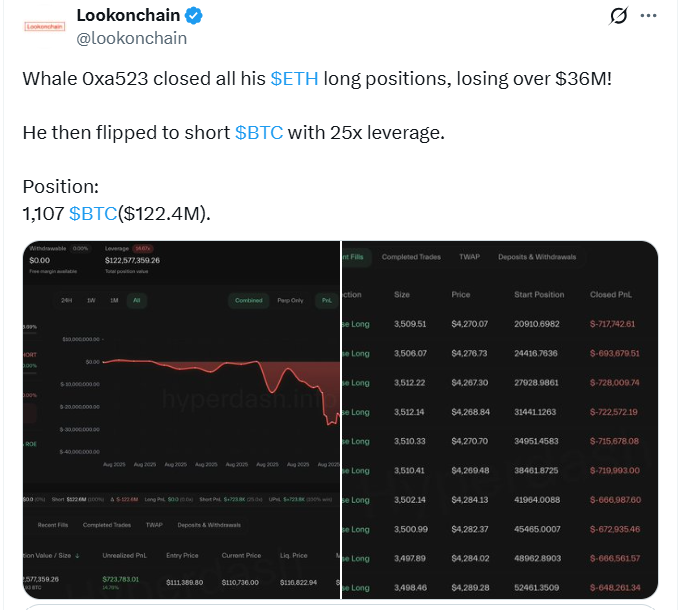
This type of rotation suggested that some traders preferred Bitcoin over Ethereum in the short term.
While exchange supply for ETH fell, open interest on the Chicago Mercantile Exchange increased.
Analysts said this showed more traditional finance involvement. They added that this activity might not be fully directional, as some could have been linked to arbitrage strategies.
The shift highlighted how closely Ethereum and Bitcoin trading remained connected.
Large moves in one asset often influenced the other, and leveraged trades increased the size of such impacts.
Spot Ethereum ETF Outflows Add Pressure
Ethereum faced another challenge from the exchange-traded fund market. On September 5, spot Ethereum ETFs recorded net outflows of $447 million.
Wu Blockchain reported that this was the second-largest outflow on record.
On the same day, Bitcoin ETFs also recorded outflows, totalling $160 million, with no inflows across the twelve listed funds.
Glassnode data showed that more than half of Ethereum ETF inflows in recent months matched increases in CME open interest.
This suggested that much of the activity came from institutions who might have been using ETFs in combination with futures.
Some analysts noted that the recent activity may be more about hedging or arbitrage than direct exposure.
With exchange supply at record lows, ETF outflows at historic highs, and strong selling in futures markets, the short-term outlook for Ethereum is still unclear.
A rebound is possible given the low supply, but the heavy selling and investors shifting elsewhere make it uncertain how soon Ethereum could move back toward the $5,000 level.