Bitcoin
 Solana
 Pearl
Pearl Zerebro
 Aerodrome Finance
 LayerZero
 NEAR Protocol

Robinhood stock price has been in a strong surge this year. This makes it one of the best-performing companies on the New York Stock Exchange.
HOOD stock has jumped by 266%, bringing its market capitalization to over $106 Billion. This article examines why it reached a record high this week and the key risk it now faces.
Robinhood Stock Price Soared as it Became a Polymarket Challenger
Robinhood stock price surged this week. CEO Vlad Tenev shared an update about its new prediction marketplace. The platform was recently launched to expand its offerings. Robinhood aims to grow its market share in the US and globally.
He stated that customers had transacted over 4 billion event contracts. Remarkably, 2 billion of those occurred in just the third quarter.
This makes it one of the fastest-growing companies in an industry where Polymarket has a substantial market share. Robinhood offers the service through a partnership with Kalshi.
The prediction market is part of Robinhood’s approach to diversifying its business. It’s a move that has been highly successful in the past. For example, the company started its business as merely a stockbroker in the US.
Today, Robinhood’s business is broader than that, with the options market being its most profitable one. It has also expanded to the crypto industry. There, it has become a major competitor to companies like Kraken and Coinbase.
Its cryptocurrency rose by 32% in Q2, while its two competitors stagnated. The company has also expanded globally by launching in several European markets.
It recently started offering tokenized stocks in these markets. Also, it is now working on a layer-2 solution through a partnership with Arbitrum. This Layer 2 solution will enable developers to build solutions such as decentralized exchanges (DEXs), lending protocols, and stablecoins.
A notable example of a company that has entered the industry is Coinbase, which launched the Base Protocol. However, it is not the biggest player in the sector. Coinbase is now considering the launch of the Base token, a move that could unlock billions of dollars in value.
Most recently, HOOD stock was added to the S&P 500 Index, a widely recognized benchmark of blue-chip companies. It’s a move that boosted its profile and forced the ETFs that track it to buy it.
Valuation is a Major Risk for HOOD Stock
Robinhood is recognized for its innovative approach in the brokerage industry. It often launches new solutions ahead of its competitors, such as Fidelity and Schwab.
Robinhood’s business has seen steady growth in recent years. Its revenue rose from $682 Million in Q2 ’24 to $989 Million last quarter. Its adjusted EBITDA moved from $301 Million to $549 Million.
Therefore, the company deserves a premium valuation multiple compared to its competitors, such as Fidelity and TD Ameritrade. Morgan Stanley now owns it.
However, the company’s valuation has now become too stretched, with a forward price-to-earnings ratio of 80. It is significantly higher than the sector median of 11. Its non-GAAP P/E ratio has jumped to 72, much higher than the S&P 500 Index average of 22.
Therefore, these valuation numbers indicate that the company is now valued for perfection. Additionally, a minor revenue or earnings miss will likely cause the Robinhood stock to decline significantly.
Robinhood Stock Price is Overbought
HOOD stock price also has some technical risks. Its key technical indicators, such as the RSI and Stochastic, have reached overbought levels.
This suggests the asset may be due for a pullback or consolidation. It is common for an overbought stock to retreat as investors book profits.
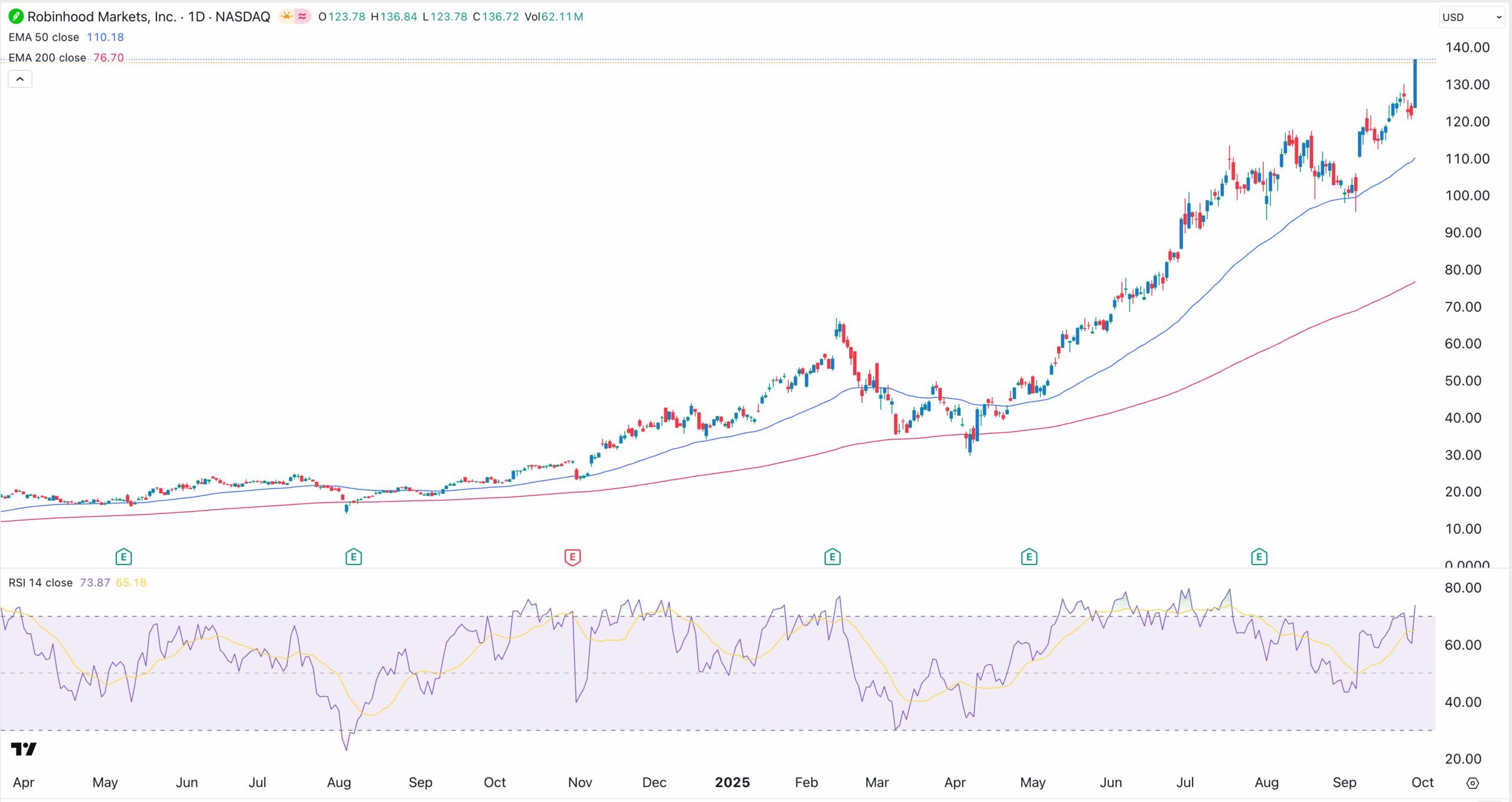
The other technical risk is that the standard deviation has increased significantly over the past few months. Robinhood stock remains well above its key moving averages.
The 50-day and 100-day EMAs are currently at $110 and $76, respectively. The risk here is that the stock may go through a mean reversion, especially if it misses its earnings.