
 Claudia
 Bunker Mode
 Pearl
Pearl Starknet
 Solana
 NEAR Protocol
 Render

Polygon’s Rio hardfork, described by developers as one of the most extensive updates to its proof-of-stake (PoS) network, goes live on mainnet today following a successful testnet run. The upgrade redefines how validators produce and verify blocks, a change Polygon Labs said will make the network faster, more efficient, and free from chain reorganizations.
The Rio upgrade, first outlined earlier this year, forms part of Polygon’s broader “gigagas” roadmap to scale performance for global payments and real-world asset transactions. According to Polygon, Rio introduces a redesigned validator rule set, stateless block verification, and new economic incentives to improve fairness across the validator ecosystem.
Polygon Rio Overhauls Block Production and Validation
At the center of Rio is a new model known as the Validator-Elected Block Producer (VEBloP). Instead of multiple validators creating blocks simultaneously, a smaller, elected pool of producers will handle block creation over longer time spans. This change, outlined in Polygon Improvement Proposal (PIP)-64, is designed to shorten block times and eliminate competing versions of the chain, commonly known as reorganisations (reorgs).
Under the new framework, validators can elect block producers and replace them if they fail, allowing uninterrupted block creation. The system aims to achieve “one-block finality,” where confirmed transactions remain irreversible.
Rio’s design also includes an updated economic model under PIP-65, which redistributes transaction fees among all validators. This replaces the older structure that favoured active block producers and ensures those running lighter hardware still receive rewards.
Stateless Verification and Lower Costs
Another key feature of Rio is witness-based stateless validation, outlined in Polygon Improvement Proposal (PIP)-72. The model allows nodes to verify transactions using cryptographic proofs, rather than maintaining the network’s full historical state.
By discarding the need to store gigabytes of data, the approach reduces hardware requirements and speeds up node synchronization. Polygon developers stated that this would make running a validator more affordable and accessible, thereby opening the door to wider community participation.
“Stateless validation drastically cuts storage bloat and lowers the barrier to entry,” developers wrote. “It allows the network to scale without compromising decentralization.”
Polygon crypto becomes one of the first major blockchains to deploy this kind of stateless architecture on mainnet, positioning it ahead of Ethereum’s similar long-term efforts in this area.
Combined with the new block production model, stateless validation ensures that validators can instantly confirm each block’s validity. According to Polygon, this integration makes the network inherently reorg-resistant, a trait viewed as critical for payment and institutional use cases that depend on transaction certainty.
5,000 Transactions Per Second Target
With Rio active, Polygon expects the proof-of-stake (PoS) chain to process roughly 5,000 transactions per second five times higher than the throughput achieved in prior upgrades. Developers said the changes will prepare the network to handle rising demand for stablecoin transfers and real-world asset (RWA) tokenization.
The new system also increases the per-block gas limit, further boosting capacity. Polygon stated that this improvement will enable high-frequency payment activity to proceed without network congestion or increased fees.
Rio’s efficiency upgrade supports Polygon’s “gigagas” roadmap, an ongoing initiative aimed at turning the PoS chain into a global payments infrastructure. Previous upgrades brought throughput closer to 1,000 TPS. Rio, however, lays the foundation for exponential scaling through modular design.
“Polygon is evolving into faster, fairer, and more resilient rails for global value transfer,” the company said.
Three Governance Proposals Anchor the Polygon Rio Upgrade
Polygon developers outlined the Rio upgrade through three key Polygon Improvement Proposals (PIPs) approved by the network’s governance community.
PIP-64 introduces the Validator-Elected Block Producer (VEBloP) system, which shifts block creation to a single elected validator per span, thereby speeding up confirmation and reducing the risk of reorganisation. PIP-65 revises the network’s economic model, ensuring transaction fees and rewards are distributed more evenly across all validators. PIP-72 implements witness-based stateless validation, allowing nodes to verify blocks without storing the full blockchain state.
Combined, the proposals reshape Polygon’s proof-of-stake network to deliver faster finality, lower costs, and broader validator participation. Analysts said the changes move Polygon closer to its zkEVM ecosystem and strengthen its positioning as a scalable foundation for payments and tokenized real-world assets.
Path Toward Global Payment Infrastructure
Polygon developers framed the Rio upgrade as part of a broader effort to meet institutional-grade reliability standards. By mitigating reorganisation risks and reducing participation costs, the network aims to attract enterprises exploring blockchain settlement systems.
The company argued that the changes bring Polygon closer to functioning like a “universal payment rail” capable of moving money and assets as efficiently as traditional payment processors but without centralized intermediaries.
Rio’s activation arrives amid growing attention to blockchain performance and energy efficiency, especially as global stablecoin transactions expand.
Polygon’s latest changes appear designed to capture that market. The network now combines instant finality, low-cost validation, and higher throughput features that could make it more competitive in high-volume transaction environments.
Next Steps in Polygon’s Scaling Polygon Roadmap
Rio also lays the groundwork for future performance improvements under the gigagas roadmap, which targets transaction speeds in the tens of thousands per second. According to Polygon, further updates will build on Rio’s architecture to support features such as “agentic payments”, automated, on-chain transactions driven by smart contracts and AI-based systems.
The company said Rio represents “a faster, fairer, and more resilient foundation” for the network. Its longer-term impact, however, will depend on how quickly validators upgrade and how the system performs under real transaction volume.
Polygon’s hardfork adds to a growing list of technical overhauls across the Ethereum ecosystem aimed at improving throughput without compromising security. For Polygon, Rio’s success could determine its competitiveness in an increasingly crowded Layer-2 market.
MATIC Price Shows Modest Reaction
Polygon’s native token MATIC traded at $0.2377 at publication time, up 2.1% over the past 24 hours, according to Coingecko data. The token also gained 2.2% against Bitcoin (BTC), trading around 0.00005193 BTC.
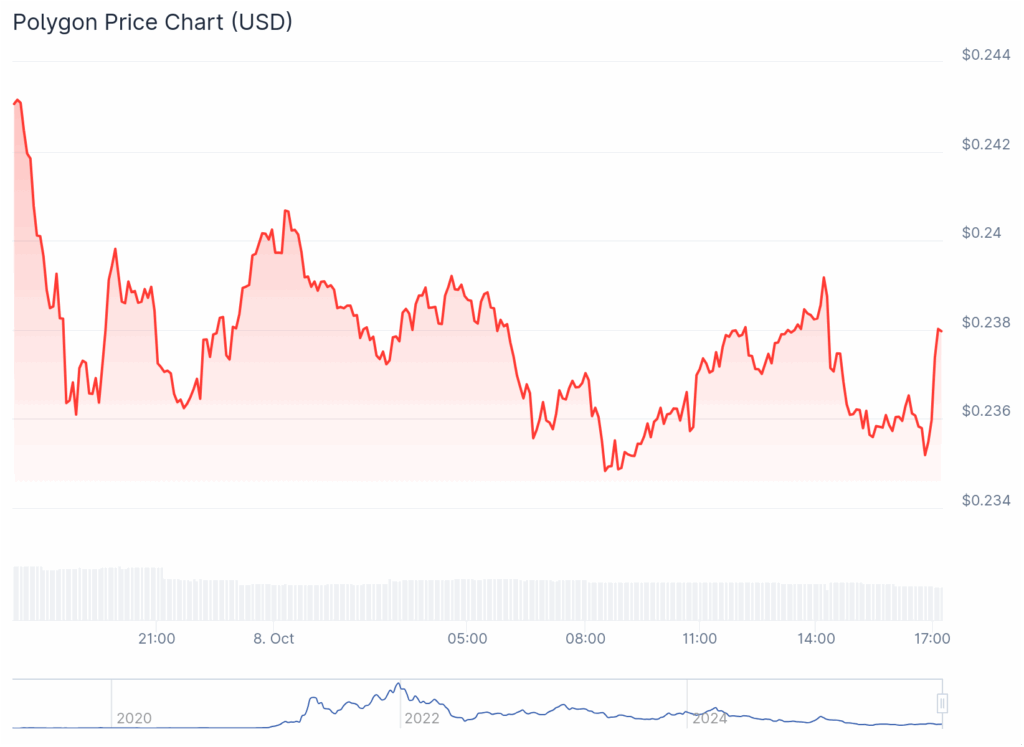
The mild uptick suggests a restrained market response to the Rio upgrade, as traders wait to gauge the network’s performance under the new framework. MATIC has remained lower over the past month, reflecting broader weakness across Ethereum-linked scaling networks despite higher on-chain activity.