Pearl
Pearl Bitcoin
 NEAR Protocol
 Starknet
 Solana
 Quant
Quant Ondo
Ondo
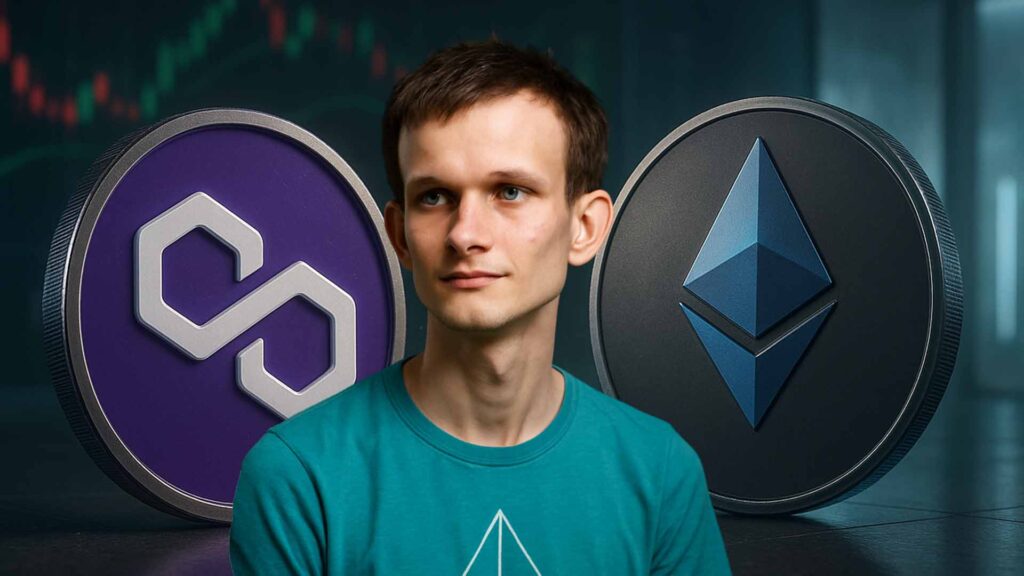
Polygon founder Sandeep Nailwal has raised serious concerns about Ethereum’s internal culture and leadership.
His comments on X drew wide attention from the crypto community and led Ethereum co-founder Vitalik Buterin to respond publicly with praise and clarification.
Polygon Founder’s Concern About Ethereum’s Culture
Polygon’s Sandeep Nailwal has expressed worry about how Ethereum is being managed and how its community treats projects built around it.
In a lengthy post on X, he stated that he has begun to question his loyalty to Ethereum after years of support.
Nailwal explained that Polygon has always stayed close to Ethereum in both vision and technology, but has not received the support he expected from the Ethereum Foundation or its community.
He said that instead of recognition, Polygon often faces criticism for not being considered a “true” layer-2 network.
Nailwal believes that this attitude affects how the project is seen in the market.
Nailwal also mentioned that if Polygon were seen as a layer-1 chain, its value could be several times higher.
He pointed out that other layer-1 projects with smaller ecosystems often enjoy higher market valuations.
Nailwal said the Ethereum community has become divided and that many developers who have made major contributions now feel left out.
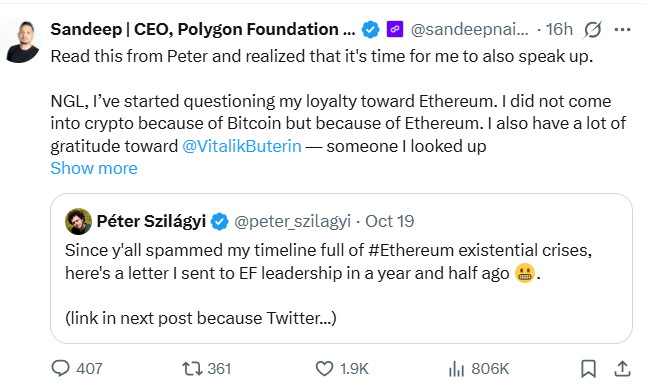
His comments followed those of Péter Szilágyi, a former lead developer at the Ethereum Foundation, who shared his own concerns about the disproportionate influence a few individuals seem to have over Ethereum’s direction.
Szilágyi stated that a small group of insiders and venture capitalists often influences decisions within the foundation.
Nailwal’s post has added to the growing debate over how Ethereum is run.
He made it clear that he still believes in Ethereum’s mission but feels the culture needs to change to be more open and fair to contributors outside the core group.
Vitalik Buterin’s Response to the Debate
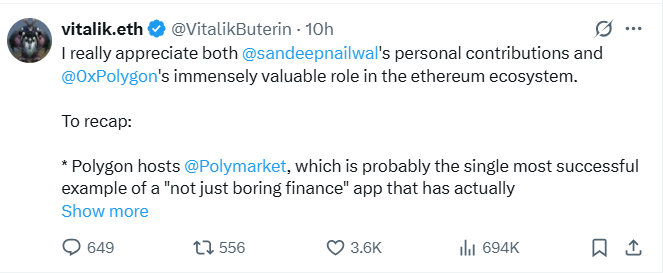
Vitalik Buterin responded to the discussion by showing support for Nailwal and Polygon.
He wrote that Polygon has played a crucial role in Ethereum’s growth, particularly by providing the scalability necessary for numerous applications.
He mentioned that projects built on Polygon, such as Polymarket, have demonstrated how Ethereum-based technology can be utilized for more than just financial tools.
Buterin also recognized Polygon’s early work on zero-knowledge technology, which helps improve transaction speed and security.
Notably, he stated that Polygon made significant contributions by supporting research and development when the technology was still in its infancy.
He suggested that Polygon could soon utilize new zero-knowledge systems to enhance security on its main chain. Buterin also spoke about Nailwal’s charitable work.
In addition, he noted that Nailwal’s leadership in health-related donations and projects has significantly contributed to research and public health efforts in India and beyond.
Mixed Reactions From the Crypto Community
The exchange between Nailwal and Buterin drew strong reactions across the crypto community.
Some agreed with Nailwal’s view that Ethereum’s leadership has become too centralized and that community decisions favor certain projects.
Others said open disagreement is normal in a large and complex network like Ethereum.
Developers and investors expressed mixed opinions. Some supported Nailwal’s call for change, while others defended Ethereum’s structure, saying it still allows anyone to contribute.
Andre Cronje from Sonic Labs also shared that communication with the Ethereum Foundation has become difficult, which many saw as further evidence of internal problems.
The discussion has sparked a broader conversation about how large blockchain projects should be managed as they expand.
It has also been shown that even long-time supporters, like Nailwal, are questioning their role within the ecosystem.
While there is no sign that Polygon will separate from Ethereum, Nailwal’s post suggests a desire for more independence and recognition.
Buterin’s calm reply has helped ease tension, but the debate continues among developers and investors about how Ethereum can remain open and fair as it expands.