
 IGNITION
 streamoors
 Injective
 NEAR Protocol
 Pearl
Pearl LayerZero
 Quantus

According to recent XRP news, Canary Capital has filed Form 8-A with the U.S. Securities and Exchange Commission (SEC). This marks the last step before its XRP ETF can be listed on the Nasdaq.
The filing, made on November 10, 2025, clears the way for trading to start as soon as November 13 once the exchange confirms approval.
Canary Moves Closer to Launching XRP ETF
It is worth noting that Canary Capital is one step away from bringing its XRP ETF to market.
The company has submitted Form 8-A to the U.S. SEC, a key requirement before listing on an exchange.
As reported by Crypto in America Journalist, Eleanor Terrett, the filing registers the ETF under Section 12(b) of the Securities Exchange Act of 1934.
The document lists “Canary XRP ETF” as the name of the trust and identifies the Nasdaq Stock Market LLC as the exchange where it will be traded.
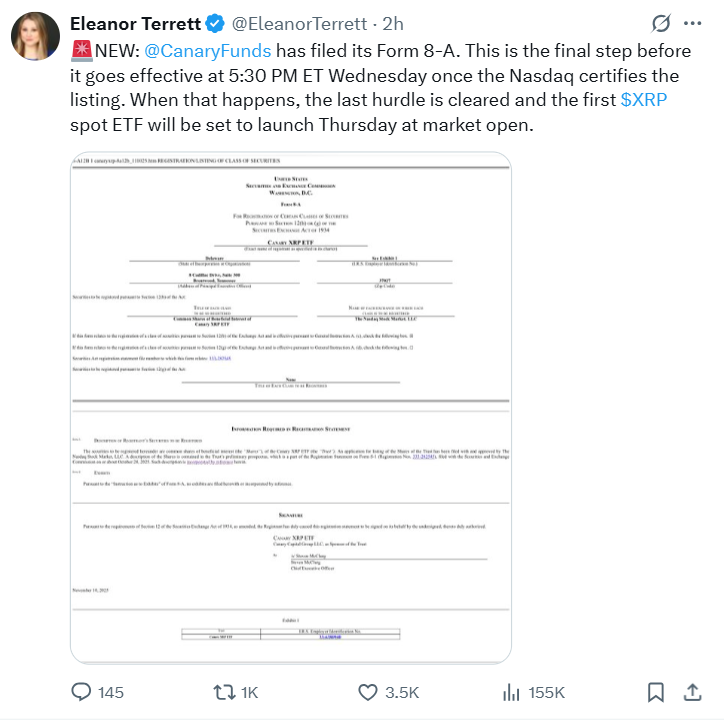
As detailed, the filing was signed by Steven McClurg, the Chief Executive Officer of Canary Capital Group LLC, on November 10.
This move signals that all regulatory conditions for listing have been met. Industry watchers say the process now depends on Nasdaq’s certification, expected by 5:30 p.m.
Once the exchange gives final approval, the ETF could start trading at the next market open.
Based on past patterns, such as the launch of the HBAR ETF, trading could begin on Thursday, November 13.
The new ETF aims to provide investors with access to XRP in a regulated and familiar format.
It allows investors to hold shares tied to the value of XRP without needing to manage the digital asset directly.
XRP’s Use Case Draws Industry Attention
It is worth noting that several industry figures have commented on XRP’s practical use in the financial system.
Sal Gilbertie, CEO of Teucrium, said XRP has a “real and solid use case” and praised Ripple, the company associated with the coin, for operating like a professional financial institution.
Gilbertie added that his firm chose to support XRP because of its existing adoption in payment systems rather than speculation.
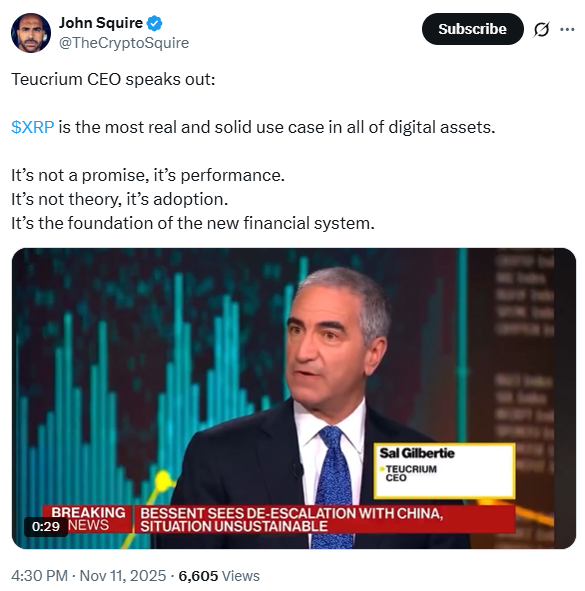
He said Ripple’s team is structured and focused on real-world utility.
His remarks reflect growing interest from traditional financial firms in digital assets with established use cases.
At the time of writing, the XRP price was trading around $2.43, down 3.44% in the last 24 hours.
Its market capitalization stands at about $146.41 million, and daily trading volume is around $4.89 billion.
Although prices have dipped, traders are watching closely for how the ETF’s launch might affect demand. Some believe an approved ETF could bring new liquidity to the market.
What the ETF Could Mean for Investors
The approval of the XRP ETF could open the door for broader participation in the asset.
It gives both retail and institutional investors a way to invest through regular brokerage accounts instead of using cryptocurrency exchanges.
For many investors, this makes access simpler and reduces concerns about storage and security.
Canary Capital’s decision to move forward reflects a growing shift in how digital assets are treated in mainstream finance.
By following the SEC’s filing process and listing on Nasdaq, the company is positioning XRP within the same framework as other exchange-traded funds.
If Nasdaq finalizes the listing this week, the launch would represent an important milestone for XRP and the broader crypto market.
It would show continued progress in merging digital assets with traditional financial systems.
The coming days will determine when trading begins, but all signs indicate that the XRP ETF will soon transition from planning to reality.