
 Quantus
 Injective
 NEAR Protocol
 Sei
Sei Derive
 Bitcoin
 Zcash
Zcash

The Binance Bitcoin to stablecoin reserve ratio fell to 1.008 this week, marking its lowest level in seven years.
As detailed, the drop took place on the exchange as stablecoin balances increased.
The shift could point to rising buying interest and early signs of a potentially bullish market setup.
Stablecoin Balances Rise as Ratio Falls to Multi-Year Low
It is worth noting that the Binance reserve ratio dropped to 1.008 this week. The figure marks the lowest reading since 2018.
Basically, the ratio compares the amount of stablecoins on the crypto exchange with the amount of Bitcoin held there.
A lower ratio shows that stablecoin holdings now exceed Bitcoin by a wide margin.
The level signals that traders hold large stablecoin balances on the exchange with these balances acting as buying power.
They sit in accounts as funds that can enter the market at any time. This rise gives the market a pool of ready liquidity.
Data from Cryptoquant shows that the ratio has not touched this level for more than six years.
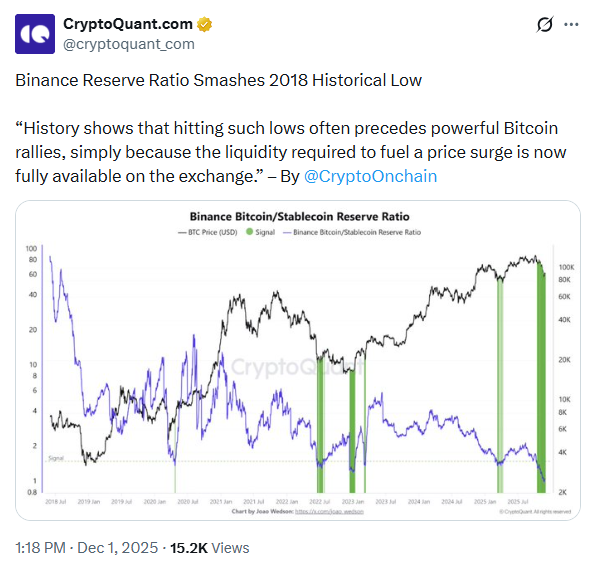
Past cycles show that low ratios typically emerge before strong Bitcoin price rallies. The current move does not confirm any future trend. It only shows that traders have placed funds on the sidelines.
Charts posted with the data highlight the same pattern. The green bars in earlier cycles marked similar setups.
The data suggests that the market now holds enough liquidity to support any future increase in activity if buyers decide to step in.
Market watchers note that this ratio does not act as a direct signal. It only reflects the balance between stablecoins and Bitcoin on Binance.
According to the update, any shift in sentiment would determine how the liquidity moves.
Bitcoin Trades Lower as Market Tests Key Price Levels
Bitcoin traded at $85,636 at the time of reporting, as the price dropped by 6% within one day.
Meanwhile, the hourly chart shows support near $84,754 as most of the daily range had already played out by that point. This left little room for sharp moves over the next session.
Charts on the daily timeframe show a failed move above $93,065. The price turned lower after touching that level.
The market moved back into a declining path as buyers lost strength. The setup now suggests a potential test of the $80,000 zone if pressure persists.
Volume remained low throughout the session, as this metric often signals hesitation on both sides.
It means that neither buyers nor sellers have taken full control. This condition keeps the market in a narrow range until a clear direction forms.
Market watchers warn that it is too early to expect strong moves as the week has only started.
More data would be needed before a long-term view can be formed. Traders continue to watch support and resistance zones for signs of strength.

Market commentary also added views on the broader environment. Ki Young Ju noted that selling Bitcoin below a certain value could pressure the market.
His point centered on market stability and the possible impact on related assets.
Global Market Views Add Context to Bitcoin’s Position
In a discussion on X, some analysts also follow signals from traditional markets.
Tom Lee of Fundstrat gave his view on the S&P 500 as he said he’s expecting a move toward the 7,200 to 7,300 area in December.
He said that central bank actions could help push the market. His comments do not directly connect to Bitcoin.
However, traders often watch global markets because large moves in stocks can shape sentiment across other asset classes. These links remain loose but still offer context.
More importantly, the main signal for the week remains the Binance reserve ratio. The seven-year low shows that stablecoin balances have grown well above Bitcoin levels.
This setup could support future activity, but it does not confirm direction. Traders will watch how fast this liquidity moves and whether it enters the market.