
 Walrus
 Quantus
 Pudgy Penguins
 Bitway
 Quant
Quant Sui
Sui Bitcoin

Vanguard has started allowing clients in the United States to trade Bitcoin, Ethereum, XRP, and Solana ETFs . The change follows a shift in leadership and could influence how millions of long-term investors integrate digital assets into existing accounts.
Vanguard’s New Step Into Crypto and What It Could Mean
Vanguard embracing crypto ETFs marks a clear change in direction for a firm long known for caution with new asset classes.
The update comes as Salim Ramji takes over as chief executive officer. He has experience working on a major Bitcoin ETF at BlackRock and brings experience with large index products. His arrival helped bring this policy shift forward.
The new access covers Bitcoin, Ethereum, XRP, and Solana ETFs offered by several firms. These firms include BlackRock, Fidelity, Grayscale, VanEck, and Bitwise.
Investors can trade these products through the same platform they already use for other ETFs. This applies to both individual accounts and institutional accounts.
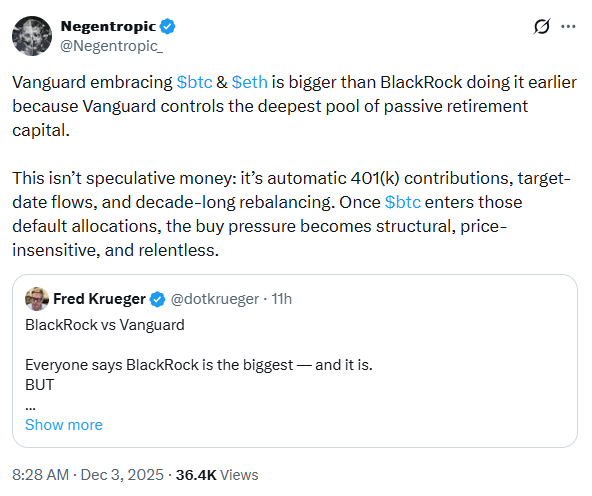
Vanguard manages $11 trillion for its millions of investors. Even a small shift of 0.5% into these ETFs would equal $55 billion. That figure would be larger than the new flows seen in the first year of the 2024 Bitcoin ETF cycle.
This scale is why analysts see the decision as meaningful. The firm’s reach into retirement plans and long-term accounts gives it a level of influence that goes beyond day-to-day trading.
The firm also leads in several key parts of U.S. investing. It is the largest provider of retirement accounts, index mutual funds, and direct-to-consumer investing.
These areas serve millions of people who make steady contributions to IRAs, 401(k)s, and long-term savings plans. When these investors gain access to new products, those products often see steady and durable activity over time.
How $11 Trillion in Assets Creates a Different Kind of Demand
Vanguard’s asset base gives this shift an unusual level of scale. Many of its clients use set schedules for contributions and rebalancing. These automatic flows continue across decades and do not depend on short-term market conditions.
Meanwhile, access to crypto ETFs inside these accounts could create new sources of steady buying. Millions of investors now have the option to buy spot Bitcoin, Ethereum, XRP, and Solana ETFs without leaving the platform they use for other holdings.
This level of convenience could matter in the long run. Institutional accounts that prefer to keep assets under one system also gain a new way to reach these products. The update comes after two active years for crypto ETFs. A major Bitcoin ETF has grown to more than $80 billion.
Ethereum ETFs continue to expand, while XRP and Solana ETFs have recently been launched. Rules are clearer, and large banks have released new structured products tied to Bitcoin.
These steps have made the ETF market more stable and easier to use. With these conditions in place, the change at Vanguard adds another layer of access.
The firm’s longstanding focus on low-cost investing and index products may help bring crypto ETFs into a wider range of portfolios. The impact might build slowly, but steady flows often matter more than rapid bursts of interest.
What the New Access Could Mean for Bitcoin ETFs
Bitcoin ETFs could see a different pattern of activity as this new access shapes sentiment. Eric Balchunas shared that the first trading day after the update showed a rise of about 6% near the U.S. market open.
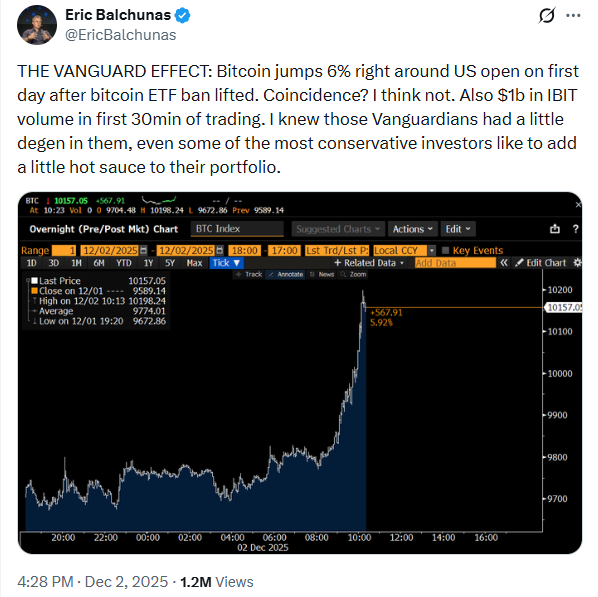
It is worth noting that one of the leading Bitcoin ETFs, IBIT also reached $1 billion in trading volume within the first half hour. These early signs do not confirm long-term trends, but they show that the new access may bring fresh attention and liquidity.
Market observers expect more investors to evaluate how crypto ETFs fit within diversified holdings. Even small allocations across a wide base of investors can lead to meaningful flows.
Notably, as more organizations respond to competitive pressure, the market for these products could continue to develop.