
 Zerebro
 Bitcoin
 Quantus
 Pearl
Pearl Starknet
 ZKsync
 NEAR Protocol

Ethereum news from January 8 highlights that Vitalik Buterin published posts drawing parallels between Ethereum, BitTorrent, and Linux.
The Ethereum co-founder stated one metaphor for Ethereum is BitTorrent and how that peer-to-peer network combines decentralization with mass scale. Ethereum’s goal is to do the same thing but with consensus.
Vitalik Compares Ethereum to BitTorrent and Linux Systems
Ethereum news included Buterin’s comparison of the blockchain to Linux operating systems. He stated Linux is free and open-source software that does not compromise on these principles.
Linux is quietly depended on by billions of people and enterprises worldwide. Governments regularly use Linux systems for critical infrastructure.
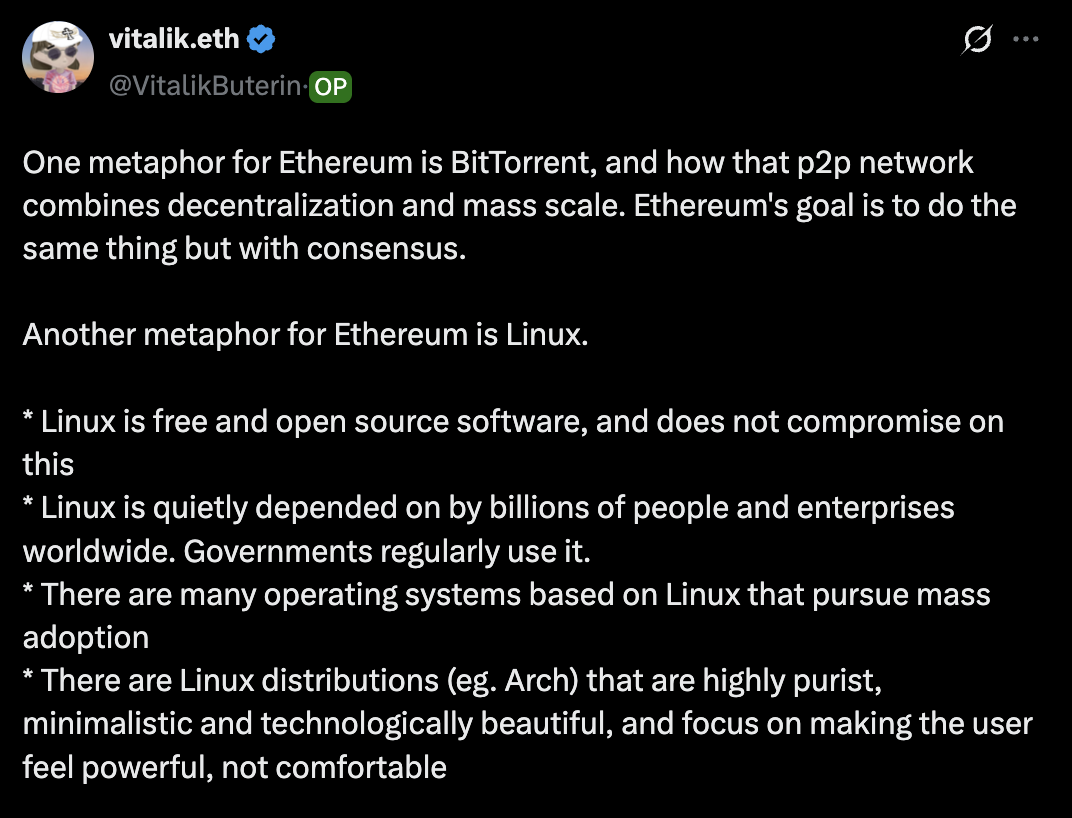
Buterin noted that there are many operating systems based on Linux that aim for mass adoption. Linux distributions like Arch are highly purist, minimalistic and technologically beautiful. These distributions focus on making users feel powerful rather than comfortable.
BitTorrent is also relied upon by enterprises, with many businesses and governments utilizing it to distribute large files to users.
The Ethereum co-founder stated that the network must work as the financial home for individuals and organizations seeking greater autonomy.
The system must provide them with full network access without dependence on intermediaries. What Linux shows is that this approach is compatible with providing value to large numbers of people and being trusted by enterprises worldwide.
The comparison positions Ethereum as an infrastructure that combines ideological purity with practical enterprise adoption, like Linux achieved.
Ethereum News: L1 Must Serve Autonomy-Seeking Users
Ethereum news from Buterin emphasized Layer 1 must serve as the foundation for autonomy.
The network must serve as the financial and, ultimately, the identity, social, and governance hub for those seeking independence. Users need access to full network power without dependence on intermediaries.
The walkaway test applies to Ethereum itself. The blockchain cannot depend on constant social re-juggling to maintain decentralization.
Economics cannot handle the entire load of maintaining decentralization, but must handle most of it. The system must function automatically without constant human intervention.
Buterin stated Ethereum was not created to make finance efficient or apps convenient. The network was created to set people free.
This line from the Trustless Manifesto carries important implications for development priorities. Efficient and convenient imply improving the average case in situations that are already quite good.
Efficiency involves reducing latency from 473 milliseconds to 368 milliseconds or increasing yields from 4.5% to 5.3%.
Convenience means making one click instead of three and reducing signup times from one minute to 20 seconds.
These improvements can be good but Ethereum will never match Silicon Valley corporate players at this game.
Bandwidth Scaling Safer than Latency Reduction Approach
Ethereum news included a technical discussion of scaling approaches. Buterin stated increasing bandwidth is safer than reducing latency.
With PeerDAS and zero-knowledge proofs, developers can scale their systems potentially thousands of times compared to current capacity. The numbers become far more favorable than before with sharding implementation.
The network must support censorship resistance and anonymity for nodes, particularly proposers and attesters.
Running a node in non-concentrated locations must not only be possible but also economically viable. If staking outside New York drops revenues by 10%, more people will stake in New York over time.
Ethereum Serves as World Heartbeat not Game Server
Buterin stated that Ethereum is not the world’s video game server, but the world’s heartbeat. Applications faster than the heartbeat will need offchain components.
This reality explains why Layer 2s will continue to play a role, even in a greatly scaled Ethereum. Other reasons include virtual machine customization and applications that require even greater scalability.
Artificial intelligence will necessitate applications going faster than the heartbeat regardless of infrastructure improvements.
If an AI can think 1,000 times faster than humans, the subjective speed of light becomes only 300 kilometers per second.
The AI can communicate near-instantly within a city but not beyond, requiring city chains that are potentially localized to single buildings as Layer 2s.
Making it viable to run staking nodes on Mars would cost too much. Bitcoin does not strive for this either.
Buterin mentioned that Ethereum belongs to Earth, with Layer 2s serving hyper-localized needs in cities and hyper-scaled needs planet-wide. Users on other worlds will require separate solutions.