
 Dacity Coin
 Zcash
Zcash Celestia
 Bitcoin
 Pearl
Pearl Injective
 Pons
Pons
Crypto news is once again at the center of U.S. financial debates. The Senate Banking Committee has advanced the Bipartisan CLARITY Act, a landmark bill set to reshape digital asset regulation.
Scheduled for markup on Jan. 15, 2026, the legislation promises long‑awaited clarity for an industry long plagued by uncertainty. For years, unclear rules slowed innovation and weakened investor confidence.
The CLARITY Act seeks to change that. By defining boundaries between securities and commodities, it could unlock growth, strengthen oversight, and mark a turning point for U.S. crypto markets.
Crypto News: Bipartisan Support and Legislative Progress
Crypto news circles have focused heavily on the CLARITY Act, a bill that could reshape digital asset regulation. Passed by the House of Representatives in July 2025, it sets clear boundaries for oversight.
The Commodity Futures Trading Commission (CFTC) will regulate spot markets for non‑security digital assets. Also, the Securities and Exchange Commission (SEC) will continue to oversee investment contracts.
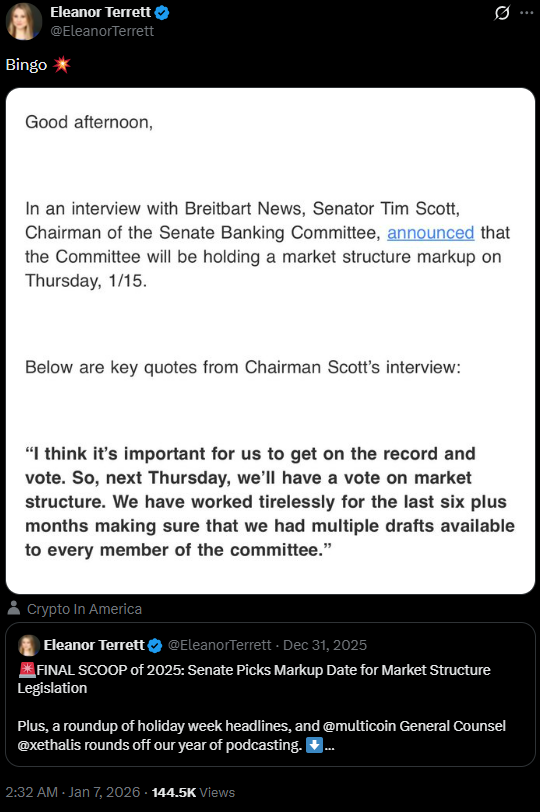
Senator Tim Scott highlighted the urgency of action. “I think it’s important for us to get on the record and vote. So, next Thursday, we’ll have a vote on market structure. We have worked tirelessly for the last six plus months, making sure that we had multiple drafts available to every member of the committee.” His statement reflects months of negotiation and preparation.
The bipartisan nature of the bill is striking. Republicans and Democrats have worked together to address industry concerns. This cooperation highlights the increasing significance of digital assets in the U.S. economy.
Key provisions stand out. Stablecoin issuers may be allowed to offer yields, though banks remain cautious. DeFi protocols must comply with sanctions and anti‑money laundering rules. Most tokens will be classified as commodities, not securities.
Crypto news portrays this framework as a balance between innovation and accountability. It signals a new era of clarity for the industry.
Crypto News: Market Impact and Industry Optimism
Analysts caution that hurdles remain. The bill requires 60 votes in the Senate, and Democratic support is uncertain. With midterm elections looming in November 2026, progress could stall. Reports describe this as a “make-or-break” moment for the industry.
Building on earlier efforts such as FIT21, the CLARITY Act expands regulatory scope to cover stablecoins and DeFi more directly.
Advocates, including David Sacks, serving as “Crypto Czar” under President Trump, have lobbied senators to push the bill forward. If passed, it is expected to be signed into law, signaling strong support from the administration.
Optimism in the market is evident. Online posts hail the markup as a breakthrough. Additionally, analysts predict that clearer oversight will encourage institutional participation in U.S. cryptocurrency markets. Bitcoin has already rallied above $90,000, reflecting investor confidence in reduced regulatory risks.
Debate and Future Outlook
Critics, however, warn of potential overreach. Consumer protection groups argue the framework may prioritize industry interests over safeguards. The Senate Agriculture Committee could play a role in shaping amendments, potentially expanding CFTC powers further.
As Jan. 15 approaches, all eyes are on Capitol Hill. The CLARITY Act could redefine the crypto landscape. It could unlock trillions in institutional capital and position the U.S. as a global leader in blockchain innovation.
Yet political pressures remain. Failure to pass swiftly could delay progress until 2027, leaving the industry in continued uncertainty.
The upcoming markup will determine whether the U.S. enters a new era of digital asset regulation or remains mired in ambiguity.