
 Pearl
Pearl Starknet
 Quantus
 Sui
Sui NEAR Protocol
 Pudgy Penguins
 Lighter

Gold price traded back near record territory into late December after an October pullback. Analysts showed the price holding a rising channel around the $4,460 area. Short-term action also shows a breakout from a two-week triangle near $4,500.
More so, major banks have linked 2026 upside risks to falling real rates and steady demand. With those drivers in view, traders are watching whether $5,000 becomes a reachable target in 2026.
Gold Price Breakout Keeps the Rising Channel Intact
According to recent analysis, the price of Gold broke above a two-week triangle. With this, the breakout line passed through the middle of $4,400. After several swings inside narrowing trendlines, the price is marked at about $4,505 on the breakout.
Retests and follow-through would receive more attention if the upper boundary is crossed. Before a more directional shift, the triangle structure frequently serves as a volatility pause.
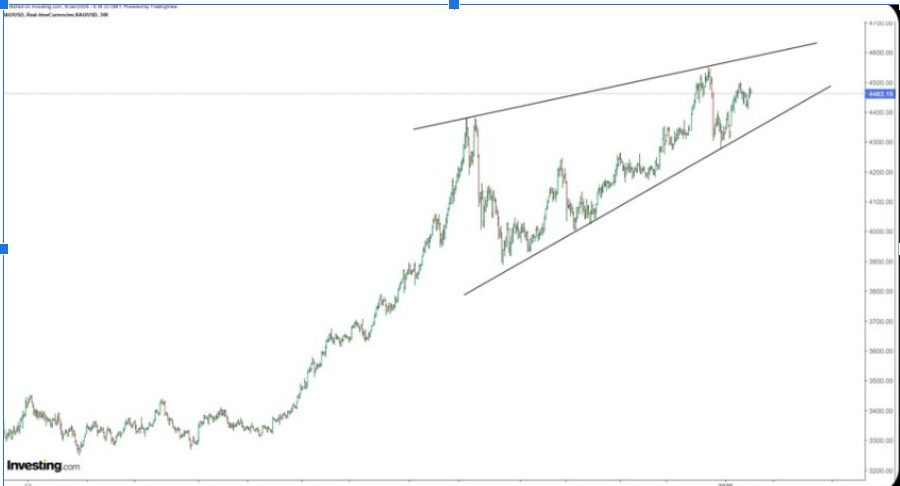
Furthermore, Gold is moving within an upward channel. While the upper boundary slopes toward the $4,700 region, the lower channel line rises from the low $4,300. As long as the gold price remains above the channel base, the trend structure remains valid.
Banks lift 2026 Targets as Real Rates Fall
A recent report said Gold recovered much of the ground lost in a sharp late-October pullback. The metal returned to record territory by the end of December. Also, it set a new all-time high on December 29.
The same report said the metal posted its strongest year since 1979, rising 64% in 2025. It also reported gains of almost 140% since the start of 2023.
UBS strategists noted that strong demand for real assets helped sustain late-December highs. They pointed to a weaker U.S. dollar, geopolitical tensions, and thin seasonal liquidity as key drivers.
They also pointed to a decline in U.S. real interest rates, described as the opportunity cost for holding non-yielding assets.
The bank said real rates fell to their lowest level since mid-2023. Consequently, UBS raised its March 2026 Gold target to $5,000 per ounce.
Additionally, UBS mentioned near-record demand from central banks and investors as a sustaining pillar of support. Concerns about rising government debt across advanced economies also kept Gold in focus as a store of value.
The report referenced International Monetary Fund estimates that advanced-economy debt may reach about 110% of GDP this year. It compared that level with about 75% from two decades ago, with projections rising toward 118% by the end of the decade.
UBS projected central bank Gold purchases at 900 to 950 metric tons in 2025. That was slightly below the prior year’s record. It also forecasts total global Gold demand around 4,850 metric tons.
What’s Next for Gold Price?
Another chart shared by GoldPredictors marked a multi-decade cup-and-handle pattern with a breakout above key resistance. The analysis placed a highlighted level around $5,500 as the next reference point.
While the long-term projection extends far beyond 2026, the chart keeps $5,500 visible as a higher milestone.
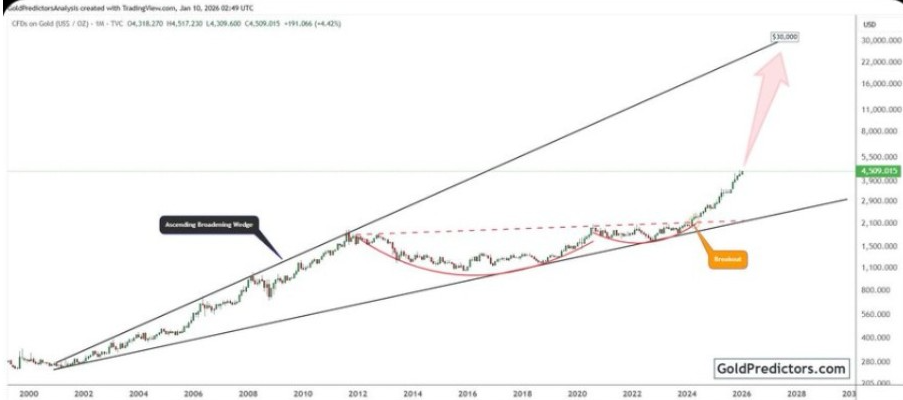
In the near term, the technical map starts with the $4,500 area, which aligns with the triangle breakout line. Holding above that zone would keep the recovery structure intact. If the gold price clears those levels and sustains momentum, $5,500 becomes the next target.