Bitcoin
 Aerodrome Finance
 Zerebro
 Starknet
 Zama
Zama Pearl
Pearl ZKsync

Ethereum price is showing signs of a possible trend reversal after a steep correction. A rare diamond pattern has formed, and there has been a surge in network activity on the Ethereum mainnet above key layer-2s. Analysts are monitoring both the price action and on-chain signals to determine whether the asset is capable of reclaiming higher levels.
Ethereum Price Holds $2,900 as Diamond Pattern Signals Reversal
Ethereum has formed a diamond pattern on the hourly chart, which is often seen as a signal of a price reversal. The pattern has formed near the $2,930 level, which is a critical demand zone considering Ethereum has just fallen from over $3,300.
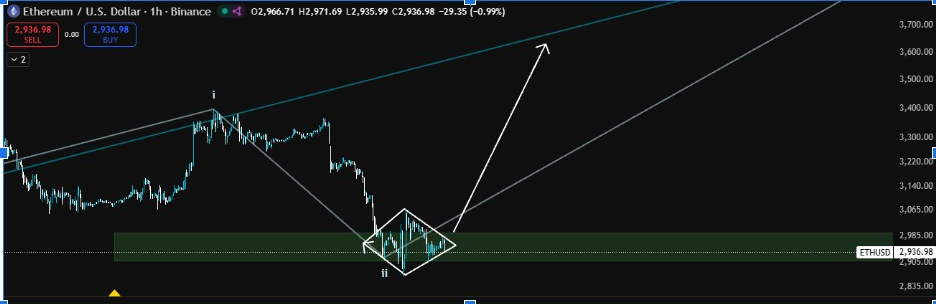
The price is now trading in a tight range with buyers defending support around $2,900. If the pattern works its way back to the upside, projections stretch up to $3,300 and possibly $3,600. That zone is associated with earlier resistance and represents a major technical barrier.
If ETH price breaks lower than the pattern, however, analysts warn of a retest of the $2,800 region. The diamond structure, in conjunction with key horizontal levels, could dictate Ethereum’s price direction in the near term. Traders are watching volume to determine whether a breakout or breakdown in price is more likely.
Ethereum Mainnet Activity Surpasses Layer-2 Networks
Ethereum mainnet has taken the lead over all the major layer-2s in terms of daily active users. Data from Token Terminal reveals that the network reaches 945,000 addresses daily, surpassing Arbitrum, Optimism, and Base.
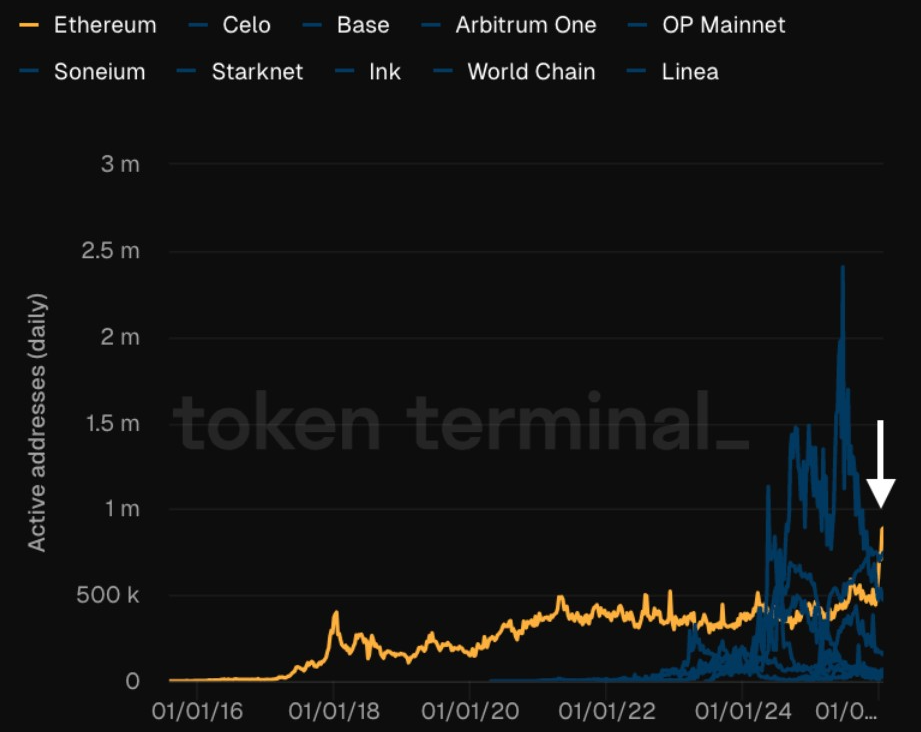
This increase follows the Fusaka upgrade in December, which brought a significant reduction in gas fees. With reduced transaction costs, more users have come back to the Ethereum base layer for on-chain activity. Some observers view this as a positive development, implying greater trust in the network.
However, others say the activity may not be fully organic. The increase in usage coincides with increased dusting and the addressing of poisoning attacks. While these scams are not dangerous in themselves, they can cause users to make mistakes during transactions.
The decline in fees has made such attacks more affordable and frequent. This brings up the need to differentiate between genuine usage and artificially inflated metrics.
Spike in Volume Linked to Scam Tactics
Security researchers have noted a surge of malicious activity on Ethereum. The most notable trend is the case of address poisoning, where scammers spoof wallet addresses to trick users into copying and pasting the wrong address.
With gas fees now lower, it is now very cheap for attackers to send small transactions across the network. This behavior artificially inflates transaction volume and active addresses.
Cyvers, a blockchain security firm, has been analyzing the pattern and has come to believe that there is a strong correlation between address poisoning and the recent surge in network activity. Analysts suggest this tactic is not merely a small contribution to on-chain traffic, but a significant part of it.
Despite these risks, there’s no direct harm unless users mistakenly send funds to fake addresses. Education and wallet warnings still play a major role in avoiding losses from such scams.
Ethereum Leads in Tokenized Asset Market
While there are anomalies in short-term activity metrics, Ethereum remains the dominant token of the tokenized assets space. According to ARK Invest, more than $400 billion in on-chain assets are on the Ethereum network. That includes stablecoins and real-world assets such as tokenized treasuries or commodities.
Ethereum has 56% of the total stablecoin supply across all chains. When factoring in layer-2 networks, Ethereum has 66% of all tokenized real-world assets, according to data from RWA.xyz.
Institutions and developers are still relying on Ethereum for on-chain finance infrastructure. With projections estimating over $11 trillion in tokenized assets by 2030, Ethereum is the most widely adopted blockchain in the sector.
Despite the noise from spam activity, the long-term trajectory is backed by real utility. Ethereum’s role in financial and enterprise applications has stayed safe as short-term patterns and technical setups affect market behavior.