
 Hyperliquid
 Lighter
 Axis Robotics
 Pudgy Penguins
 Bitcoin
 Backpack
 Venice Token


Robinhood stock declined after the company reported a 55% drop in cryptocurrency transaction revenue during the third quarter. HOOD closed at $91.42 on Oct. 28, losing 3.32% despite record overall revenue.
The results highlighted weakening crypto trading activity and rising operating expenses. However, options trading and prediction markets helped offset the cryptocurrency business decline.
Robinhood Stock Falls as Crypto Revenue Drops 55%
HOOD stock dropped sharply after the company reported third-quarter revenue, which showed its business continued to grow. Total revenue jumped 12% to $1.42 billion, driven by higher transaction volume.
The transaction revenue was largely offset by a $120 million drop in crypto revenue, down 55% YoY. Its crypto revenue dropped even after Bitcoin and most altcoins recorded a strong rebound during the quarter. After falling to $57,300 in July, Bitcoin rallied to $87,300 during the quarter. Indeed, Galaxy Digital recorded a strong recovery during the quarter.
Robinhood’s net interest revenue fell by 9% during the quarter to $415 million, while Trump Accounts drove its Other revenue by 61% to $142 million.
The results also showed that its profits plunged during the quarter. Its net income dived by 14% to $476 million. This retreat was driven by the performance of Robinhood Ventures Fund 1, whose stock has fallen by over 67% from its all-time high.
HOOD stock also dropped after the company said that its costs jumped during the quarter. Its operating expenses jumped by 16% to $739 million as the company took higher provisions because of the Trump Accounts and Rothera, its joint venture with Susquehanna.
On the positive side, the company expects the costs to fall over time. It expects to spend between $2.675 billion and $2.775 billion, down by $50 million from the previous guidance.
Robinhood Plots 24/7 Equities Trading
Robinhood has continued innovating, a move that it aims to drive revenue and profitability growth over time. The most notable one is the upcoming launch of 24/7 stock trading on its platform. It will leverage the concept of tokenization, which the Securities and Exchange Commission (SEC) gave a five-year innovation exemption a while ago.
The company also plans to leverage the growing concept of AI agents on its platform. Customers are now able to program their AI agents, which open and close trades on their behalf. If this technology catches up, it can help to drive its transaction revenue. Its agentic trading volume has jumped to over $1.6 billion.
Rothera, its prediction platform has already reached $100 million in annualized revenue as the number of contracts jumped to 6.4 billion. The company is also serving nearly 70 million children through its Trump Accounts solution.
These products make it one of the most innovative companies in the financial services industry, which will help to justify its valuation.
HOOD Stock Price Technical Analysis
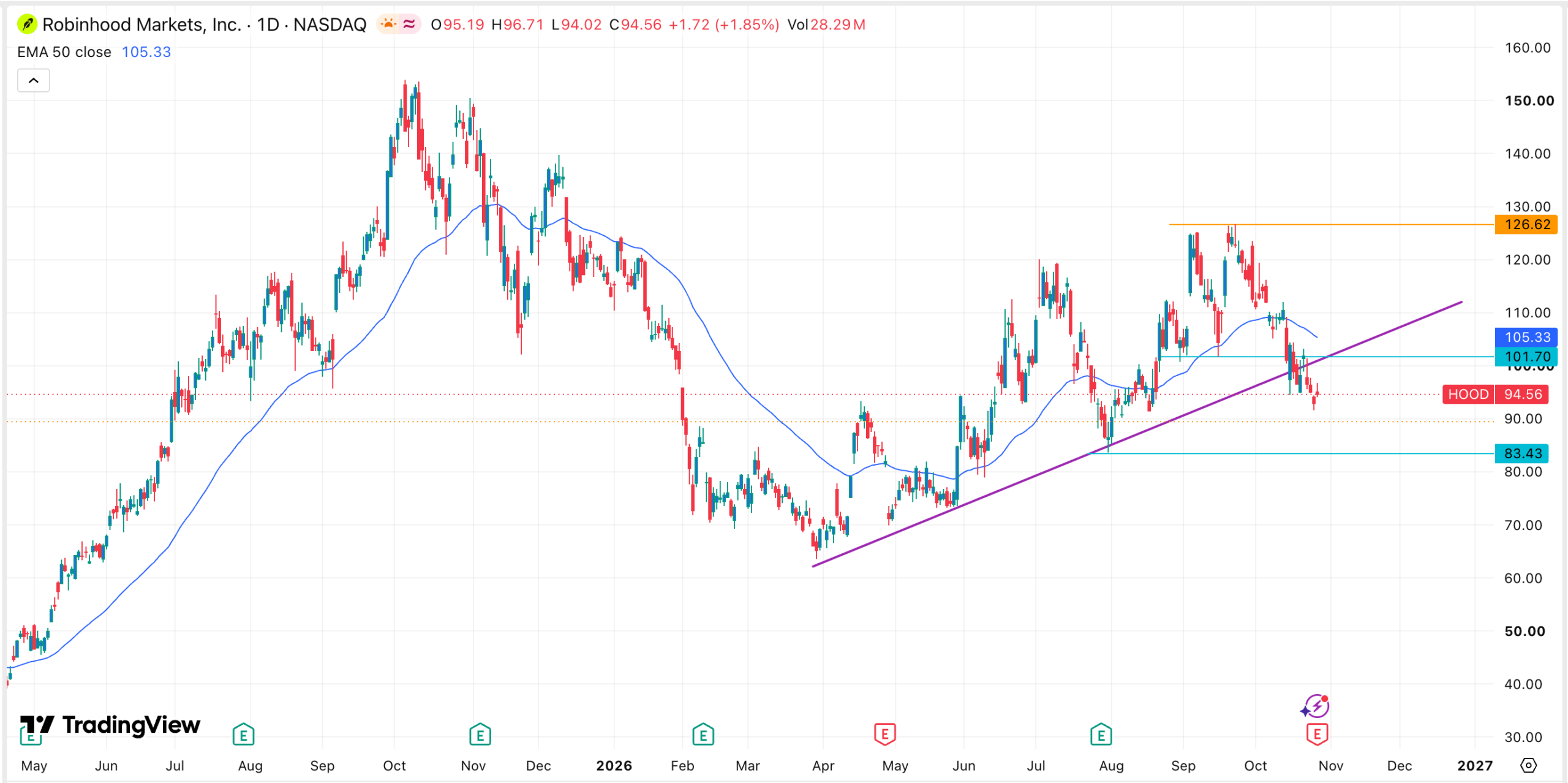
The daily chart shows that HOOD stock has slumped in the past few weeks, moving from a high of $126.62. This retreat occurred after it formed a double-top pattern with a neckline at $101.70, its lowest level on September 16. A double-top is one of the most bearish patterns in technical analysis.
It has now slumped below the ascending trendline that links the lowest swings since March this year. It has also moved below the 50-day moving average. Therefore, the stock will likely continue falling, potentially to the key support level of $83.43, its lowest level on July 31st. In the long term, however, the stock will likely bounce back, potentially to $100.
This article is for informational purposes only and does not constitute financial advice. Stock investments involve market volatility and potential losses. Readers should conduct independent research before making investment decisions.