Altai the Tiger
 IGNITION
 streamoors
 NEAR Protocol
 Sui
Sui Ethereum
 Pudgy Penguins

Key Insights:
- ETH rallied 13.5% in two days, nearing the $3,000 mark.
- Futures premium at 5%, showing lukewarm bullish conviction.
- Ethereum fees dropped 22%, cutting ETH burn rate.
Ethereum surged to $2,985 after ETF inflows, but weak demand and bearish derivatives signal doubt. Traders remain cautious as futures and options data reveal low conviction despite recent momentum.
ETH hits $2,985, but confidence remains weak
Ethereum (ETH) rallied 13.5% over two days, reaching a high of $2,985 on Thursday. The breakout followed net inflows into spot ETFs and technical signals pointing to upward momentum.
Yet despite the price surge, traders appear hesitant to call for a sustained breakout above the $3,000 mark. On-chain data and derivatives markets indicate weak confidence, suggesting caution could limit upside potential.
Derivatives market data reflects fading bullish conviction
According to Laevitas, ETH’s monthly futures premium sits at 5% a level considered borderline neutral. That marks an increase from last week’s 3.5%, but still falls short of confirming strong market confidence.
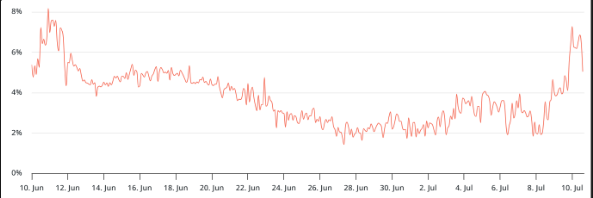
The last time the premium showed notable bullishness was Jan. 23, when ETH traded above $3,300. Since then, professional traders have reduced short exposure, but current levels show only mild optimism.
Options markets present a similar picture. ETH’s 30-day delta skew stands at -3%, indicating balanced demand for calls and puts. This skew has hovered in neutral territory for four weeks, implying a market lacking directional conviction.
ETF flows and Golden Cross ignite short-term optimism
Despite the cautious positioning, Ethereum has received support from institutional flows. Data shows $468 million in net inflows into U.S.-listed ETH ETFs over the past four days.
The move coincides with purchases by companies like ShapLink Gaming (SBET) and Bit Digital (BTBT), both adding ETH to their corporate treasuries. These events likely contributed to ETH’s recent short-term strength.
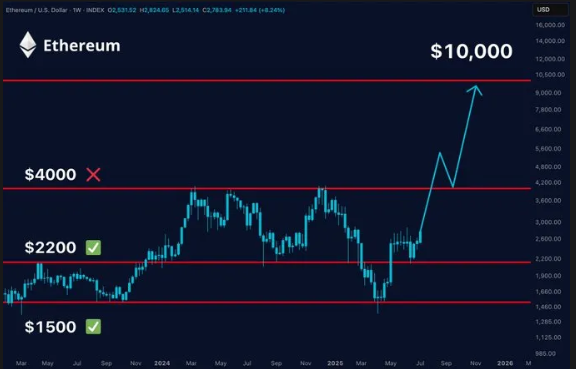
Technical analyst @MerlijnTrader noted on X that ETH just triggered a Golden Cross on the weekly chart. “The average move after this signal? +84%,” the post read, adding that $4,000 is “in sight.”
A previous tweet by the same analyst added: “$ETH is on a mission. Every resistance is turning into rocket fuel… Next stop: $10,000.”
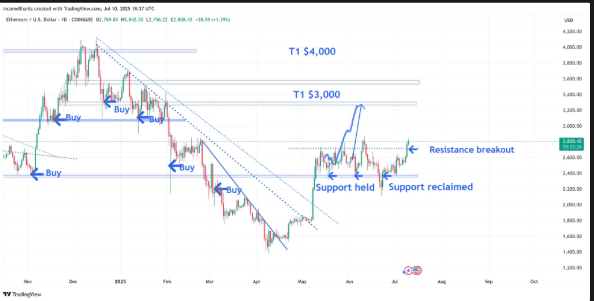
Other traders remained cautiously bullish. @IncomeSharks said ETH was confirming a breakout, adding that “last time news badgered it back down, this time it’s built a stronger base.”
Fees decline, dragging on ETH’s supply-side dynamics
Ethereum’s fee revenue continues to weaken, impacting ETH’s deflationary mechanics. Over the past 30 days, Ethereum network fees dropped 22% to $34.8 million, according to Nansen.
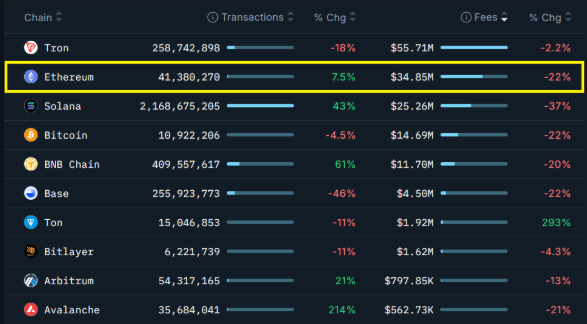
Unlike earlier cycles, this drop in usage directly affects ETH’s burn rate. Because the burn mechanism introduced by EIP-1559 depends on gas fees, lower network activity results in reduced token destruction.
This shift has led to more ETH staying in circulation, a factor that could limit upside pressure on price even as demand from layer-2s increases.
Layer-2s thrive, but ETH demand stays flat
Ethereum’s layer-2 ecosystem has continued to gain ground. In the past 30 days, decentralized exchanges (DEXs) built on layer-2s handled $58.6 billion in volume.
However, that growth has not translated into higher ETH demand. Decentralized exchange volumes on Ethereum itself have dropped to a nine-month low, according to DefiLlama.
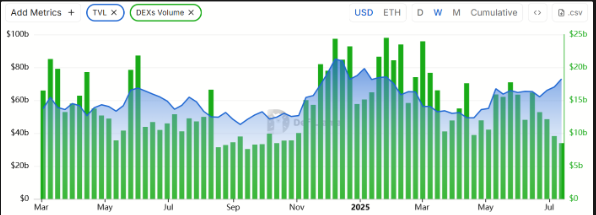
Meanwhile, Ethereum’s total value locked (TVL) increased from $50 billion to $73 billion over three months. But the rise in locked assets has not offset the network’s falling transaction fees.
Solana and Tron now generate more fees than Ethereum. Tron’s 30-day fees are 60% higher, while Solana’s fee revenue reached $25.3 million despite having a TVL 86% lower than Ethereum.
Market needs more than price to stay bullish
ETH remains down 41% from its all-time high in Nov. 2021. While the recent rally and ETF flows hint at returning institutional interest, the broader data points to a cautious market.
With both futures and options metrics leaning neutral, the path to a confirmed breakout remains unclear. Unless demand rises or fees rebound, ETH may struggle to push past the psychological $3,000 barrier with conviction.
Disclaimer
This article is for informational purposes only and provides no financial, investment, or other advice. The author or any people mentioned in this article are not responsible for any financial loss that may occur from investing in or trading. Please do your research before making any financial decisions.