Identity.md 6900
 Bunker Mode
 Crawlerpad
 Claudia
 Quantus
 Starknet
 Bitcoin
The U.S. Securities and Exchange Commission proposed new crypto regulation rules on Aug. 18, targeting token fundraising under federal securities laws. The framework creates two registration exemptions and a conditional safe harbor for certain crypto assets.
The proposal, called Regulation Crypto Assets, follows the SEC’s March interpretation of federal securities laws. Chairman Paul Atkins said the agency wanted clearer fundraising routes while Congress continued work on broader market-structure legislation.
SEC Sets Two Paths for Crypto Token Offerings
The SEC’s proposal creates two exemptions from Securities Act registration requirements for certain crypto investment contracts. The first route allows an issuer to raise up to $5 million during a four-year period. The agency designed that option as a one-time exemption for smaller offerings that meet the proposed conditions.
The second route allows issuers to raise up to $75 million during each 12-month period. Issuers using either exemption must provide investors with narrative disclosures. Those using the larger exemption must also provide financial statements and meet ongoing reporting requirements.
The SEC says the structure aims to give crypto businesses clearer fundraising routes under federal securities laws. The proposal follows the Commission’s March 2026 interpretation on how securities laws apply to some crypto assets. That guidance set the legal context for the new offering rules.
Safe Harbor Could Change Security Status
Regulation Crypto Assets proposes a conditional safe harbor tied to the term “investment contract.” If an issuer satisfies the required conditions, the crypto asset would no longer fall under an investment contract for purposes of the Securities Act of 1933 and the Securities Exchange Act of 1934.
SEC Chairman Paul S. Atkins said the safe harbor would apply after an issuer completes or permanently stops the essential managerial efforts it promised under an investment contract. That approach focuses on the issuer’s role after fundraising.
The proposal addresses state securities rules. It would preempt state registration and qualification requirements for securities that issuers sell under the federal exemptions. The same treatment would also cover some secondary-market transactions linked to those exempt offerings.
SEC Targets Clearer Rules for US Crypto Markets
The SEC says the proposal seeks to reduce barriers for crypto companies that want to raise capital in the United States. It aims to give entrepreneurs defined routes to operate within federal securities law instead of relying on offshore structures or uncertain legal interpretations.
Atkins said the Commission wants to provide clearer paths for crypto entrepreneurs while Congress works on broader legislation. He linked the proposal to the agency’s effort to modernize securities rules for digital assets. The framework would create a regulatory route under current law if the SEC adopts it.
The proposal arrives as lawmakers continue work on crypto market structure legislation. The SEC’s rulemaking process moves on a different track and focuses on securities offerings involving certain crypto investment contracts. The Commission must review public feedback before deciding on a final version.
Meanwhile, the odds of the CLARITY Act passing in 2026 have continued to decline, with Polymarket pricing the probability at 21%.
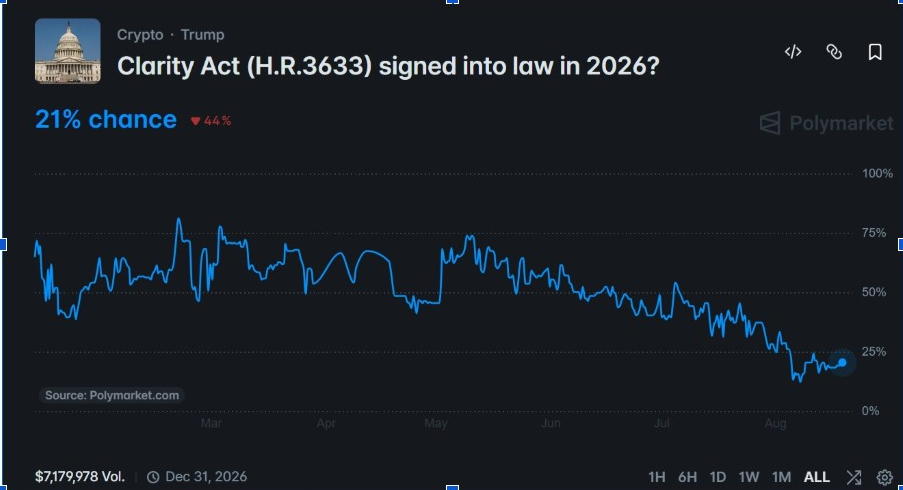
The market’s odds are down 44%, signaling weaker expectations for the bill’s passage this year.
Public Comment Period Opens for 60 Days
The SEC will keep the public comment period open for 60 days after the proposed release appears in the Federal Register. Market participants, legal experts, issuers, investors, and stakeholders can submit feedback on the proposed exemptions, disclosure rules, and safe-harbor conditions.
The Commission may revise the proposal after reviewing those comments. Any final rules would need formal SEC approval before they take effect.
This article is for informational purposes only and does not constitute financial or legal advice. Digital assets can experience sharp price movements.