Pearl
Pearl Walrus
 Bitway
 Bitcoin
 Quantus
 Quant
Quant Pudgy Penguins

Bitcoin price recovered sharply from roughly $63,500 to around $80,000 as spot demand strengthened and derivatives leverage declined.
QCP Capital said the latest rally differs from moves driven primarily by leveraged futures traders. Spot ETF demand increased while Bitcoin-denominated futures open interest fell, suggesting short covering and direct buying played larger roles.
BTC briefly traded above $81,000 before pulling back. The next major test sits around the $81,000–$86,000 region, where onchain supply and technical resistance could slow another breakout attempt.
Spot ETF Inflows Support Bitcoin Price Rally
According to the QCP report, spot demand has played a central role in Bitcoin’s latest recovery. U.S. spot Bitcoin ETFs recorded about $2.8 billion in inflows across eight consecutive sessions.
Those purchases arrived while BTC recovered more than $16,000 from its recent low near $63,500. The flow profile suggests buyers were acquiring Bitcoin directly rather than relying mainly on derivatives.
This distinction matters because spot-driven rallies do not require rising leverage to sustain price gains. They also reduce dependence on aggressive futures positioning during short-term market moves.
Bitcoin’s latest advance has therefore carried stronger underlying spot participation. QCP described that structure as supportive while the price moved toward the $80,000 region.
Futures Leverage Falls While BTC Climbs
The second factor is the drop in Bitcoin-denominated futures open interest. Open interest fell from about 646,000 BTC in mid-August to roughly 588,000 BTC.
At the same time, funding rates remained contained and below levels normally linked with crowded leveraged long positions. BTC still moved sharply higher during that period.
QCP said this combination points toward short covering and spot buying as larger drivers. Fresh leveraged longs have played a smaller role in the rally.
Options positioning has started catching up with the spot move. Call skew has risen, while the put-call ratio remains below one. Implied volatility has also increased ahead of Jackson Hole. However, derivatives positioning has not reached levels associated with an extreme leveraged move.
Treasury Liquidity and Nvidia Add Macro Support
The third factor comes from broader financial conditions. Risk sentiment improved after new Treasury liquidity measures and strong Nvidia earnings. The U.S. Treasury announced plans to expand liquidity-support buybacks across longer-dated securities. Maximum purchases will rise from $2 billion to at least $4 billion.
The change takes effect from September 9 and covers securities in the 10-year to 30-year range. Long-term yields initially moved lower after the announcement. The dollar also weakened, while gold and Bitcoin traded higher. Treasury officials described the program as a market-liquidity measure rather than yield targeting.
Nvidia earnings added another source of support for risk assets. Quarterly revenue reached $96.2 billion, representing annual growth of 106%. Concurrently, the data center revenue climbed to $89 billion, while Nvidia guided toward roughly $108 billion in current-quarter revenue. The results supported technology stocks and broader risk appetite.
Bitcoin Faces $83K Supply as Traders Watch $73,880
Bitcoin price now approaches a large overhead supply area between roughly $81,000 and $86,000. On-chain data places a key concentration between $83,307 and $84,569.
Around 975,000 BTC were previously acquired inside that range, according to URPD data shared by analyst Ali Martinez. That supply could slow the first breakout attempt.
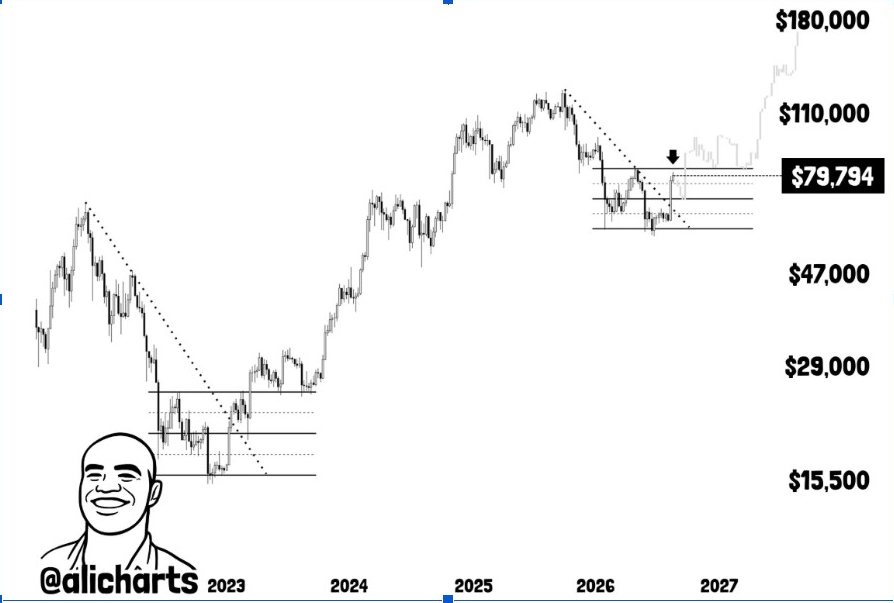
Ted Pillows also identified liquidity between $81,000 and $84,000 on the upside. The lower liquidity cluster sits around $74,000 to $76,000.
Analyst Pillows said Bitcoin must hold $73,880, where the negative 0.5 MVRV Pricing Band currently sits. Holding above that area could keep $100,000 within the model’s next major range.
This article is for informational purposes only and does not constitute financial advice. Cryptocurrency markets can experience sharp price movements.