Dacity Coin
 Injective
 NEAR Protocol
 Quantus
 Bitcoin
 Pearl
Pearl Sui
Sui
Summary
- Onchain Iceberg Orders in DeFi divide large-scale trades into multiple smaller transactions, ensuring trader confidentiality and reducing market disruptions.
- Centralized agents introduce privacy vulnerabilities and the potential for front-running, jeopardizing the secure facilitation of on-chain iceberg orders.
- By harnessing encrypted private mempools, a secure, confidential, and decentralized management of iceberg orders is realized.
- Elektrik incorporates Fairblock’s SDK to sidestep centralized intermediaries in iceberg orders, amalgamating block identifiers with public keys to enhance transactional security.
A New Dawn in Financial Transactions
The evolution of financial markets has led to the emergence of a plethora of order types, from simple limit orders to more complex TWAPs. The blockchain sphere, especially DeFi, has become a new playground for these financial instruments. Yet, adapting these traditional order types to the decentralized world isn’t always straightforward.
Iceberg orders, which allow traders to execute large trades through multiple smaller transactions, are prime examples. Those orders are crucial for high-volume traders, allowing them to display only a fraction of their trade, thereby preventing significant financial downturns. Elektrik, a pioneering DEX, is at the forefront of developing a decentralized mechanism to efficiently handle and execute these iceberg orders.
The Dilemma of On-Chain Iceberg Orders
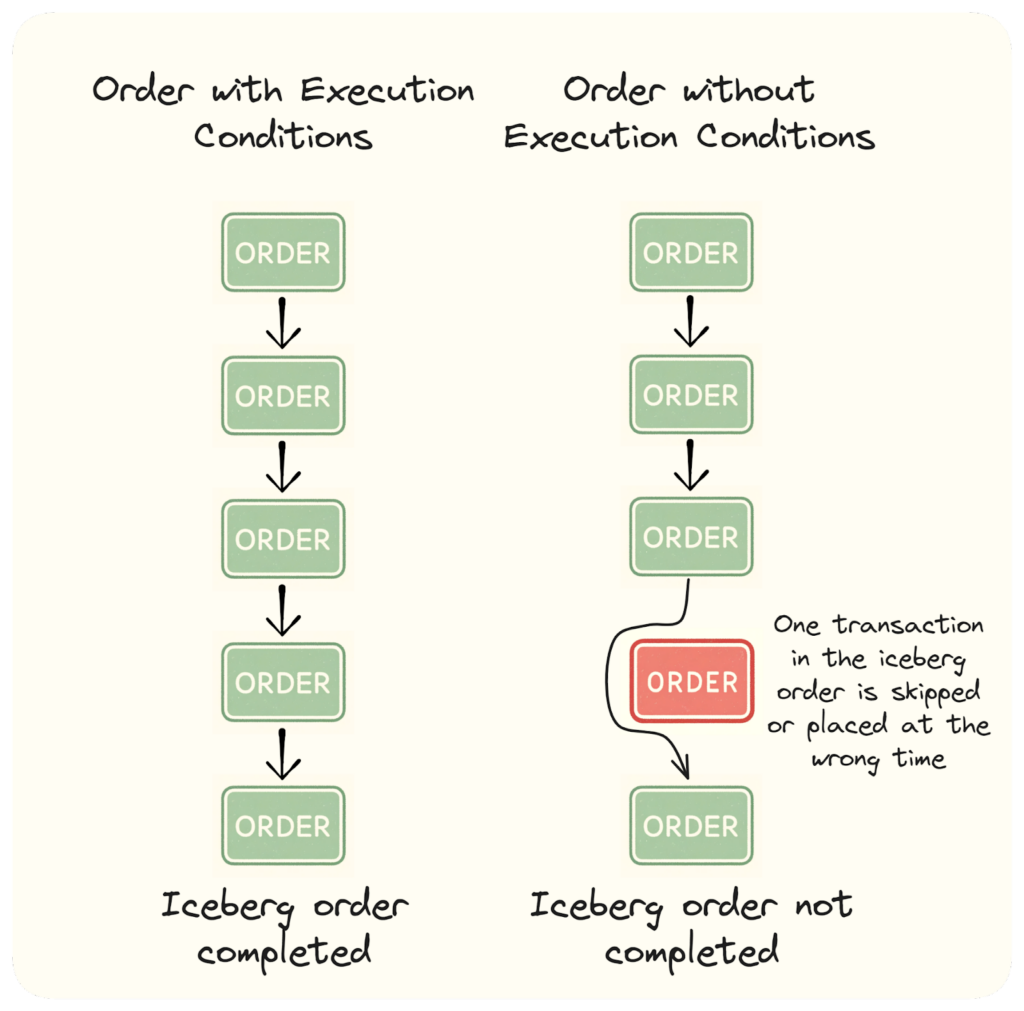
An ‘iceberg order’ is a trading strategy where a sizable transaction is fragmented into multiple smaller limit orders. These orders are typically orchestrated through automated systems, serving to obscure the true scale of significant trades, thereby reducing their influence on the market. The analogy of an iceberg is fitting: just as only a small portion of an iceberg is visible above water, only a fraction of the total order is exposed in the market, with the majority hidden.
What is the reason for this concealment? It’s rooted in market dynamics. Large orders, when openly placed, can significantly alter market perceptions and lead to issues like price slippage. For example, a hefty sell order might inadvertently signal a dwindling confidence in an asset, prompting others to follow suit. Moreover, a big order might not find enough liquidity at a desired price, forcing the trade to settle for the next best rate, resulting in slippage. Fragmenting these orders allows traders to avoid such unintended market repercussions.
Within a blockchain, where orders await execution in a mempool, iceberg orders offer traders an extra layer of protection. By decentralizing the order process and hiding the true transaction size, these strategies deter malicious entities from capitalizing on upcoming large trades. It prevents them from engaging in harmful activities like front-running or sandwich attacks. It ensures traders can make significant trades without inadvertently tipping off potential market manipulators.
The Centralization Hurdle
Currently, on-chain iceberg orders are largely dependent on centralized intermediaries. Whether they’re brokers or centralized exchanges, these entities act as custodians, shaping and directing iceberg orders based on the trader’s preferences. Details such as price impact, total volume, average volume, and limit price are usually handed over to these intermediaries, determining the path and execution of the iceberg order.
Yet, this centralized approach comes with its set of challenges, primarily trust. Handing over crucial order information to centralized entities introduces potential risks. For instance, these orders might fall prey to front-running by those managing the exchanges. Given that these intermediaries have advanced knowledge of the order specifics, they could misuse this data, making trades that benefit them before the initial order concludes. Furthermore, this centralized approach contradicts the fundamental principles of decentralization and trustlessness intrinsic to blockchain.
These issues highlight the urgent need to reevaluate the current system. If iceberg orders are about discretion and tactical execution, shouldn’t the platforms supporting them align with these values? As the financial world progresses and decentralized systems become more mainstream, the focus should naturally shift toward solutions that address the flaws of centralized structures.
Exploring Trading Beyond Public Exchanges
Beyond the public exchanges, a significant amount of trading occurs in dark pools and among private investors. These platforms enable large trades to be conducted with reduced risk and minimal market disturbance, mirroring the advantages of iceberg orders. Dark pools, which are private trading platforms or forums, remain off-limits to the average investor. They primarily serve institutional investors looking to trade vast quantities without causing drastic price shifts. In the same vein, private investors, who make up a considerable market segment, often opt for off-exchange trades to lessen market impact. This reliance on alternative trading platforms by traders emphasizes the demand for efficient on-chain strategies like iceberg orders.
Mempools: The Heart of Transaction Processing
In blockchain ecosystems, such as Ethereum, a placed order finds its temporary home in a mempool before it’s executed. Mempools, essentially repositories, ensure that transactions are systematically queued, and ready to be added to the next block by a miner or validator. However, the transparency of conventional mempools can be a double-edged sword, as they are open for all to see.
Then there are private mempools. These are emerging as a potent countermeasure against the vulnerabilities of centralized intermediaries, particularly for iceberg orders. These mempools, as the name suggests, offer a sanctuary where transactions remain shielded until execution, all while upholding the principles of decentralization. The linchpin of their security is cutting-edge cryptographic techniques, ensuring that each transaction remains cloaked until its designated execution time.
Fairblock’s Pioneering Cryptographic Solutions
In its quest to decentralize iceberg orders in DeFi, Elektrik has partnered with Fairblock, a leader in applied cryptography. Fairblock’s infrastructure is anchored in its revolutionary Secret Sharing Scheme (SSS). This entails a group of validators collaboratively generating a distributed public key, ensuring enhanced transactional security.
Furthermore, Fairblock introduces the concept of Identity Based Encryption (IBE). Rather than generating unique public keys for every transaction, IBE employs block numbers as unique transaction identifiers. This approach ensures that each transaction is bound to a specific block, fortifying its cryptographic security. The decryption process is then synchronized with specific block heights, ensuring the privacy of iceberg orders at all times.
A Deep Dive into the Execution Mechanism
Let’s delve into how an iceberg order undergoes processing within Elektrik’s framework:
Initiation: A trader sets the ball rolling by placing an iceberg order on Elektrik.
Segmentation: The primary order is dissected into smaller limit orders. These subdivisions are determined using a randomized distribution to counter potential statistical inference threats. Each smaller order denotes a specific price and a randomized volume, ensuring the cumulative volume matches the original order’s magnitude.
Execution Schedule: Traders choose a timeline for the entire order’s execution. This timeline, when divided by the total number of orders, gives the execution time for each individual limit order.
Block Number Allocation: Using a specific formula, the block number for every limit order is deduced based on its designated execution time. It’s pivotal to note that block numbers can be manually allocated without affecting the overall execution trajectory.
blockNumberi=currentBlock.timestamp +(inumber of seconds to wait n each limit order)block_mining_time(500ms in the case of Lightlink)
Cryptography: Orders undergo encryption using a designated public key and a block number, which acts as a unique identifier for each order.
Mempool Dispatch: Encrypted transactions, tethered to a predetermined future block height, are relayed to the Fairblock mempool.
Final Execution: Upon reaching the designated block height, Fairblock decrypts the transactions specific to that block. These transactions are then relayed to a settlement contract for verification against predefined conditions. Once validated, these transactions are primed for execution, ensuring the iceberg strategy’s integrity is maintained.
In Retrospect
Elektrik’s innovative approach to on-chain iceberg orders signifies the potential of DeFi to rival, and potentially surpass, traditional financial mechanisms. By eliminating centralized intermediaries and bolstering transactional privacy, Elektrik is setting the stage for a more secure and efficient decentralized trading landscape.
Disclaimer: Any information written in this press release or sponsored post does not constitute investment advice. Themarketperiodical.com does not, and will not endorse any information on any company or individual on this page. Readers are encouraged to make their own research and make any actions based on their own findings and not from any content written in this press release or sponsored post. Themarketperiodical.com is and will not be responsible for any damage or loss caused directly or indirectly by the use of any content, product, or service mentioned in this press release or sponsored post.