NEAR Protocol
 Bitcoin
 Aerodrome Finance
 Pearl
Pearl Uniswap
 Quantus
 Pudgy Penguins

The Japan stocks index, the Nikkei, plunged 2.5% today. The stock index posted losses due to surging Japanese government bond (JGB) yields.
The situation has sparked fears of a broader selloff in both the global stock and crypto markets.
The Nikkei Plunge and Bond Yields Spike
Podcast host Mario Nawfal highlighted that the Nikkei fell 2.5% due to rising JGB yields. Essentially, bond yields represent the return investors demand for holding government debt.
Yields and bonds have an inverse relationship. This means that when yields rise, bond prices fall, indicating higher borrowing costs for the government.
Market expectations of tighter monetary policy or economic uncertainty likely drove the yield surge.
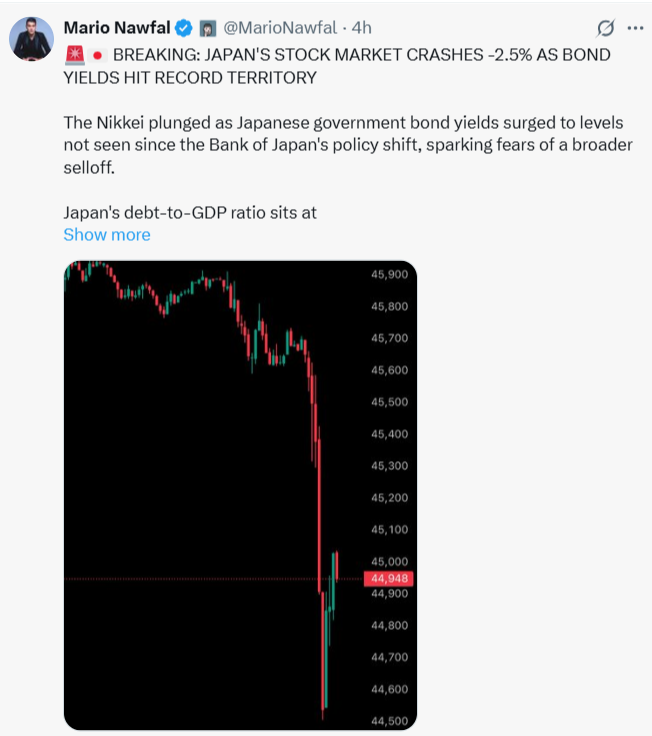
Nawfal emphasized that the Bank of Japan (BOJ) has maintained ultra-loose monetary policies for decades to stimulate the economy. The Central Bank also implemented near-zero interest rates and yield curve control.
According to Nawfal, Japan has a debt-to-GDP ratio of 260%, the highest among developed nations. This implies that Japan’s public debt is 2.6 times its annual economic output.
Rising bond yields increase the cost of servicing this massive debt, putting pressure on government finances and raising fears of fiscal instability.
The rising yields and potential BOJ policy tightening raise concerns about a wider market downturn. Higher yields can reduce corporate profits. It could also make stocks less attractive compared to bonds, prompting investors to sell their equities.
Meanwhile, the Nikkei plunge follows the BOJ’s announcement that it is maintaining current interest rates. While this move is a step toward policy normalization, it dampened investor sentiment.
What Can the U.S Learn from Japan Stocks Crash?
The rising yield serves as a caution for the U.S. stock market, especially as its public debt has surpassed $37 trillion.
A rising bond yield in the U.S., similar to Japan, could lead to market instability or economic strain unless deficit spending is addressed.
Moreover, the U.S. weekly jobless claims also dropped sharply, raising concerns among bond traders. They are worried about a potentially overheating labor market.
The U.S. stock market is enjoying optimism from the recent Fed rate cuts. During its September 2025 FOMC meeting, the U.S. Federal Reserve announced a 0.25% interest rate cut for the first time this year.
Following the rate cut announcement, the S&P 500, Nasdaq, and Dow Jones all hit all-time highs.
The Stoxx 600 and FTSE 100 also experienced a rebound, while the U.S. small-cap index jumped 2.5%.
Implication for the Crypto Market
The surge in Japanese government bond yields and the U.S. growing debt have implications for the crypto market.
Investors may shift from cryptocurrencies as yields rise to safer fixed-income assets that offer higher returns.
Higher yield also slows economic growth and reduces investors’ interest in cryptocurrencies like Bitcoin (BTC).
However, in the long term, if U.S. debt concerns and inflation persist, Bitcoin could benefit as a hedge against fiat currency debasement.
Bitcoin and top market altcoins are facing short-term bearish pressure from rising yields and liquidity shocks.
At press time, the value of BTC has decreased by 0.65% over the previous day to $116,570. The price decline is quite shocking as many market participants anticipated the leading coin to sustain its bullish momentum following a Fed rate cut.
In a similar move, Ethereum (ETH), the top market altcoin, experienced a 1.6% decline in its value to $4,525.
Other altcoins such as XRP, Solana (SOL), and Binance Coin (BNB), also experienced declining prices. These digital assets decreased by 2.9%, 1.6%, and 0.6% within the past 24 hours.