
 Sword Inu
 streamoors
 Altai the Tiger
 no crying in the casino
 IGNITION
 Pudgy Penguins
 Quantus

Chainalysis has predicted that the US government could turn to asset seizures for its strategic Bitcoin reserves. The blockchain analytics firm shared this prediction in a recent report analyzing illicit crypto on-chain balances.
The report highlights a substantial volume of illicit cryptocurrency associated with illegal activity on public blockchains. This creates a significant risk for potential exploitation. This is because law enforcement could target and seize these assets for crypto reserves.
$75 Billion in Illicit Crypto On-chain and Mostly in Bitcoin
The report claimed that a total of $75 Billion is available onchain with ties to illegal entities. Of these funds, around $15 Billion is held by the entities themselves. On the other hand, more than $60 Billion is in downstream wallets.
These downstream wallets are those that have received more than 10% of their total inflows from illicit sources. Darknet market vendors and administrators alone hold more than $40 Billion in cryptocurrency.
Interestingly, most of the nearly $15 Billion held directly by illicit entities is stolen funds. Bitcoin accounts for the majority of the funds due to its sizable rise in value.
Despite that, the amount of BTC held by those entities has been falling since 2020. By comparison, Ether and Stablecoin have been increasing.
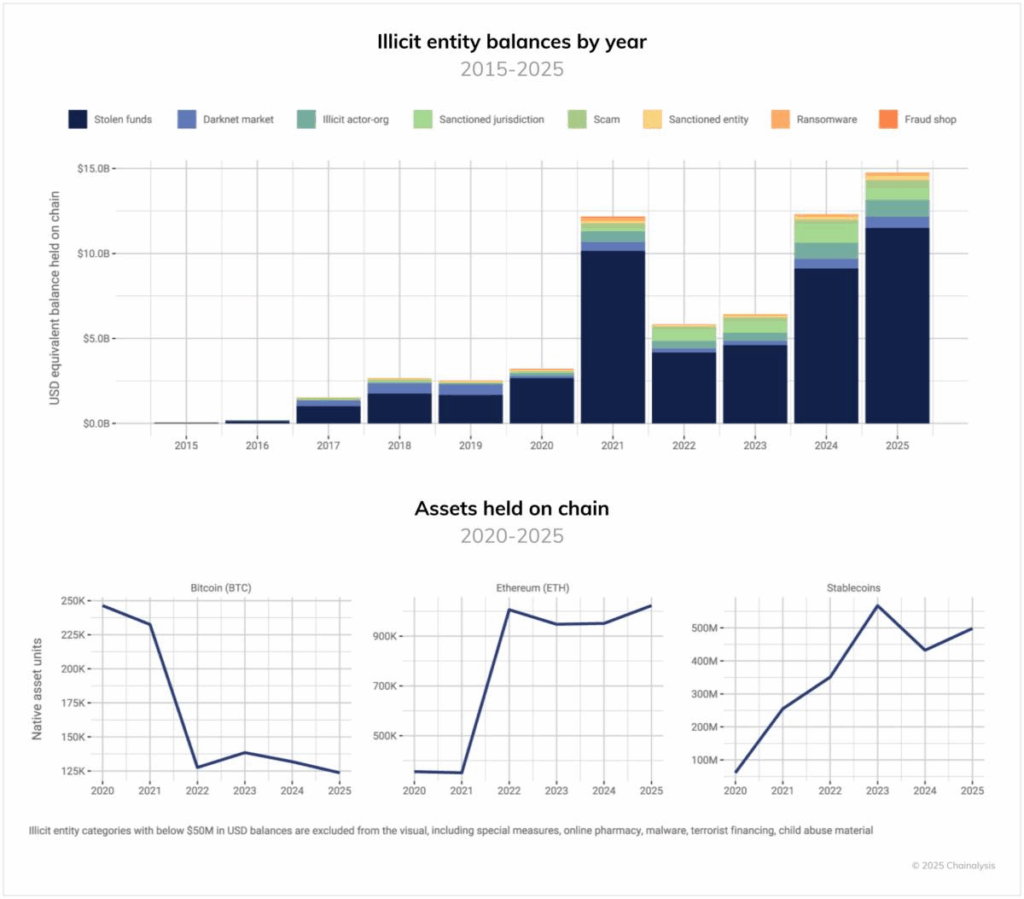
However, it is the downstream shadow economy that is holding most of the value in illicit activity. Chainalysis noted darknet markets alone control $46.2 Billion onchain, while money laundering platforms also have some.
Surprisingly, the report also found that centralized exchanges (CEXs) continue to be a significant means of converting cryptocurrency. It identified almost $7 Billion in flows from illicit sources to CEXs in the first half of 2025.
Still, direct illicit crypto flows to CEXs have declined over time, from around 40% of flows in 2021 to 15% in 2025.
Chainalysis notes that criminals are now leveraging crypto for payments and storing value. This shift is also driven by improved compliance among centralized exchanges (CEXs).
Governments Must Coordinate to Target On-chain Illicit Funds
Meanwhile, Chainalysis believes that the $75 Billion in on-chain illicit crypto is a significant opportunity. The report stated that there is an opportunity for asset recovery.
However, the firm acknowledged that it can prove challenging, particularly as most of these funds cannot be frozen.
It said:
The firm recommended potential solutions, including cross-border law enforcement cooperation and enhanced technical capacity. It added that law enforcement would also require expedited seizure powers.
Seized Illicit Crypto Could End in Digital Assets Reserves
Chainalysis observed that strategic digital asset reserves might motivate law enforcement to target illicit crypto. These reserves could act as a powerful incentive for seizing illegal funds. This aligns with a view that Treasury Secretary Scott Bessent shared in August.
Bessent said on Fox Business at the time that the US government would not buy Bitcoin. Instead, the government would use confiscated assets to increase its crypto holdings.
He said:
A recent post by CleanSpark chairman Matthew Schultz on X also appears to confirm this. Schultz said he had dinner with Bessent, during which they discussed BTC.
During the conversation, they discussed the U.S. government’s crypto holdings. Schultz claimed the U.S. will not sell its roughly $17 billion worth of BTC.
Meanwhile, the UK is reportedly planning to retain most of the 61,000 BTC it seized in 2018. The country has stated it has no intention of creating a Bitcoin reserve. Still, speculation persists that it may secretly hold BTC.