
 Puffer
 ZKsync
 Bitcoin
 NEAR Protocol
 Pearl
Pearl Quantus
 Sui
Sui

Bitcoin wallets holding 100 BTC have increased again, according to new Santiment data shared on X.
Notably, onchain trends show the rise started on November 11 and comes as the market tries to recover after a sharp selloff.
This was driven by futures liquidations and heavy trading in the United States.
Growth in Bitcoin Wallets Holding 100+ BTC Gain Attention
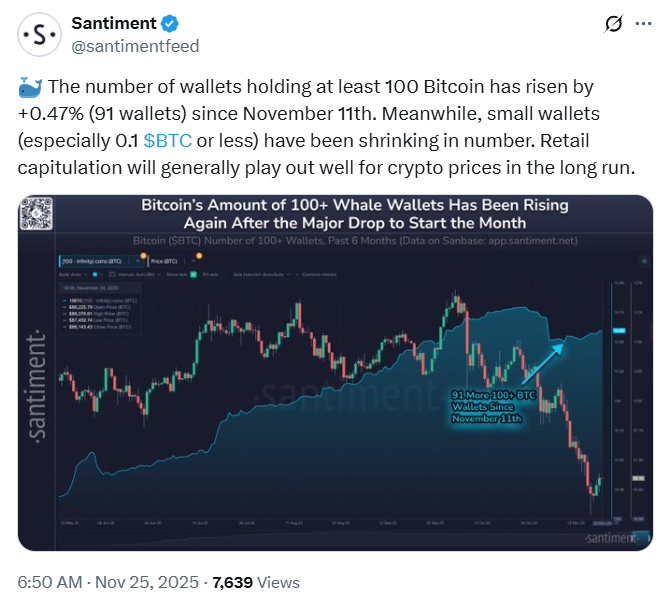
Bitcoin wallet data shared by crypto data analytics platform Santiment shows that the number of wallets holding at least 100 BTC has been on the rise since November 11.
Santiment stated that this group grew by 0.47%, which equals 91 wallets. The increase is being viewed as a sign of renewed accumulation.
Additionally, wallets holding less than 0.1 BTC have been declining in the same period.
Analysts see this as continued weakness among small holders, as retail accounts step back from the market.
Carmelo Alemán noted that the recent trend reflects selling by both retail and larger groups, while some mid-sized holders continue to buy. Alemán is a verified on-chain analyst at CryptoQuant.
The Bitcoin 100+ wallet growth stands out because it comes after a sharp price drop.
Bitcoin fell from $106,000 to $79,500 over 11 days, mainly due to futures pressure. Price has since bounced near $88,000.
Some observers believe the rebound may show the formation of a local bottom. Alemán explained that the recent move higher can be linked to moderate accumulation by mid-tier holders.
These holders include the 10–100 BTC and 100–1,000 BTC groups. He added that this activity may help reduce selling pressure in the near term.
No confirmation of a new trend has been given by analysts. Wallet data will remain important as the market continues to react to shifts in liquidity and sentiment.
Cohort Trends Place Selloff in Clear Context
Meanwhile, recent data from Cryptoquant shows the role of different holder groups in the latest decline.
Alemán explained that wallets holding between 1,000 and 10,000 BTC continued to reduce holdings over the past two months.
He also noted that retail holders reduced their holdings instead of buying during the fall. The combined effect increased the selling side of the market.
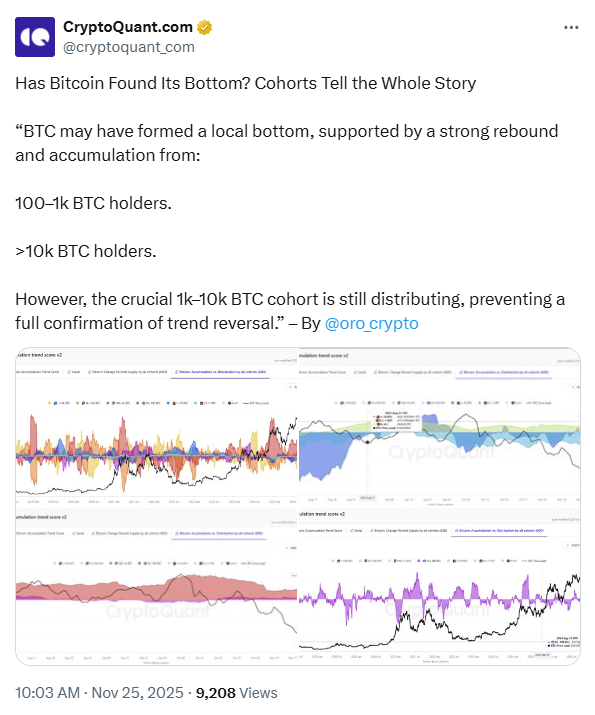
The Bitcoin 100+ wallet increase is seen as a stabilizing factor. However, analysts say the market still depends on the behavior of large holders.
Continued selling by the 1,000–10,000 BTC group would slow any full recovery. In addition, Alemán stated that futures activity triggered the sharpest phase of the decline.
Futures-linked liquidations removed long positions and also forced additional sales in a short period.
The move led to rapid price movement and added to margin-related orders.
Cohort data highlights that the current recovery phase must be supported by continued accumulation.
Wallets holding 100 BTC will serve as a signal for strength or weakness if volatility continues.
Selloff Viewed as Mainly Driven by U.S. Trading Hours
Several market researchers believe the latest decline was driven by U.S. market activity.
Matthew Sigel from VanEck wrote that Bitcoin’s fall to $82,000 happens mostly during U.S. trading hours.
He added that tighter liquidity and wider credit spreads amplified the overall selling.
Concerns over rising AI spending are also affecting market confidence, according to Sigel. Fragile funding conditions during the same period helped drive prices lower.
Anthony Pompliano explained that Bitcoin has experienced declines of 30% or more many times in the past decade.
He said the asset remains volatile, and institutional investors who entered recently have more difficulty with these movements.
Reports indicate Pompliano also noted that end-of-year behavior can drive additional sales, as fund managers reassess exposure.
The next phase depends on accumulation. Wallets holding 100 BTC are expected to remain a key measure of confidence as the market seeks balance after weeks of pressure.