
 Quack AI
 NEAR Protocol
 Zcash
Zcash Celestia
 Pons
Pons Pudgy Penguins
 Bitcoin

There has been a massive amount of chatter surrounding banking giant JPMorgan’s shorting of the MSTR stock. On November 24, the cryptocurrency community engaged in a frenzied trading session, driving the stock price higher by 5% to $180 levels. However, a careful look at the SEC filing shows no evidence of the banking giant shorting Michael Saylor’s Strategy.
JPMorgan Did Not Short MSTR Stock, Per SEC Filing
A widely circulating claim that JPMorgan is shorting MicroStrategy has been debunked following a review of official U.S. Securities and Exchange Commission (SEC) filings. The same rumor also sparked comparisons to the GameStop short squeeze.
However, the latest SEC disclosure shows no reported short position by JPMorgan in MicroStrategy. The bank’s short exposure is literally zero! This contradicts the social media chatter about JPMorgan shorting MSTR, since November 23, which lacked sources or evidence.
The filing does confirm that JPMorgan sold 772,453 shares of MicroStrategy during Q3. Besides, the banking giant also holds put options valued at approximately $117 million. While these positions suggest a more cautious outlook, they do not represent a direct short position.
MicroStrategy’s total short interest currently stands at 9.74% of available float, noted market expert Shanaka Perera. This is far below the levels seen during the GameStop squeeze, which exceeded 140%.
Perera further noted that there’s a shift in the institutional approach for seeking exposure to Bitcoin. Previously, many preferred purchasing MSTR stock as a regulated means of exposure to BTC. As a result, the share price always commanded a premium over the BTC price.
However, the game has flipped with more institutional players now preferring BlackRock Bitcoin ETF (IBIT). Harvard University disclosed a $443 million position in BlackRock’s spot Bitcoin ETF, now its largest portfolio holding. Other institutions, including Abu Dhabi’s sovereign wealth fund and Emory University, reported significant increases in ETF exposure.
Perera noted that Wall Street investors appear to be moving away from Bitcoin exposure via MicroStrategy and toward direct positions in spot Bitcoin ETFs. With MSTR stock now trading at a roughly 12% discount to its underlying Bitcoin holdings, analysts say its previous role as a proxy for institutional Bitcoin access may be diminishing.
Strategy Riding on Tight Rope Raises MSTR Stock Fall Concerns
In another detailed analysis, Perera noted that Strategy’s financial structure is showing increasing strain. The company currently holds approximately $54 million in cash, while its preferred stock obligations require $700 million in dividend payments annually.
With its software division generating negative cash flow, Strategy (MSTR) must raise the full dividend amount each year before allocating capital toward additional Bitcoin purchases.
In the first nine months of 2025, MicroStrategy raised $21.5 billion. However, the filings show that the company used a majority of these funds to service previously issued debt rather than expand its Bitcoin holdings. Perera refers to it as a Ponzi-style financing, where new capital is required to pay interest obligations from earlier raises.
As said, the MSTR stock was previously trading at a premium to the Bitcoin price. When the equity traded at roughly twice its net asset value, issuing new shares increased Bitcoin holdings on a per-share basis, benefiting existing shareholders.
However, the premium has collapsed in recent months. Thus, issuing new equity would dilute the shareholder value. The preferred share structure further complicates the model. MicroStrategy introduced preferred stock at a 9.0% annual dividend rate in July, later increasing it to 10.5% by November in order to attract buyers as share price volatility increased.
If MSTR stock falls below $100, dividend rates may continue climbing, raising funding pressure. This could weaken investor confidence, forcing the company to sell Bitcoins to meet its obligations.
Strategy Introduces New Funding Mix
MicroStrategy has raised a total of $20.8 billion so far in 2025, according to its latest disclosure. The capital was secured through a combination of $11.9 billion in common equity, $6.9 billion in preferred equity, and $2.0 billion in convertible debt.
The filing shows that the capital raise was spread across multiple structured securities. This includes STRF, STRC, STRE, STRK, and STRD products, with individual allocations ranging from hundreds of millions to more than $2 billion.
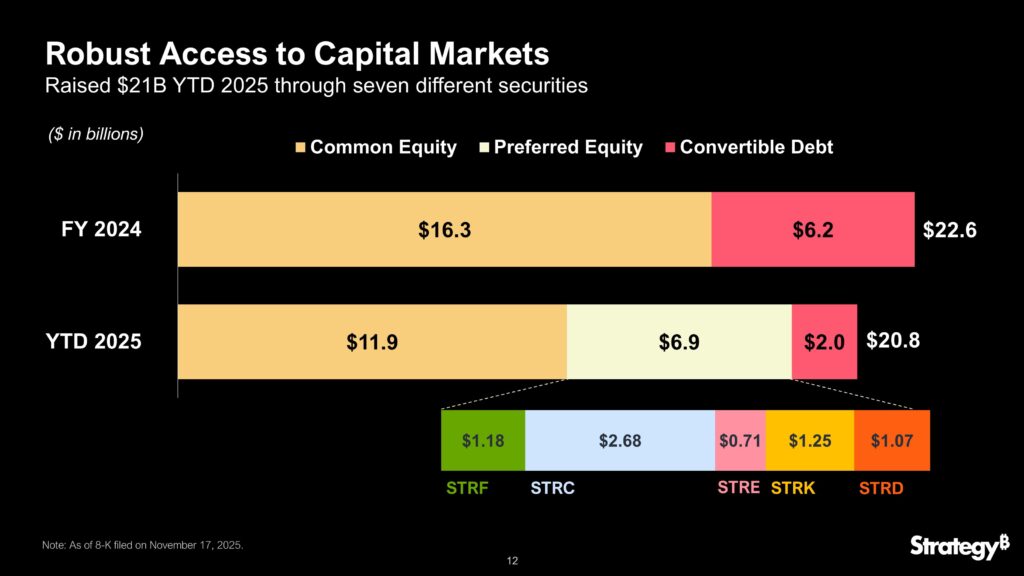
The latest capital raise marks a shift in MicroStrategy’s funding approach compared to fiscal year 2024, when the company secured $22.6 billion. Back then, the primary source of capital was through $16.3 billion in common equity and $6.2 billion in convertible debt.