
 Bitcoin
 Aerodrome Finance
 Zerebro
 Starknet
 Zama
Zama Pearl
Pearl ZKsync

Investors are questioning whether Michael Saylor and Strategy may be forced to sell Bitcoin. The concern comes as the stock faces sharp volatility.
Bitwise Chief Investment Officer Matt Hougan addressed two main concerns. These concerns include potential removal from MSCI indexes and the possibility of forced Bitcoin sales.
The Bitcoin treasury company, formerly known as MicroStrategy, holds approximately $59.3 billion in Bitcoin.
Speculation about forced sales has grown as the stock trades below recent highs. This has prompted analysis from industry experts about the company’s financial position.
MSCI Index Removal Could Trigger $2.8 Billion Strategy Selling
On October 10, MSCI announced it was considering removing digital asset treasury companies like Strategy from its investable indexes. The decision carries weight, with nearly $17 trillion benchmarked against those indexes.
JPMorgan warns index funds could sell up to $2.8B of Strategy stock. This raises pressure on Michael Saylor if the firm is cut from benchmarks.

MSCI views digital asset treasury companies as more like holding companies than operating companies. The index provider excludes holding companies like REITs from its investable indexes.
Michael Saylor rejected that portrayal. He argued that Strategy is a real company with a software business and sophisticated Bitcoin‑focused financial engineering. MSCI will announce its decision on January 15, following discussions with clients.
Hougan estimates a 75% chance that Strategy will be removed from MSCI indexes, given the current sentiment.
The analyst observed that MSCI is leaning toward removal. Digital asset treasury firms remain divisive among institutional investors.
Strategy Stock Price Impact Likely Already Priced In
Bitwise’s CIO argued that MSCI removal would not hurt Strategy stock. $2.8 billion in forced selling sounds big. However, historical index additions and deletions typically show smaller effects than anticipated.
When Strategy was added to the Nasdaq-100 Index in December 2024, funds tracking the index bought $2.1 billion of the stock. The price barely moved during the addition period.
Hougan believes part of Strategy’s decline since October 10 already prices in potential removal. The market has had months to digest the possibility. This further reduces the likelihood of major swings when the official decision is made.
Hougan stated that long-term value for Strategy depends on execution of its Bitcoin strategy, not forced ownership by index funds.
Michael Saylor’s Strategy Faces No Near-Term Debt Pressure
The concern about forced Bitcoin sales stems from a theory that Strategy stock will crater below net asset value, forcing liquidation. Hougan called this argument “flat wrong” after examining the company’s debt structure.
Strategy has two relevant obligations: approximately $800 million per year in interest payments and specific debt instruments that need conversion or rollover as they mature. Neither creates near-term pressure to sell Bitcoin.
The company holds $1.4 billion in cash, enabling it to make dividend payments for a year and a half without drawing on its Bitcoin holdings. The cash buffer removes immediate liquidity concerns.
The first debt instrument doesn’t mature until February 2027. That obligation amounts to roughly $1 billion, a small fraction of the company’s close to $60 billion in Bitcoin holdings.
Michael Saylor Controls 42% of Strategy Voting Power
Hougan mentioned that even if insider pressure to sell Bitcoin surfaced, Michael Saylor’s control structure makes that scenario unlikely. Saylor personally controls 42% of the voting shares, giving him decision-making authority over Strategy’s Bitcoin strategy.
Finding a human being with more conviction on Bitcoin’s long-term value than Michael Saylor would be difficult, Hougan noted. Saylor didn’t sell when Strategy stock traded at a discount in 2022.
Michael Saylor’s voting control ensures he can keep pursuing Bitcoin accumulation. This holds regardless of stock price swings or outside pressure.
Strategy’s Bitcoin Position Shows Substantial Profit
Bitcoin currently trades around $92,000, which sits 27% below its all-time high. Bears point to this drop as evidence of problems with the Strategy model.
The Bitcoin price of $92,000 stands 24% above the average price at which Strategy acquired its holdings. The company’s average acquisition price comes in at $74,436 per Bitcoin. This means the position shows notable unrealized gains.
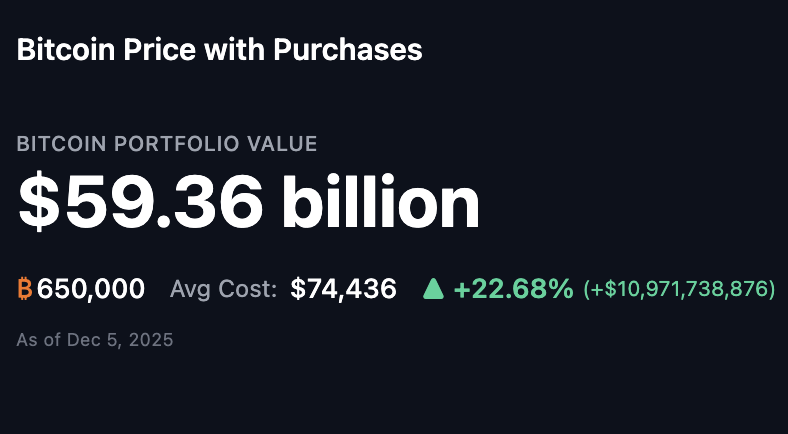
Strategy holds approximately $59.3 billion worth of Bitcoin across roughly 650,000 coins. A forced sale of that size would equal two years of Bitcoin ETF inflows.
Hougan sees no plausible near-term mechanism that would force Strategy to sell Bitcoin. The mix of strong cash reserves, long‑dated debt, and Michael Saylor’s voting control provides stability. Together, they make forced Bitcoin liquidation highly unlikely.